Home > Sports > Traditional Sports in India > Tools for Kite Flying
Tools for Kite Flying
Tools for kite flying include the manifold objects which are attached to this flying aircraft which facilitates its motion against the wind and enables it to soar higher into the sky. Kite flying. After China, India applied the kite flying as the religious ritual.

Share this Article:

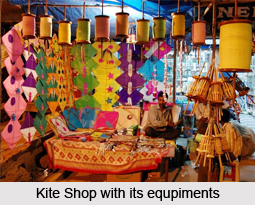
Tools for Kite FlyingTools for kite flying in India involve the various objects with the aide of which kites are flown in the country, and consist of a strong anchor system which is attached to the kites while they are sent flying in the sky.

Line System in Kite Flying in India
A `line` system effectively eases the process of flying kites. Certain single-line kites utilize `tails` which are placed at the end of the kites, to help them glide smoothly through the air, with their noses pointing towards the wind direction.

Use of Spinsocks and Spinners
Spinsocks and spinners are connected to the flying line of kites for enhancing the visual appeal of the flying artefacts, while some wind socks spin beautifully, like turbines, along with the kites. Ideally, the spinsocks and spinners should be at least 50 feet or much more in length.

Modern Kite Materials
About two or four lines are employed in most of the modern kites, in order to control the kites delicately. An additional line is attached to traction kites with the help of which kites are de-powered. They were also quite useful in disentangling kites particularly during emergencies. Various kinds of materials are used to create the line for flying kites like Dacron, hemp, cotton, dyneema, rayon, silk, polyester, linen, kevlon, `manjha` and ultra-high-molecular-weight polythelene.

Essentialities of Kite Flying
The Dacron or Polyethylene terephthalate is a great matter which is moisture and water resistant and hence utilized as a plastic material for kite lines while dyneema is an extremely light-weight gel possessing quite low gravity used in making kite lines.

Manjha in Kite Flying in India
Manjha is the string of the kite which is created from cotton threads coated with a mixture of fine powdered glass, `maida` flour, `vajram` or industrial adhesive, abrasive white and black colour and so on. This material is mainly employed to assist the flying of `fighter kites` in India, Nepal, Bangladesh, Pakistan, Afghanistan and Chile.

Designs in Kite Flying in India
The designs of Kite often emulate flying insects, birds, and other beasts, both real and mythical. The larger kites have clever hinges and latches allow the kite to be disassembled and compactly folded for storage or transport. Cheaper mass-produced kites are often made from printed polyester rather than silk.

Tails in Kite
Tails are used for some single-line kite designs to keep the kite`s nose pointing into the wind.

Related Articles
Traditional Sports in India
Kite flying in India
Tools for Kite Flying
Silk

Share this Article:

Related Articles

More Articles in Traditional Sports in India


Traditional Games in Kasargod
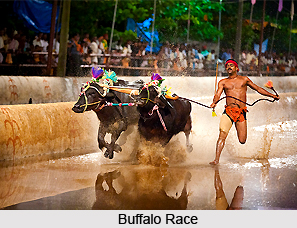
The folk arts and fairs in Kasargod includes Buffalo race and Cock fight.
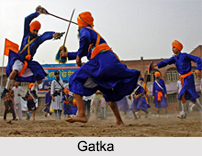
Gatka
Gatka is an ancient martial art developed to defend and display fighting skills and to better exercise self control.
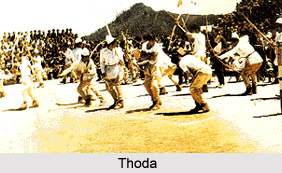
Thoda
It is a martial form of Himachal Pradesh, practised by bows and arrows.
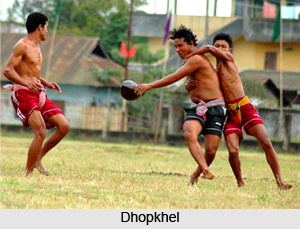
Dhopkhel
Dhopkhel is a very famous indigenous game of the Assamese. A rubber ball is used to play Dhopkhel and the players need great speed and other athletic skills to play this game.
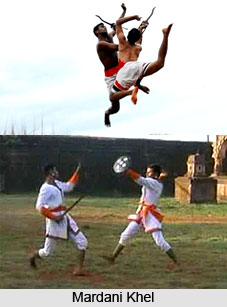
Mardani Khel
Mardani Khel is an Indian martial arts based from Maharashtra. This martial art belonged from early eras which were used as a technique in warfare.
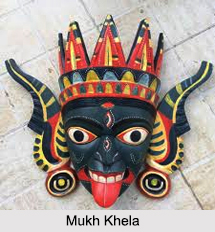
Mukha Khela
Also known as the dance of masks, the Mukha Khela is based on ancient themes.
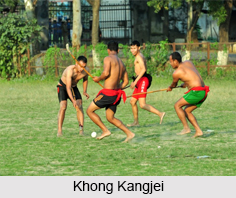
Khong Kangjei
Also known as Manipuri hockey, the sport of Khong Kangjei is one of the popular sports in the state of Manipur. The game is a combination of both hockey and wrestling.
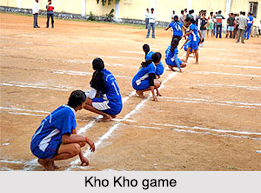
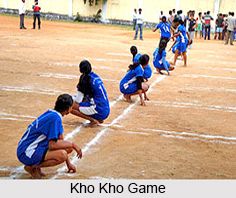
Rules of Kho Kho
Kho Kho is a popular game invented in Maharashtra, India. Apart from the India, it is also played by the Indian community residing in South Africa. It is played mostly by school children in India.
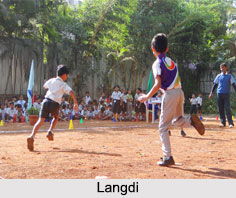
Langdi
Langdi is a traditional Indian field game which is similar to Hopscotch. The game has been included as regular game in Mumbai University. Played on one foot, it combines strategy with physical skill. Rooted in ancient history, Langdi is not only culturally significant but also serves as excellent training for other athletic disciplines.
Traditional Games
Apart from the other famous traditional games, these other regional games have also been a part of our Indian culture.
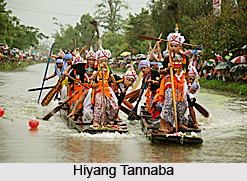
Hiyang Tannaba
Hiyang Tannaba is a traditional game of Manipur. The sport involves boat race during the festival of Lai Haraoba.
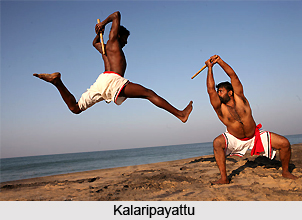
Kalaripayattu Martial Art
Kalaripayattu is an ancient form of martial art training and discipline of Kerala, which has its root back to the 12th century.
History of Kho Kho
The Kho Kho Game has its mention in the epic Mahabharata. The modern game has been transformed in many ways.
Kho-Kho
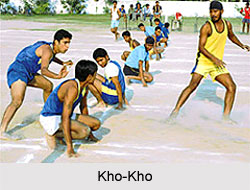
Kho-Kho is a traditional Indian sport where the participants have to chase and catch their opponents in order to win the game.
Silambam
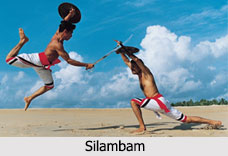
Silambam is a weapon-based Martial Art of India. It is a type of a fencing game, more popular in the state of Tamil Nadu.
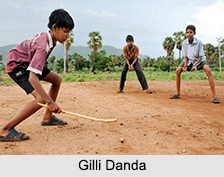
Gilli Danda
With many regional variations, Gilli Danda is a traditional Indian sport played with two wooden sticks.
Chaturanga
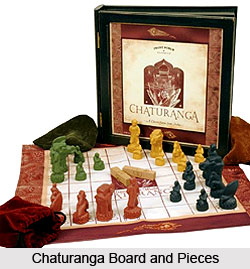
Chaturanga is one of the oldest board games in India. It is considered to be the ancestor of modern Chess.
Kabaddi in India
Kabaddi in India, introduced during the pre-historic period, is recognised as a premier National Sport.
Pallankuzhi
Pallankuzhi is a traditional board game of Tamil Nadu, which is mainly played by the women of Tamil Nadu.
Hide and Seek Game
Hide and Seek is a popular children’s game where one person would find the other players who are hiding in different places.