Introduction
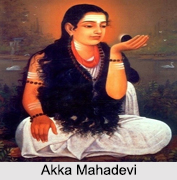
Akka Mahadevi was one of the early female poets of the Kannada language and a well-known personality in the Veerashaiva Bhakti movement of the 12th century. Her "Vachanas" in Kannada, in the form of didactic poetry, are considered her greatest contribution to Kannada Bhakti literature. In total she wrote about 430 "Vachanas" which is relatively fewer than that compared to some other saints of her time. Yet the term `Akka` (elder Sister), which is an honorific given to her by great Veerashaiva saints like Basavanna, Chenna Basavanna, Kinnari Bommayya, Siddharama, Allamaprabhu and Dasimayya who had spoken volumes of her contribution to the movement that was underway.
Journey of Akka Mahadevi as a Saint Poetess
Akka Mahadevi emerged as a prominent figure within Lingayatism, a reformist denomination of Hinduism founded in the 12th century. Her literary legacy includes around 430 vachanas, spontaneous and mystical poems, as well as two short prose works, Mantrogopya and Yogangatrividh, which together form some of her most significant contributions to Kannada literature. Living in an era marked by political turmoil and social unrest, she consciously chose the path of spiritual enlightenment and remained unwavering in that decision.
She actively participated in intellectual and spiritual gatherings such as the Anubhavamantapa in Kalyana (present-day Basava Kalyana), where scholars and mystics engaged in debates on philosophy and the pursuit of enlightenment, or moksha, which she referred to as ‘arivu.’ In her quest for union with her divine beloved, Lord Shiva, Mahadevi renounced family life and worldly attachments, finding companionship instead in animals, flowers, and birds.
An ascetic by conviction, she is believed to have rejected the wearing of clothes altogether. According to legend, her absolute devotion and pure love for God were so profound that her body was said to have been naturally covered and protected by her own hair.
Early Life of Akka Mahadevi
Akka Mahadevi was born in Udutadi (or Udugani) near the
ancient city of Banavasi (in Shikaripura taluk Shimoga
district of Karnataka). She was born in C. 1130 and throughout
her life she mainly worked for the welfare of women.
Some scholars suggest that she was born to a couple named Nirmalshetti
and Sumati, who were both devotees of Lord
Shiva. She displayed her religious proclivities which she possibly
inherited from her parents even when she was a child. She was a shining example
of beauty and princess of lyrical poetry.
Life of Akka Mahadevi as a Saint
King Koushika, the ruler of the land, was immediately captivated when he first saw her. He proposed marriage, but she firmly refused. Unwilling to accept her decision, Koushika resorted to threatening her family with severe consequences, eventually coercing her into agreeing to the marriage. Mahadevi consented only on the strict condition that he would never claim her without her explicit will.
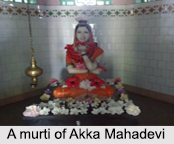
Legends of Akka Mahadevi
Akka Mahadevi is considered by contemporary scholars to be a major figure in the field of female liberation. She had said that she was a woman only in name and that her mind, body and soul belonged to Lord Shiva. Akka Mahadevi had accepted Chennai Mallikarjun as her spiritual spouse. When the local King Koushika asked her hand for marriage, she refused, but later she had to agree to protect her family and parents. The King in his lust tried to impregnate her and she left the palace leaving her family, regal pleasures and worldly controls at the back. Then she went in search of fellow seekers or "sharanas". She found the company of "sharanas" in Basavakalyana, Bidar district. She uttered many "vachanas" in praise of them. She joined a group called "Veera Saiva". There, in the "Anubhava Mandapa", a stage for open debate on various issues including philosophy and social development, she spoke boldly. Her confidence earned her the honorific title, "Akka", meaning "elder sister". It is believed that at the age of 25 years, she found the "Kadali vana" in the locality of the Shrishaila temple and lived the rest of her life in a cave.
Works of Akka Mahadevi
Akka Mahadevi’s experiences, both spiritual and household, come out in the type of simple stanzas (vachanas) in Kannada. Set in conversational language and filled with realistic similes, her vachanas go in the ethics of the reader with their depth of meaning and lyrical beauty. They number over 300 and feature in Yoganga Trividhi, treated as a text book by advanced sadhakas. Her works, like many other Bhakti movement poets, can be sketched through the use of her "ankita", or the signature name by which she addressed the figure of her devotion. She uses the name "Chennamallikarjuna" to devote to Lord Shiva. About 350 lyrical poems or "vachanas" are ascribed to Akka Mahadevi. Her works regularly use the metaphor of a prohibited love to explain her devotion to Lord Shiva.
The lyrics of her works have been described as symbolizing an “essential illegitimacy” that re-examines the position of women. At times she used strong sexual descriptions to symbolize the unification between the devotee and the object of devotion. In some “vachanas” she explains herself as both, feminine and masculine. Her works, like the works of various other female Bhakti poets, also touch the themes of estrangement: both, from the material world, and from social hopes and mores regarding women. She describes her love for Lord Shiva as traitorous, viewing her husband (King Koushika) and his parents as obstacles to her union with her Lord Shiva.