Introduction
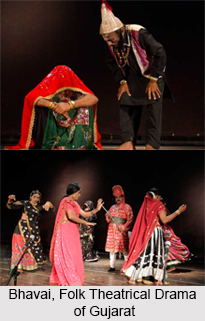
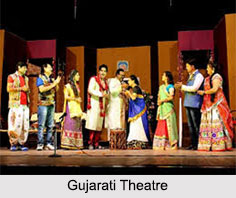 With a rich history and unique traditions, Gujarati theatre has prospered since the 14th century when the folk theatre of Bhavai started. Performed primarily in the Gujarati language, including its other dialects, Gujarati theatre is mainly produced in the states of Gujarat and Maharashtra along with the cities like Mumbai, Ahmedabad, Vadodara and Surat.
History of Gujarati Theatre
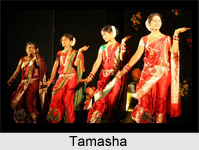
Commencing from the 14th century, Gujarat has had a long tradition of folk theatre. Starting with the popular folk theatre of Bhavai, its origin was traditionally credited to Asaita Thakar, a religious folk singer. Eventually in the early 16th century, new elements were being incorporated in the Gujarati theatre, like using the Tamasha folk tradition of Maharashtra. In the royal courts and temples of Gujarat, Sanskrit drama was performed and during the reign of the British East India Company, foreign operas and theatre groups inspired the local Parsis to start their own travelling theatre groups, largely performed in Gujarati.
The year 1852 was the turning point of Gujarati theatre, when a Parsi theatre group performed Shakespeare in Gujarati language and it continued to prosper in the early 20th century. The first theatre group of Gujarati theatre was founded by Framjee Gustadjee Dalal in 1853 and was called the Parsee Natak Mandali, which staged the first Parsi-Gujarati play, Rustam Sohrab.
According to historian Makrand Mehta, the first theatre group in Gujarat was founded in Morbi by Mulji and Vaghji Oza. The "Arya Subodh Natak Mandali" came into existence in 1878. This was the first group that was not coming from the Parsi theatre or the Bhavai tradition. It was the result of the influence of both the Indian as well as the western traditions. Its first production was `Bharthari`, which created a history of its own on Gujarati theatre as it continued to be performed for years together in Saurashtra.
Development of Gujarati Theatre
Development of Gujarati theatre happened through Sanskrit theatre acts, as in the fourteen century, Asaita Thakar, a folksinger of religious tales, started a participatory form known as Bhavai by means of historical and mythological themes and characters, creating consciousness among audiences on collective issues concerning the society. He is said to have written about 360 veshas (literally "dress") or acts, he performed them all over Gujarati-speaking western India with the help of his three sons.
The development of Gujarati theatre was mainly embarked by three dramatist-managers: Dahyabhai Jhaveri (1867-1902), and the brothers Moolji and Vaghaji Asharam Oza (1850-97). They introduced new elements of theatre to the stage like; tableaux, social themes, and conventional Garba dance of Gujarat. The Morbi Arya Subodh Natak Mandali and Wankaner Aryahit Vardhak Natak Mandali made a huge fame and name in the Kathiawar peninsula as travelling repertories. But, the style basically remained melodramatic, as one with fashionable clothing, painted two-dimensional settings, and melody, which had previously obtained a very vital spot in making Gujarati theatre trendy and famous.
With Indian cinema and films capturing the minds of audiences in the late 1920s, theatre showed two parallel drifts, independent and misguidedly opposing each other. For the so-called "old" professional theatre (also known as Parsi theatre outside the Indian state of Gujarat), this period was marked by money-investors owning or controlling companies, where each element (including the script) was hired and sold to the public. Writers like Brahmbhatt, Dwivedi, and Dossa; actors like Pransukh `Eddie Polo`, Mohan Lala, Ashraf Khan (1893-1962), and Chhagan `Romeo`; directors like Master Kasam, Mulchand Mama, and Kasambhai Nathubhai Mir (1906-69) worked for such troupes as Desi Natak Samaj, which normally staged formulaic plays maintaining status quo, while renting their playhouses to exhibit films for profit. Performances continued to be caught in the sentimental rut, finally leading to the closure of many companies, and pushing the remainder to travel in small towns and villages for their sustenance.
On one side, between the Quit India movement (1942) and Independence of India (1947), barefoot folklore research by Zaverchand Meghani, poetry by Umashankar Joshi (1911-88) and Sundaram, novels by Pannalal Patel, and short stories by Chunilal Madia (1922-68) provided a pragmatic pedestal to the depiction of pastoral Gujarat; Madia and Joshi also composed one-act drama in the identical style. Life in the state was generally full of the sense of sacrifice and hope. Quit India was followed by the Naval Mutiny in Mumbai, but the mature Gujarati theatre remained blissfully unaffected.
Individual playwrights and actors formed their own groups: the Indian People`s Theatre Association (IPTA, Mumbai and Ahmedabad), Bharatiya Vidya Bhavan, Indian National Theatre, and Rangbhoomi (Mumbai); Rangmandal, National Theatre, Rupak Sangh, and Natmandal (Ahmedabad); Rashtriya Kala Kendra (Surat). The decade after Independence also saw the launch of three educational institutions (Natya Vidya Mandir, Ahmedabad 1949; M.S. University, Vadodara, 1950; Saurashtra Sangeet Natak Academy, Rajkot, 1956), the publication of short-lived theatre magazines {Natak, `Drama; Nepathya, `Backstage`; Gujarati natya, `Gujarati Theatre`), the centenary celebrations of Gujarati theatre in 1953, and the commencement of state drama competitions of the then bilingual Bombay State in 1955, helping the spread of theatre consciousness.
In the early 1960s, the Indian National Theatre, Bahuroopi, and Rangbhoomi in Mumbai introduced many actors and managers like Vishnukumar Vyas, Pratap Oza, Madhukar Randeriya, Damu Zaveri, Lalu Shah, and Vanlata Mehta, while Rangmandal, Rupak Sangh, Darpana, and Javnika in Ahmadabad brought forward actors like Dhananjay Thaker, Kailash Pandya, Markand and Urmila Bhatt, Damini Mehta. Adi Marzban (1914-87) and Phiroz Antia were very active in Parsi theatre comedies. However, the most popular were the actor-couple Pravin (1936-80) and Sarita Joshi (1941- ) of Indian National Theatre, usually producing adapted Broadway hits, sometimes directing original drama such as Ramji Vania`s Moti veranan chokman ("Pearls Scattered in the Yard", 1969) and Madhu Rye`s Kumarni agasi (translated as The Terrace, 1972). Actor-director Kanti Madia also attracted full houses with his plays like Ame barafna pankhi ("We are Birds of Snow", 1974).
This period was marked by some good one-act drama from Jayanti Dalai (1909-70), Prabodh Joshi (1926-91), Shiv Kumar Joshi (1916-88), and Chunilal Madia. The brief one-act diversion imitated the European trend of absurdist theatre. There were notable sparks in writers like Labhshankar Thaker, Subhash Shah (Ek undar ane Jadunath, `A Rat and God`, 1966), and Adil Mansoori (Hathpag, `Hands and Feet`, 1970). This apparently rootless movement spread like wildfire, catching the imagination of young playwrights, but also died with the same speed when the Youth Festivals in the state were discontinued. Credit for an attitudinal change to the language of theatre should go to Madhu Rye, in Koipan ek phulnun nam bolo to, 1968, or Tell Me the Name of a Flower, who also gathered some dramatists in an informal self-training group, Akanth Sabarmati, in 1972. Newer voices included Shrikant Shah (Tirad, "Crack", 1972), Hasmukh Baradi (Kalo kamlo, "Black Blanket", 1975), Raghuvir Chaudhari (Sikandar Sani, 1976), and Chinu Modi (Navalsha Hirji, 1977). The authors turned to performing as well: Rye and Labhshankar Thaker with Darpana, Subhash Shah and Modi at Hathisingh Visual Arts Centre, Baradi in Garage Studio Theatre. These efforts benefited their search for a modern theatre language.
During 1980s, prominent change was towards stylization, especially in Thaker, Sitanshu Yashashchandra, and Baradi (Janardan Joseph and the verse drama Jashumati, and a quest for elements fresh from performing traditions rooted in the soil. The rich heritage of folk expressions like Bhavai and musical dance forms like Ras-Garba, or storytellers like Man Bhatt, contributed. Kailash Pandya (1923-2007) and Janak Dave extensively used folk elements in their productions. Stylistically at the opposite pole, professional companies had commercially sold-out shows like Vinod Jani`s Pritpiyu ne panetar ("Love, Husband and Wedding Gown", 1963), which still runs after a record 7000 performances, and those of Arpan Theatre led by Ramesh Amin.
The scholar-designers Goverdhan Panchal (1913-96) and Mansukh Joshi (1922-2000) had a strong and singular effect in evolving the correct theatre consciousness. Panchal reconstructed and researched conventional traditions, while Joshi won accolades and respect for work on folk scenography or stagecraft. The scheme employed by Sangeet Natak Akademi to encourage young potential directors discovered talents like Manvita Baradi, Prabhakar Dabhade, Aditi Desai, Janak Rawal and PS. Chari. Almost every year, the National festivals structured by Rajendra Bhagat, brought bright air and sights of newer researches in sister theatres. Over the last two decades one-act competitions and performances by the Indian National Theatre and Gujarat Samachar also raised interest among young people.
Type of Gujarati Theatre
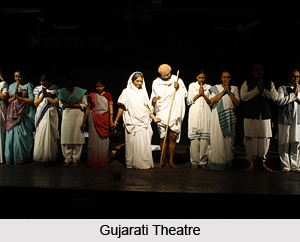 Types of Gujarati theatre can be mainly divided into three main parts. The onslaught of television has affected the output of directors like Nimesh Desai and Bharat Dave, among others in Gujarat responsible for some very interesting productions in the 1990s. Actor-directors now find money and glamour in the electronic medium, not realizing that it cuts both ways: theatre loses and television does not benefit. Elsewhere, the four-decade-old theatre training facilities at the university level have not been very beneficial, nor the efforts to preserve Bhavai, although authentic performers like the female impersonator Chimanlal Naik (1925) did conduct workshops. Furthermore, in the absence of even the semblance of research or serious theatre criticism, most remarkable works go unnoticed and writers get discouraged.
Commercial Gujarati Theatre : The main commercial variety in Mumbai depends on Hindi cinema or Bollywood or Broadway adaptations for easy formulae tied with double-entendre dialogue, commissioned by agents for "contract shows" to societies, ringing the death knell of the box office, which used to form an acid test for their (so-advertised) slick and efficient performance. They sell mystery, tears, jokes and even ideals in high-speed exchanges delivered by smartly costumed casts in fashionable decor, in scripts proudly imported from abroad or Marathi language. However, alongside this activity, notable experiments were conducted by US-based actor-director Chandrakant Shah and others, for instance performing a series of successful Gandhi plays that presented controversial aspects of the Mahatma"s life.
Amateur Gujarati Theatre : The second category is the amateur activity, centred in the cities of Ahmedabad, Vadodara, Surat, Rajkot, and marginally in Mumbai (the Chhabildas experimental movement and Mahendra Joshi),
 where groups stage original plays or classics, following Stanislavskian Method acting or Brecht, Grotowski, and Peter Brook. New drama among these groups seems to have increased: the critic Vinod Adhvaryu evaluated the 1990s as the most notable decade of playwriting; the poet-editor Niranjan Bhagat forecast that the Gujarati play is emerging. Solo scripts were produced in Mumbai and Gujarat on the lives of great writers like Narmad, Kalapi, and Kant. The longest-running troupe is the thirty-year-old Garage Studio Theatre, from which flowered a production, training and media centre with land and partial financial help from the government. A recent theatre movement among the young is led by writer-director Saumay Joshi, who has tackled themes of communal conflict and the sorrows of the common man.
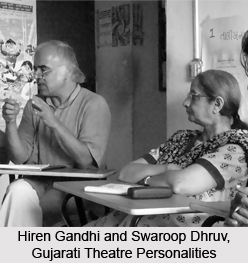
Developmental Gujarati Theatre : Third category is developmental, socially relevant attempts by non-government institutes and committed troupes like Parivartan (Vadodara), Garage, Chetna, Awaj, and Nehru Foundation (Ahmedabad) who conduct workshops and perform thematic plays for awareness, inspired by Badal Sircar and Augusto Boal, in which the audience is allowed equal participation. Third theatre"s contribution is the emergence of Indian street theatre (Samvedan, Garage, and Lok Kala Manch in Ahmadabad, Parivartan in Vadodara) in efforts to take Gujarati theatre to people at street corners, in middle-class housing colonies, or open public places. Hiren Gandhi and Swaroop Dhruv of Samvedan stage socially conscious plays with actors from the weaker sections of society.
Plays of Gujarati Theatre
The Gujarati play - Rustom, Jabuli and Sorab, which are based on the popular dramatic tale of Shah Nama, is considered as the beginning of Gujarati theatre. It was staged at the Grant Road Theatre of Mumbai on October 29 in 1853. Bhavai, the popular folk form of Gujarat was not much related to theatre earlier but now it has been incorporated into most of the Gujarati theatres. Currently, social issues and awareness is being spread via Gujarati theatre, like the evils of dowry, women"s equality and health, alcoholism, vaccination etc.
The Gujarati theatre actors got exposure when the Bharatiya Vidya Bhavan and the Bombay State Competitions held between 1950 and 1960 provided most of the projects to the professional Gujarati theatre. For example, Pravin Joshi, Vijay Dutt and Kanti Madia were launched in the 1953 competition. In the same way, some of the intercollegiate competitions organized by the Indian National Theatre in 1975-78 gave break to the talents like Mahendra Joshi, Paresh Raval, Mukesh Raval, Siddharth Randeria, Homi Wadia, Sameer Khakhar, Nikita Shah, Sujata Mehta, Daisy Rani and Latesh Shah. Now, they are trying to establish younger generation of theatre professionals.
It is said that a Gujarati play named "Harishchandra" influenced very much the father of the nation, Mahatma Gandhi. The Gujarati theatre has inspired thinking of the people, created social awareness and national spirit during pre independence days.
Modern Gujarati Theatre
In the late 1980s, the Parsi dramatic companies laid the foundation of modern Gujarati theatre. These theatre companies brought western techniques and themes as well as music to form a renewed vernacular theatre. Thus, original plays like "Kumar Ki Chhat Par" and "Kahat Kabira" by renowned playwrights like Madhurai, Vinayak Purohit, Shiv Kumar Joshi and others were revived.
In the centenary year of the 1857 uprising, the Indian National Theatre staged a Gujarati play "Bharelo Agni". It is regarded as a landmark for the non-professional Gujarati theatre. One of the most versatile Gujarati actresses is Sareeta Joshi, who has dominated in the new Gujarati Theatre for the longest time. Another talented Gujarati dancer and actress is Mallika Sarabhai, who made her name for the role of Draupadi in the world famous playwright Peter Brooke`s "Mahabharata".
In the 21st century, cinema and television have taken over the field of entertainment. But the Gujarati theatre has not lost its charm yet. Sometimes the flow of the plays has slowed down and sometimes changes are done to match with the tastes of the audiences. But the Gujarati theatre has survived along with the new style. Amol Palekar is one of the recent actors cum filmmaker from Gujarat, who has also tried to revive the Gujarati theatre. The Gujarati theatre has also marked its place in the World Theatres through its colourful representation of the plays.