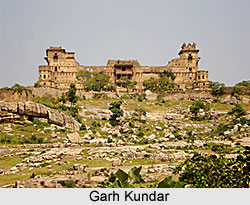
 Garh Kundar is a tiny village located in the Tikamgarh Distirct of Madhya Pradesh. The place is named after the splendid fort of Kundar that is situated here as well. Here `Garh` means `Fort`.
Origin of Name for Garh Kundar
The name of the place is taken from `Kundarka` which means `pond` and `Arka` stands for `sun`. Incidentally there existed a pond built in the village by the worshipper of sun god called the kshatriyas (known as Arkawanshis). It is often said that a person with skin disease could get himself cured after taking bath in the pond or the `Arka-kund`. The remains of the pond still can be seen near the temple of `Gajanan Maa`.
The fort is perched on high hill, bordered by forest and picturesque hills. Apart from main fort there are also ruins of many other monuments and structures that can be seen here. These antique remains of the old structures seem to quietly narrate the tales of the exquisite past. There are also old remains of a temple of Gajanan Maa (an epithet of Goddess Durga, considered to be `Kula Devi` by Khangars), which was constructed during the reign of Maharaja Khet Singh Khangar. The temple of `Giddha Vahini` Devi is also located here.
There is a complex built around the fort which is has a spacious and large courtyard. There are few pillar and rock inscriptions that have also been found in the region of the fort. There are beautiful pillars of moon and sun that can be found in the boulders and fallen masonry, among the overgrown and rough stones. During the Mughal period the granite floor structure have been renovated by the Bundela Kings.
History of Garh Kundar
After a chief of Khangars Khet Singh thought of building his capital in Kundar in 1180 AD, the place came into being. He established his own state after capturing the fortress of Jinagarh from Chandelas, which was situated here. His grandson, Maharaja Khet Singh Khangar, after his death, had built a tremendous fort in place of Jinagarh fortress and kept the name as "Garh Kundar". The place remained the capital of Khangar kings till it was captured by the army of Mohammad Bin Tughlaq in the year 1347 AD. Afterwards it was handed over to Bundelas, who were actually feudatories of the Mughals.
Apart from the fort, which in itself is an attraction for people, there are several other historical remains that can be found here too. These lonely and secluded remains quietly speak the tale of the glorious past of Khangar Kshtriyas. There are large sized courtyards, inscribed pillars that can be found in the fort which speak about the rich culture of the fort.