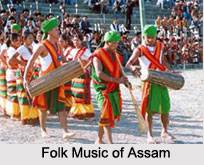
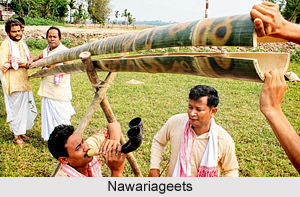
 Nawariageets are the boatmen`s songs, a part of the folk music of Assam. These songs, sung by the boatmen are marked by a spirit of spontaneous joy and flowing grace. They are to a certain extent like the Bhatiali songs of Bengal, Bhata meaning downstream.
Origin of Nawariageets
It is possible that the Nawariageet originated when the boatman leisurely paddled his boat or drifted along with the current of the water without having to ply his oar. This indicates that they were born a long time back, in the days before the invasion of the province by railways or other means of road transport. During this time, the rivers naturally played a prominent part in the life of the people as the main avenues of communication. This is why they comprise such a big part of the folk songs and ballads.
Themes of Nawariageets
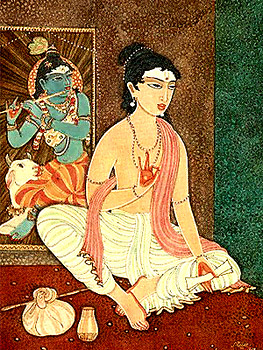
Some of the boat-songs, particularly popular in western Assam, are noted for their strength of expression and inspiration drawn from Vaishnava themes. "Kanai, ferry me across the river" is a request of Radha to Lord Krishna, and in this context the latter`s conduct is that of a crafty ferryman. This is one of the most beautiful poems set in romantic tones.
Kanai par karahe, belir diki cuwa,
nasla haila dudher bhandar, bazar goila boiya
Anya Radha par kaile laibo ana ana, foi Radha par kaile laibo kanar sona.
There are certain other songs which not exactly folk songs of the boatmen-type but bear on the life of the rivers. These are the Baramahi-song. They speak of the expansive river-borne trade of the time and the natural impact on the mind of a lonely wife whose husband is away for a long time on the river for trade. Strictly speaking, though its note is secular, Baramahigeet ends on a note of spiritual exaltation in the spirit of Vaishnava poetry. The picture of the lovelorn maiden is poignant and significant,
Aharar mahot Radha adharma barisana, Pushpare palangite Radhe karila sayana;
Pushpare palangite Radhe nahila ghumati, Kaika gaila prananathe nahila ulati.
The constant reference to Radha`s restlessness due to pangs of separation is picturesque. Kaina Baramahi, another poem of this variety, is a dialogue of a lovelorn maiden with a vagrant whom she happens to come across. Each line of this story-poem is replete with fragments of broken sighs.