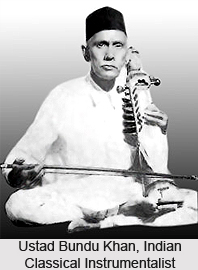
 Ustad Bundu Khan was born during the times of the princely era and when the streets of Old Delhi would resonate with the blissful and melodic tunes of various vocalists, accompanied with instrumental music and brilliantly-lit darbars. He became attracted to sarangi at an extremely tender age, and that turned out to be the turning point of his life. Then onwards, he was inseparable from his adored sarangi and played on in the streets of Old Delhi or as the court musician of Rampur and Indore. He was a rare gift from god on earth and a completely absorbed religious player, who made several innovations into the instrument. He was never worried about earning riches and believed that music could be learned from every kind of ambience in the country.
Early Life of Ustad Bundu Khan
Bundu Khan was born in Delhi in 1880 as a worthy inheritor of the musical traditions of the Delhi gharana. He was trained by his grandfather Saungi Khan and his maternal uncle, Mamman Khan, one of the highly respected singers of his time. Born with a deep-rooted passion for music, it seemed evident that little else besides music interested him from a very early age. All his relatives and dear ones were closely involved with music. Being from an essentially sarangi gharana, it comes as no surprise that Bundu Khan took to the instrument at an early age.
Life in Music for Ustad Bundu Khan
Bundu Khan was an exceedingly engrossed man of riyaz and went ahead to make numerous innovations in the instrument, such that it became the eloquent companion of his soul. Needless to say, he soon rose to fame in his youth and manhood and was appointed court musician in the princely states of Rampur and Indore, where he served for several years. Soon, he returned to his beloved Delhi as a staff artist in All India Radio and remained there until the time he left for Pakistan.
A highly sensitive and otherworldly soul, music was his sole obsession. Most of Bundu Khan`s life and time was spent practicing, improvising or exchanging mores with contemporary musicians and maestros. His intense passion for this instrument and music drove him to extreme measures, owing his family being quite unhappy with him. As a result he became an addict of opium and ganja for relief. Though an addict, he always forbade his students and young musicians from so much as touching it.
During the pre-Independence times, it was a common sight to see the engrossed Bundu Khan walking along the streets of Old Delhi, clutching his dear sarangi, oblivious to the goings-on around him. If anyone requested him to play, he would sit on the footpath and blissfully play the instrument. He had absolutely no qualms about accompanying wayside singers or playing during the Ramlila celebrations in Delhi. No musical opportunity, he felt, was to be missed, for there was always something to be learnt and be delighted by, from the plenteous musical resources in this country. Such was his frenzy for his beloved sarangi, that he used to never let go of it, and umpteen legendary stories abound in the Old Delhi area about this soulful and child-like man and his other half - the sarangi.
The Partition and its aftermath proved traumatic for Bundu Khan. This guileless man, ever lost in the abstract world of music and melody, was suddenly hurled into the glaring light of reality and time. He had hoped to continue in this country, but owning to his family migrating to the new country (Pakistan) in search of hope, he was obliged to comply. As a result he left for Pakistan after three years of the Partition. The Delhi AIR tried much to intervene to bring him back here, but travel restrictions made the job even tougher. Distressed and dejected, he died in 1955, a broken man, a tragically alienated artist. AIR apparently has a rich storehouse of Bundu Khan`s recordings. It is hoped that they would release these recordings for the benefit of music lovers and the younger generation of sarangi players.