
 Tourism in Bihar comprises of both the nature tourism and pilgrimage tourism, that attracts Indians and the tourists outside India. Bihar, in North India, is full of tourist attractions. Being one of the oldest inhabited places in the world with history of three thousand years, it becomes the hub of Buddhist architecture. The state has rich culture and heritage which is depicted in the numerous ancient monuments that dots the place. Tourism in Bihar is an integral part of tourism in India. It is one of the most sacred places and offers a wide array of pilgrimage tourism. People from various religions like Hinduism, Jainism, Buddhism, Islam and Sikhism come here for spiritual enrichment. Forts and palaces in Bihar are rooted in deep historical significance. Wild life plays a vital part in boosting the tourism industry of Bihar. Ideally situated on the eastern Gangetic plain, it was the seat of several of the most famous ancient Indian dynasties and also the cradle of many religions.
Tourism In Bihar
Tourism in Bihar comprises pilgrimage sites belonging to Hindus, Muslims and Buddhists, majestic forts, palaces and wildlife.
Introduction
Tourism in Bihar comprises of both the nature tourism and pilgrimage tourism, that attracts Indians and the tourists outside India. Bihar, in North India, is full of tourist attractions. Being one of the oldest inhabited places in the world with history of three thousand years, it becomes the hub of Buddhist architecture. The state has rich culture and heritage which is depicted in the numerous ancient monuments that dots the place. Tourism in Bihar is an integral part of tourism in India. It is one of the most sacred places and offers a wide array of pilgrimage tourism. People from various religions like Hinduism, Jainism, Buddhism, Islam and Sikhism come here for spiritual enrichment. Forts and palaces in Bihar are rooted in deep historical significance. Wild life plays a vital part in boosting the tourism industry of Bihar. Ideally situated on the eastern Gangetic plain, it was the seat of several of the most famous ancient Indian dynasties and also the cradle of many religions.Pilgrimage Tourism in Bihar
 Pilgrimage tourism in Bihar is well known for its pilgrimage centers comprised of Hindu, Muslims and Buddhist monasteries, temples and mosques. As far as pilgrimage centers are concerned most popular of these is Gaya. This place is considered a sacred place for worship by the Hindus. Lord Vishnu (Lord Vishnu in Rig Veda) is said to have conferred upon Gaya the power to cleanse one of one`s sins. Devotees flock here to perform ceremonies to clear their dead of the burden of sin they might have carried over to the next world. They take a holy dip in the Phalgu River and lay offerings of pindas (sweets) and ritual rice cakes on the ghats along the river, before entering the Vishnupada Mandir (closed to non-Hindus) built by the Maharani of Indore in Madhya Pradesh in 1787 over the footprint Lord Vishnu is believed to have left on a stone. Within the grounds of the temple stands a banyan tree which is said to be the one under which Lord Buddha spent six years meditating.
Haramandir, a Gurudwara in old Patna, is one of the holiest places for the Sikhs. Guru Govind Singh, the tenth and last Sikh Guru, was born and died here. it was built in the 19th century around the room where the Guru was born and stands at the centre of Patna`s Sikh district. It is a tall building in white marble, housing a museum of the Sikh religion. Apart from this Patna houses some of the most interesting Mughal religious buildings. At Maner, 18 miles away from Patna, are two mausoleums: Choti Dargah, in a small Muslim cemetery, is the grave of Maneri, a Muslim ascetic of the 17th century. Bari Dargah, on the high bank of an artificial pond, was built around 1620 by Ibrahim Khan, Governor of Bihar under Jahangir, as a mausoleum for Shah Daula, his religious preceptor.
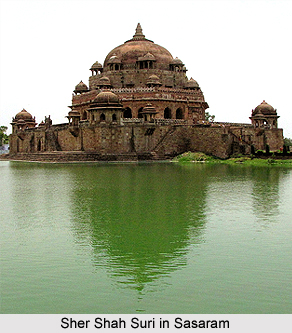
At Sasaram there are some large monuments belonging to the era of Sher Shah Suri in North India. The Tomb of Sher Shah built in the 16th century in the middle of a square; a wide tank, and the mausoleums of Hassan Sur Khan, Sher Shah Suri`s father, Alawal Khan, the officer in charge of building the mausoleum and the uncompleted one of Salim Shah, Sher Shah`s son.
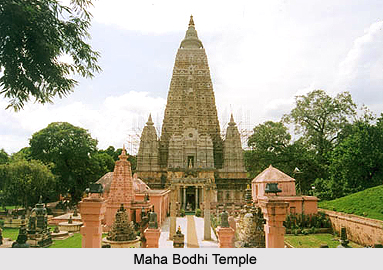
 Religious places belonging to the Buddhists are scattered throughout Bihar. Foremost amongst these is the place where Buddha attained enlightenment. It is located in Bodhgaya, 12 km south of Gaya, along the Phalgu River. It was actually King Ashoka who erected a shrine near the Bodhi tree under which Gautama Buddha received enlightenment. This was replaced in the 2nd century by the present Mahabodhi Temple with a 177-ft spire. Under the tree is the Vajrasana, the Diamond Throne, a stone slab marking where the Buddha was sitting when he attained enlightenment.
A nearby Buddhist temple has been taken over by the Hindus as the Buddha is considered an avatar of Vishnu and it is now managed by a joint Buddhist-Hindu committee. Inside it a one will come across a gilded statue of the Buddha, sitting cross-legged, with his right hand touching the ground. Around the temple are votive stupas.
Excavations in Nalanda have yielded nine levels of occupation, six temples (chaityas) and 11 monasteries {viharas), all built in redbrick. The monasteries are on the eastern side. The main ones are Vihara: 1 founded in the 9th century by King Balaputradeva of Sumatra, and Viharas 4 and 5, built by King Kumar Gupta in the 1st century AD, with later additions by kings Harshavardhana and Devapala. The viharas show remains of student cells, lecture halls, bathrooms, kitchens, libraries, storage rooms and wells.
To the west are the temples. The most imposing is the Sariputra Stupa, built by Ashoka in honour of Ananada, the Buddha`s first disciple, who was born and died at Nalanda. It is a three-level structure, partly covered with stucco figures of Lord Buddha teaching at Bodhgaya, Nalanda, Rajgir, Sarnath and Vaishali, and surrounded by stupas erected to the memory of students who died during their studies, that could then last a whole lifetime.
North of Nalanda, a monument in the shape of a Chinese temple has been built to commemorate the memory of Hsuan Tsang, the Chinese traveler who studied at Nalanda in the 7th century.
Leaving Nalanda for Rajgir, the road passes a small Chinese temple, the Nava Nalanda Mahavira Research Centre on Buddhism and Pali Literature, set up by the Bihar Government, and Wat Thai Nalanda, a small Thai temple of recent construction.
Chanka Ramana in Bodh Gaya is a platform built in the 1st century BC which marks the place where the Buddha walked in meditation. Carved stone lotuses indicate the spots where the lotuses sprung from his feet. South of the temple a statue of the Buddha protected by a cobra stands in the middle of a large lotus pond.
 Buddhist communities from all over Asia have built monasteries in Bodhgaya. Each one is a technology centre and most accept foreign students.
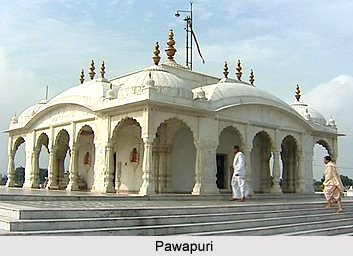
On the way back to Patna, Pawapuri, 20 miles (32 km) to the southeast, is a holy place for Jains. It was here that Lord Mahavira attained salvation in 477 BC. A white marble temple, the Jalmandir in the middle of a lotus pond, marks the place where he was cremated. There are five more Jain temples around the pond.
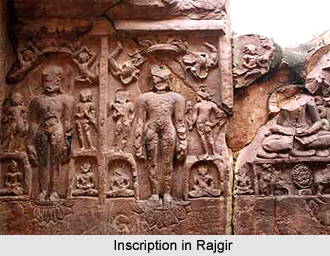
Rajgir, or Rajgriha, the "royal palace" was the capital of the Magadha empire in the 6th century BC. It is a holy place for both Jains and Buddhists. Lord Mahavira taught here for 14 rainy seasons; Muni Suvrata, the 20th Jain Tirthankara, was born here and all of Lord Mahavira`s earliest disciples died here. A monastery built by Mauryan king, Bimbisara, is set in a bamboo park. The First Buddhist Council, six months after the Buddha`s death, was held at Rajgir.
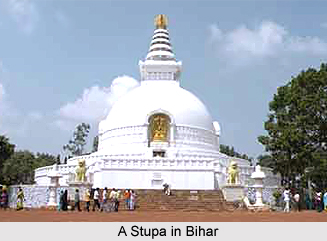
Immediately to the south of Venuvana in Rajgir, at the foot of Vaibhara Hill are Jain and Hindu temples built around 22 hot springs. Public baths have been set up where one can relax in hot emerald-green waters. Further up, past the Pippla Cave and the Jarasandha-ki-Baithak, a monastery built out of large blocks of stone, is the Saptaparni cave where the First Buddhist Council was held. Further south, Manyar Math, a cylindrical stone structure, is a former temple to Maninaga, a serpent demi-god, referred to in the Mahabharata. Turning left the road passes Jivakamhavana, the site of the mango grove presented to the Buddha by Jivaka, Bimbisara` s physician, and reaches Maddakuchchi from where one has to walk to Gridhrakuta Hill, probably the holiest place in Rajgir, where the Buddha delivered most of his sermons. From Maddakuchchi, an aerial ropeway chairlift leads to the top of Ratna Giri, a hill at the top of which Japanese Buddhists have built the Vishwa Shanti Stupa, a huge white structure visible from miles around. Four golden statues, one on each side, represent Buddha` s birth, enlightenment, teachings and death.
Most of the events in the Hindu epic of Ramayana took place in Bihar. As a result a lot of places situated in Bihar, such as, Vaishali, Buxar, Darbhanga District, Munger District, Gaya, Bhojpur District and other cities are worth a visit. Collectively these have been termed by the state tourism as the Ramayana circuit.
Nature Tourism in Bihar
 Though the state of Bihar experiences a tropical climate, there are wildlife sanctuaries and hill stations which make it ideal for nature lovers. The wild life sanctuaries of Bihar are truly marvelous abodes for the wild beasts. Bhimbandh in Munger District is well known for its Bhimbandh Wild Life Sanctuary. It is located in the south west of Munger District. The forest covers an area or 681.99 sq. km and is nestled on the undulating tract of Kharagpur Hills. This sanctuary is bequeathed with an extensive array of flora that distinctly distinguishes this sanctuary from its equals. Wild species, such as Royal Bengal Tiger, Leopards, Sloth Bear, Nilgai, Sambhar, Barking deer, Wild Bear, four horned Antelope are found here. The Palamau Tiger Reserve in Bihar provides a serene and luscious environment for the tigers. The tourists will be delighted to find several hot springs in the valleys and at the foothills of Kharagpur Hills. Amongst these the worth checking out are located at Bhimbandh, Sita Kund and Rishi Kund. Ha-Ha Punch Kumari, Rameshwar Kund, Kharagpur Lake, Sringrishi are also major eco tourist spots in Bihar. Kakolat in Nawada District is a waterfall. The fall is about 150 to 160 feet. Around this waterfall the presence of the lush green forests make it an interesting site to visit. The pictorial beauty of this place is indescribable.
Leisure Tourism in Bihar
 Leisure Tourism in Bihar is priceless who loves history. A number of Mughal monuments as well as other ancient buildings portray the rich history of Bihar.
In case the tourists are wondering from where to begin, then Patna can give them the perfect start. This capital city was known as Pataliputra in ancient India. It has seen the rise and fall of numerous kingdoms.
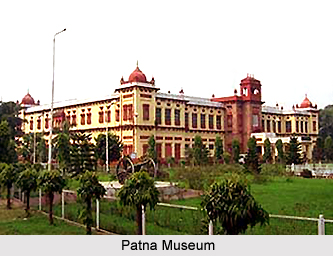
The Patna Museum near the High Court houses a collection of Hindu and Buddhist stone sculptures, bronzes and terracotta sculptures. Among the exhibits is a 49 ft long fossil tree said to be 2,000 million years old and the longest tree fossil in the world. At the entrance of the hall, on the left, is the Didarganji Yakshi, a buff-coloured Mauryan sandstone statue of a woman which is considered to be one of the greatest masterpieces of Indian art of all times.
Apart from this there is the Golghar, Khuda Baksh Oriental Library, Raj Bhawan, Padri-ki-Haveli and others.
At Gulzaribagh, further east near the Mahabir Ghat, is a former British East India Company Factory, now a Government Printing Press. Visitors can visit the opium godowns, the former ballroom and the hall where Shah Alam II was crowned Emperor of Delhi on 12 March 1761.
 There the 56 miles south of Patna is Nalanda, "the place that confers the lotus" (nalam) or spiritual knowledge. This is the site of Sri Mahavihara Arya Bhikshu Sanghasya, a monastic university that flourished from the 5th century until 1199, when it was ransacked by the Afghan invader, Bakhtiar Khilji. The university, at the height of its activities, had a vast library, 2,000 teachers and more than 10,000 students from as far as Japan, Sumatra, Java and Korea. Legend has it that it contained 9 million volumes and that it burned for six months after the sack of Nalanda. Lord Mahavira, the last Jain Tirthankara, and Lord Buddha taught here. Nalanda developed as a centre of Buddhist learning.
Buxar is the place where Lord Rama is said to have fought the demon Taraka and received, with Lakshman, higher knowledge from the sage Vishwamitra. Lord Ram is said to have left a footprint here at Ram Rekha Ghat. Nearby is the battlefield where, in 1764, the British defeated Mir Qasim, the last independent Nawab of Murshidabad and added Bengal and Bihar to their Indian possessions.
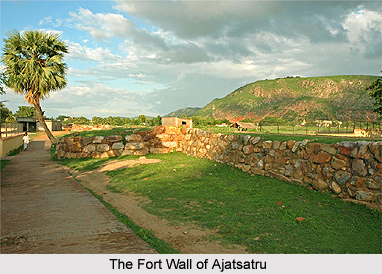
Other famous places of interest in Bihar are Ajatasatru Fort and Venuvana in Rajgir. To the east of the fort lies a Japanese temple, Nipponzan Myohoji.
A new site, Sarai Mound, has been excavated to the northeast. At this site half-faded frescos of horses and elephants have been discovered. East of the ruins, is a museum with Buddhist and Hindu stone and terracotta statues and figurines.
Besides these Sonepur Fair is a popular event in Bihar. Having its roots in the legends this fair is an age old affair. The fair traces its origin to the tale of two brothers who were devotees of lord Vishnu. Due to an enchantment one is changed to an elephant and the other into a crocodile. According to the tale on Kartik Purnima the elephant is attacked on the confluence of Ganga River and Gandak by the wicked crocodile. Lord Vishnu helps the elephant win. From then on a huge and unique fair is held to commemorate the elephants. But the moral of the story lies in the victory of the good over the evil.
Tribal Tourism in Bihar
South Bihar, called Chotanagpur, is very different from the north. A large part of the population is tribal, of pre-Dravidian stock, speaking MonKhmer languages. The main tribes are the Santhal Tribe, the Bedia Tribe, the Birhor Tribe, the Khond Tribe, the Munda Tribe, and the Oraon Tribe. Some are still wanderers, living off hunting, wild fruit and root gathering. The majority have settled to cultivate maize and millet, and raise cattle and fowl. Many now work in the new industrial cities of Bihar. In case the tourists are interested in tribal and their lifestyle they can easily explore these tribal pockets.
On the other hand, the villages in Bihar reflect the essential India. The people are unassuming and most of them are still engaged in their primitive occupation of farming. Yet the influence of contemporary times cannot go unnoticed. The best part of these villages is their hospitality. In India there is a marked difference in the social structure of a city and a village. If it is a festive season or marriage season then the elaborate customs and rituals are worth witnessing. Near the India-Nepal border, more to the east and accessible from Patna through Barauni after a seven hour drive is Madhubani, a village famous for its style of folk painting.
On the other hand, the villages in Bihar reflect the essential India. The people are unassuming and most of them are still engaged in their primitive occupation of farming. Yet the influence of contemporary times cannot go unnoticed. The best part of these villages is their hospitality. In India there is a marked difference in the social structure of a city and a village. If it is a festive season or marriage season then the elaborate customs and rituals are worth witnessing. Near the India-Nepal border, more to the east and accessible from Patna through Barauni after a seven hour drive is Madhubani, a village famous for its style of folk painting.
Recently updated articles in States of India
Bandare Waterfalls, Meghalaya
Bandare Waterfalls in South Garo Hills, Meghalaya, is a secluded natural attraction surrounded by dense subtropical forests and rugged mountain terrai...
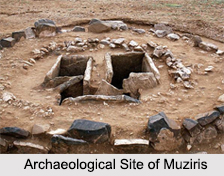
History of Thissur District
Early History of Thissur District explains flourishing of the port cities. Now these port cities are transformed into archaeological sites.
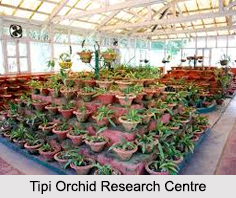
Tippi Orchid Research Centre, Arunachal Pradesh
Tippi Orchid Research Centre in Arunachal Pradesh is renowned for its rich collection of exotic and endangered orchids. Surrounded by lush rainforest...
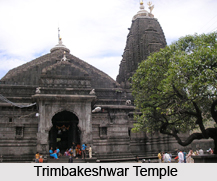
Tourism in Nashik District
Pilgrimage tourism in Nashik district involves visiting the various places of Hindu and Jain worship located here. Some of the holiest sites for Hind...
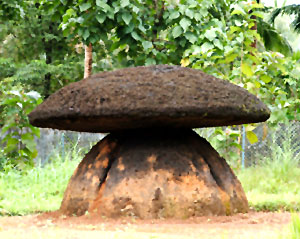
Mangadu, Kerala
Mangadu in Kerala’s Kollam district is a significant megalithic site known for its urn burials, cist burials, menhirs, and stone circles. Excavations...
Related articles in States of India
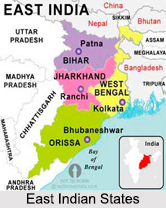
East Indian States
East Indian States comprises of Bihar, Jharkhand, West Bengal, Odisha and also the Union Territory of Andaman and Nicobar Islands. It defines the cult...
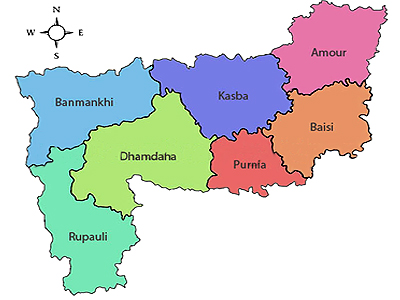
Purnia District in Bihar
Purnia District is located in Bihar and extends from River Ganga to Nepal. The district has a rich Hindu history and glorious past.
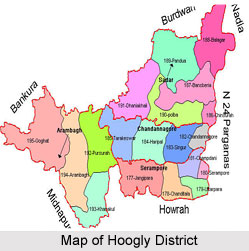
Hooghly district
Hooghly District along the bank of the river Hooghly is one of the principal trading ports of West Bengal.
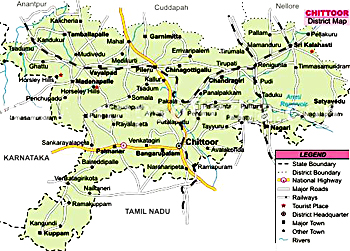
Geography Of Chittoor District
Geography of Chittoor district is spread along the topography of the land which is divided into two natural divisions; Chittoor has a dry and healthy...
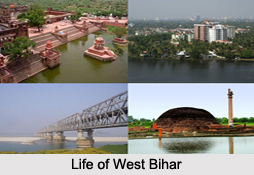
Districts of West Bihar
Districts of West Bihar is comprised of medieval monuments that were built by the different governors of Mughal era.