Introduction
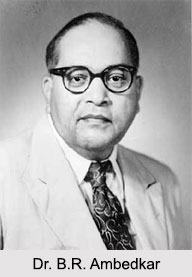
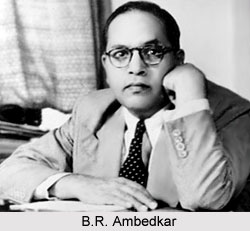
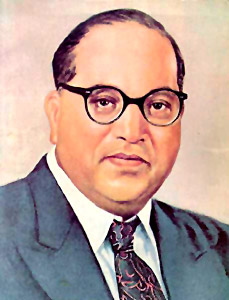
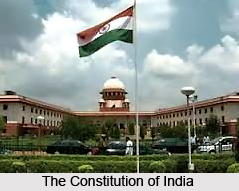
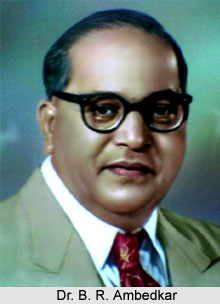
Dr. Bhimrao Ramji Ambedkar was affectionately called "Babasaheb Ambedkar" and had immense contribution in shaping modern India. He led millions of oppressed to a life of self-respect, dignity and responsibility. He had always stressed the importance of better education, so that position of common people in society can be improved. Dr. B.R. Ambedkar was chiefly responsible for drafting of The Constitution of India. He was the first Law Minister of India.
Babasaheb began the revival of Buddhism in India that has grown tremendously after his death, and continues to grow today among his countless followers. He was a veritable phenomenon of the 20th century. He was honoured with the highest national honour, "Bharat Ratna" in April 1990.
Early life of B.R. Ambedkar
Early life of B.R. Ambedkar was spent in a small family. He was born in the town and military cantonment of Mhow in the Central Provinces (now in the Indian state of Madhya Pradesh). Ambedkar was the 14th and last child of Ramji Maloji Sakpal and Bhimabai. He belonged to a family of Marathi background, from a town of Ambavade (Mandangad taluka) in the Ratnagiri district of modern-day Maharashtra. They also belonged to the Mahar Caste, who were basically treated as untouchables and subjected to socio-economic discrimination.
Ancestors of B.R. Amdedkar had, for a long time, been employed in the Army of the British East India Company. And his father also served in the Indian army at the Mhow cantonment. His parents had little formal education in English and Marathi. But they encouraged their children to learn and work hard at school. His parents encouraged him to read the classic of Hindu religion and know about the religion, from a very young age.
B.R. Ambedkar`s father used his position in the army to lobby for his children to study at the government school, as they faced resistance owing to their caste. Even when Ambedkar reached his age to join school, he and other untouchable children were separated and given slight consideration or help by the teachers. They were forbidden to enter the classroom.
Even when they were thirsty or hungry, somebody from the higher caste would have to pour that water from a height as they were not allowed to touch either the water or vessel that contained it. This task was usually performed for the young Ambedkar by school peons and if that peon was not available then he had to go without water, Ambedkar states this situation as "No peon, No Water".
His father, Ramji Sakpal retired in the year 1894 and the family moved to Satara two years later. Shortly after this his mother died. The children were taken care of by their parental aunt and also lived in the hard situations. Three sons - Balaram, Anandrao and Bhimrao - and two daughters - Manjula and Tulasa - of the Ambedkars would go on to survive them. Of his siblings, only Ambedkar succeeded in passing his examinations and finally graduated to high school. Bhimrao Sakpal Ambavadekar the surname comes from his native village `Ambavade` in Ratnagiri District. His Brahmin teacher, Mahadev Ambedkar, who was fond of him, changed his surname from `Ambavadekar` to his own surname `Ambedkar` in school records.
Education of B.R. Ambedkar
Education of B.R. Ambedkar tells the tale of sheer struggle and hard work from a person who was labelled as untouchable by fellow citizens. Ambedkar`s family also moved to Mumbai in the year 1902 and he also became the only untouchable enrolled at Elphinstone High School. In the year 1906 his marriage to a nine year old girl, Ramabai, was arranged. The very next year, 1907 he passed his matriculation examination and in the following year he entered Elphinstone College, which was affiliated to the University of Bombay, and in the process becoming first from his untouchable community to do so. This particular success of his also provoked celebration in his community and after a public ceremony he was presented with a biography of the Buddha by Dada Keluskar, the author and a family acquaintance.
In the year 1912 he also obtained a degree in political science and economics from Bombay University, and prepared to take employment with the Baroda State Government. By then, his wife 19 years old gave birth to her first son, Yashwant, in the same year. B.R. Ambedkar, along with his family moved and started to work when he dashed back to Mumbai to see his ailing father, who died on 2nd February in the year 1913.
In the year 1913 he also moved to the United States of America to pursue his further studies. He had received a Baroda State Scholarship for three years under a scheme established by the Gaekwads of Baroda that was designed to provide opportunities for postgraduate education at Columbia University.
Soon on his arrival, he settled in rooms at Livingston Hall with the Naval Bhathena, a Parsi, who, later became a lifelong friend. In the year 1915, he passed his MA exam, majoring in Economics with Sociology, History, Philosophy and Anthropology as other subjects of study; he presented a thesis, Ancient Indian Commerce. In the year 1916 he again offered another thesis in MA, National Dividend of India-A Historic and Analytical Study. On 9th May he also read his paper "Castes in India: Their Mechanism, Genesis and Development" before the seminar organized by Alexander Goldenweiser (an anthropologist).
On October 1916 he also studied for the Bar Examination at Gray`s Inn and then enrolled at the London School of Economics where he begun his work on a doctoral thesis. In June 1917 he was obliged to go back to India as his term ended. But he was given special permission to return and then submit his thesis within four years. He travelled separately from his collection of books, which were lost when the ship on which they were despatched was torpedoed and sunk by a German submarine.
Political Career of B.R. Ambedkar
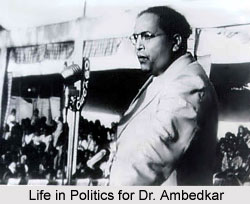
Political career of B.R. Ambedkar spans for a long time. In the year 1935, B.R. Ambedkar became the principal of the Government Law College, Mumbai, a position he held for two years. While he was based in Mumbai, Ambedkar looked after the construction of a house and stocked his personal library with more than 50, 000 books. His wife Ramabai also died after a long illness in the very same year. It had actually been her long wish to visit on a pilgrimage to Pandharpur, but Ambedkar had refused to let her go, telling her that he would create a new Pandharpur for her instead of Hinduism`s Pandharpur which treated them as untouchables.
At various meetings and public debates he would discuss the opinion about converting to a different religion and even exhorted his followers to leave Hinduism. In the year 1936, B.R. Ambedkar established the Independent Labour Party that also contested in the year 1937 Mumbai election to the Central Legislative Assembly for the reserved seats. In this very election, Indian National Congress secured one seat unopposed, fought in 8 and won 5. But Ambedkar also claimed victory in all the 15 seats.
Dr B.R. Ambedkar also published books which were greatly accepted by people. His book "The Annihilation of Caste" - a thesis hand written in New York, strongly criticized the orthodox Hindu religious leaders and also the caste system in general. B.R. Ambedkar also served at the Defence Advisory Committee and the Viceroy`s Council as the Minister for Labour.
In his popular work on Shudras, Ambedkar also attempted to explain the formation of Untouchables. He also saw the Shudras, who actually form the lowest caste in the ritual hierarchy of the Hindu caste system, as being separate from Untouchables. Dr B.R. Ambedkar also oversaw the transformation of his political party into the Scheduled Castes Federation, although it performed poorly in the elections held in 1946 for the Constituent Assembly of India. In his next book titled "The Untouchables" he said, "The Hindu Civilisation ... is a diabolical contrivance to suppress and enslave humanity. Its proper name would be infamy. What else can be said of a civilisation which has produced a mass of people ... who are treated as an entity beyond human intercourse and whose mere touch is enough to cause pollution?"
Achievements of Dr B R Ambedkar
Bhimrao Ambedkar as a child, was excelling in his studies, but was increasingly disturbed by his segregation and discrimination. He had strong fervor to attain social justice among the Indian communities for this purpose he began his vocation. Dr. Ambedkar was an iconoclastic social reformer who at the very formative years of his career realized what it meant to be an untouchable and how struggle against untouchability could be launched. The social reform movement of the caste Hindus could not win him to its side because of his existential understanding of the pangs of untouchability.
In 1908, he entered Elphinstone College and obtained a scholarship of twenty five rupees a month from the Gayakwad ruler of Baroda, Sahyaji Rao III for higher studies in the USA by 1912. For the first time in his life, Bhim Rao was not demeaned for being a Mahar. From America, Dr Ambedkar proceeded to London to study economics and political science. But the Baroda government terminated his scholarship and recalled him back. Thus he prepared to take up employment with the Baroda state government. His wife gave birth to his first son, Yashwant, in the same year.
The Maharaja of Baroda appointed Dr Ambedkar as the political secretary. He returned to Mumbai and joined as professor of political economy at the Sydenham College of Commerce and Economics in Mumbai with the help of an English acquaintance, the former Bombay Governor Lord Syndenham. The Southborough Committee was preparing the Government of India Act 1919 at that time and invited Dr.Ambedkar to testify it as a leading Dalit scholar. At this hearing, Ambedkar argued for creating separate electorates and reservations for Dalits and other religious communities. In 1920, he began the publication of the weekly "Mooknayak", the "Leader of the Silent" in Bombay. Ambedkar used this journal to criticize orthodox Hindu politicians and a perceived reluctance of the Indian political community to fight caste discrimination. The local state ruler Shahu IV was impressed with his speech at a Depressed Classes Conference in Kolhapur and Shahu IV shocked orthodox society by dining with Ambekdar and his untouchable colleagues. Ambedkar exhorted his Mahar community to abandon the idea of sub-castes, and held a joint communal dinner in which the principle of segregation was abandoned.
After completing his studies in London, Ambedkar returned to India. In July 1924, he founded the `Bahishkrit Hitkaraini Sabha`, Outcastes Welfare Association with the aim to uplift the downtrodden socially and politically and bring them to the level of the others in the Indian society. In his acclaimed publication "Pakistan and the Partition of India", he writes that, while Islam speaks of "brotherhood", the practice of slavery and caste discrimination were rampant in Muslim society in South Asia, such as the Ashraf/Ajlaf caste divide and the severe discrimination against the Arzal castes or Dalit Muslim untouchables. Thus it states that he was highly critical of the practice of the untouchability in Indian Muslim Society and was speaking of reforming social evils both in Hinduism and Muslim society.
He became a nominated member of the Bombay Legislative Council in 1926. By the time of 1927 Dr Ambedkar decided to launch active movements against untouchability. He began with public movements and marches to open up & share public drinking water resources, to which until then untouchable communities had no access; also he put up a struggle for entry into Hindu temples. His attempts were strictly forbidden by the upper caste communities. Ambedkar led the Mahad March at the Chowdar Tank at Colaba, near Bombay, to give the untouchables the right to draw water from the public tank where he burnt copies of the `Manusmriti` publicly. Ambedkar organized a ceremony at the Koregaon Victory Memorial near Pune on January 1, 1927, in the memory of the Indian soldiers who had died in Second Anglo-Maratha War at Battle of Koregaon. In that ceremony he inscribed the names of the soldiers who were from the Mahar Community on a marble tablet. The "Manusmriti",the ancient Hindu classical text was condemned and burned by his followers in a Depressed Classes Conference on December 24, for justifying the system of caste discrimination and untouchability. In 1927, he began his second journal, "Bahiskrit Bharat",Excluded India, later rechristened "Janata", The People. He was then appointed to the Bombay Presidency Committee to work with the all-European Simon Commission in 1928. This commission had sparked great protests across India.
Ambedkar`s criticisms and political work had made him very unpopular with orthodox Hindus, as well as with many Congress politicians who had earlier condemned untouchability and worked against discrimination across India. This was largely because these `liberal` politicians usually stopped short of advocating full equality for untouchables. Ambedkar`s prominence and popular support amongst the untouchable community had increased, and he was invited to attend the Second Round Table Conference in London in 1931. Here he sparred verbally with Gandhi on the question of awarding separate electorates to untouchables.[ A fierce opponent of separate electorates on religious and sectarian lines, Gandhi feared that separate electorates for untouchables would divide Hindu society for future generations.
When the British agreed with Ambedkar and announced the awarding of separate electorates, Gandhi began a fast-unto-death while imprisoned in the Yeravada Central Jail of Pune in 1932. Exhorting orthodox Hindu society to eliminate discrimination and untouchability, Gandhi asked for the political and social unity of Hindus. Gandhi`s fast provoked great public support across India, and orthodox Hindu leaders, Congress politicians and activists organized joint meetings with Ambedkar and his supporters at Yeravada. Fearing a communal reprisal and killings of untouchables in the event of Gandhi`s death, Ambedkar agreed under massive coercion from the supporters of Gandhi to drop the demand for separate electorates, and settled for a reservation of seats. Ambedkar was later to criticize this fast of Gandhi`s as a gimmick to deny political rights to the untouchables and increase the coercion he had faced to give up the demand for separate electorates.
Writings of Dr B R Ambedkar
Dr. B.R. Ambedkar penned many thoughtful books that brought a revolution in the hearts of many Indians. His writings were of supreme sublimity with ideology that could stir the world. "Learn to live in this world with self-respect. You should always cherish some ambition to do something in this world. They alone rise who strive. Some of you nurse the wrong notion that you will not rise in this world. But remember that the age of helplessness has ended. A new epoch has set in. All things are now possible because of your being able to participate in the Politics & Legislatures of this country", these were words spoken by Dr. Ambedkar to his followers. He said this to motivate his followers to fight against discrimination.
Some of his written books are as follows:
1. Castes in India, May 1916
2. The National Dividend of India, 1916
3. Small Holdings in India and Their Remedies, 1917
4. Weekly `Mook Nayak`, Started 31st January 1920
5. Provincial Decentralization of Imperial Finance in British India, June 1921
6. The Problem of a Rupee - Its Origin & Its Solution, March 1923
7. The Evolution of Provincial Finance in British India, 1925
8. Weekly `Bahishkrit Bharat`, Started 13th April 1927
9. Weekly `Janata`, Started December 1930
10. Annihilation of Caste, December 1935
11. Federation Vs Freedom, January 1939
12. Thoughts on Pakistan, December 1940
13. Mr. Gandhi & the Emancipation of the Untouchables, December 1942
14. Ranade, Gandhi & Jinnah, January 1943
15. What Congress & Gandhi have done to the Untouchables, June 1945
16. Who Were the Shudras?, October 1946
17. States & Minorities, March 1947
18. The Untouchable, October 1948
19. Maharashtra as Linguistic Province, October 1948
20. Thoughts on Linguistic States, December 1955
21. Buddha & His Dhamma, Published 1957

Role of B.R. Ambedkar in Drafting Indian Constitution
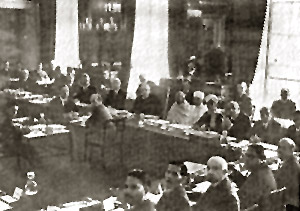
Role of B.R. Ambedkar in drafting Indian constitution has been immense. With the independence of India on 15th August 1947 the leadership of Indian national congress invited Dr Ambedkar to serve for the nation as the first law minister - which is gladly accepted. Few weeks later he was also appointed as the Chairman of the Constitution Drafting Committee, charged by the Assembly to write India`s new Constitution.
Many well-known scholars have defined the Indian constitution in their own way like Granville Austin has described the same as "first and foremost a social document". The majority of India`s constitutional provisions are either directly arrived at furthering the aim of social revolution or attempt to foster this revolution by establishing conditions necessary for its achievement."
The text that was prepared by Dr B.R. Ambedkar also offered constitutional assurances and security for a wide range of civil liberties for individual citizens, which included freedom of religion, the elimination of untouchability and the banning of all types of discrimination. B.R. Ambedkar also worked for widespread financial and social rights for women society, and also won the support of Assembly for bringing in a system of job reservations in the Indian Civil Services, schools and colleges for members of planned castes and scheduled tribes, a system similar to positive action. Lawmaker`s of India wished to get rid of the socio-economic inequalities and be deficient in of opportunities for India`s miserable classes through this way. The Constitution of India was adopted on 26th November 1949 by the Constituent Assembly.
In 1951, B.R. Ambedkar at last submitted his resignation as a member of the cabinet, following the standing in parliament of his draft of the Hindu Code Bill that required explaining gender equality in the laws of inheritance, marriage and the economy.
In the year 1952, Dr Ambedkar independently contested an election to the lower house of parliament, the Lok Sabha, but lost the contest. He was appointed to the upper house, of parliament, the Rajya Sabha in March 1952 and would remain as member till death
Social Role of B.R. Ambedkar
Social role of B.R. Ambedkar has left a huge mark among the people of India, specially the people belonging to the lower caste. B.R. Ambedkar was educated by the Princely State of Baroda and was bound to serve that State. He was also appointed to the Gaikwar of Baroda as Military Secretary but had to quit within a very short span of time. He later, gave a vivid description of this incident in his autobiography in Waiting for a Visa.
Thereafter, he also tried to find various ways to make a living for his large and growing family. He started out as a private tutor then worked as an accountant, shifting to investment consulting business. But it failed when his client learned that he was an untouchable. In the year 1918, B.R. Ambedkar, became a professor of Political Economy in the Sydenham College of Economics and Commerce in Mumbai. Though he was very successful as a student but he was barred from sharing the same jug of drinking water they all used.
B.R. Ambedkar was actually invited to testify before the South borough Committee that was readying the Government of India Act 1919. At this very hearing, Ambedkar also argued for creating separate electorate and reservation for untouchables and other religious communities. The very next year -1920, he, with the assistance of Chatrapati Shahu Maharaj I (1884-1922), Maharaja of Kolhapur, started his publication of the weekly Mooknayak (Leader of Silent). B.R. Ambedkar used this particular journal criticize orthodox Hindu politicians and perceived reluctance of Indian political community to fight the difference of caste.
The speech at a Depressed Classes Conference in Kolhapur impressed the local state rulers, Shahu IV, who described Ambedkar as the "future national leader" and shocked orthodox society by dining with him. After resigning from the post of teaching he returned to London depending on his own savings, supplemented by loans from the Maharaja of Kolhapur and his associate, Naval Bhathena. He then returned to London School of Economics and to Gray`s Inn to read for the Bar. He lived in a dire state - in poverty, and studied constantly in British Museum. In the year 1922, he also completed a thesis for M.Sc (Economics) degree at London School of Economics, and was also called to the bar. He also had submitted a PhD thesis in economics to the University of London.
Ambedkar established a successful legal practice as well and in the year 1926 he quite effectively defended three non-Brahmin leaders who had accused the Brahmin community of ruining India and were then subsequently sued for libel.