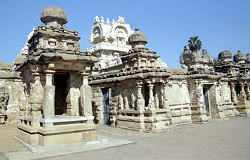
 Kailasnatha Temple is one of the oldest temples of Kanchipuram, Tamil Nadu. Built in 7th century this temple is known for beautiful architecture. Surrounded with beautiful curvatures, pillared halls and vestibules, pyramidal towers and frescos this is one of the well maintained temples of Pallava dynasty. Dedicated to Lord Shiva this temple was built by the Pallava rulers. Its construction began during the reign of Narsimha Varmana II who is also known as Raja Simha but was completed during the reign of his son Mahendravarma III. Depicting the architecture under Pallava dynasty this temple contains some fabulous structures of Lord Shiva in his Natraja form. Along with its sculptures it is also known for the vimana or the gopuram.
Kailasnatha Temple, also known as Kailashnathar Kovil, displays a unique architecture. It has its main sanctum facing the east side. The rear wall of the temple has a sculpture of Somaskanda (Lord Siva and Uma with son Muruga in the centre), which was always seen in Shiva temples of the Pallava age. There is a large sixteen-sided `Shiva linga` in the temple shrine here. This linga is about eight feet in height. In the temple there is a small passage which begins from the entrance of the garbhagriha and round the shivalinga. It starts from the right side and ends on the left side of the lingam. The Shiva linga inside is 8ft-10ft tall and carries a strip which is a unique feature of this particular lingam. According to the priests of the temple the narrow passage was built deliberately in which the devotees have to crawl and begin their rotation from the right and finish on the left side of the lingam. The process of crawling signifies that man crawls in his initial stage and learns to grow slowly and gradually while he again has to crawl in his later stage. In this way Lord Shiva ensures that there is no punarjanma if one is successful in completing the rotation.
Kailasnatha Temple was once visited by Rajaraja Chola I who named this temple as Kachipettu Periya Thirukatrali (Stone Temple of Kachipettu) which is the original name of Kanchipuram. It is also believed that after being inspired the sculpture and architecture of this temple he built the Brihadeeswarar temple in Tanjore.
Besides the Shiva lingam and the surrounding passage. The Kailasanatha temple has many attractive sculptures, which portrays the different manifestations of Lord Siva like Dakshinamurti, Lingodhbhavamurti, Gajasamharamurti and many others. These sculptures also depict Siva in various dance poses that speak of the skill and deftness of the Pallava sculptors and master craftsmen. The temple is also known for the fine pillars which surround the mandapa of the temple. From the entrance the temple has numerous pillars and panels which are rich in ancient sculptures. Commonly they contain the structures of lion and figures of Hindu gods and goddesses along with beautiful structure of Natraja. This makes it one of thoroughly decorated temples of Kanchipuram that depicts pallava style of architecture. Presently the temple is maintained by Archaeological Survey of India. There is a `Somaskanda` panel in the Kailasanatha temple, which is said to be the original image worshipped here. There is a lingam on the rear wall, which belonged to a later age. The row of fifty-eight miniature shrines on all four sides of the courtyard of this temple-complex facing the main temple is very remarkable feature of the temple. All these shrines here are of square shaped and are of sandstone. There are very gorgeous sculptures found inside the inner wall and on some of them the `Somaskanda panel` can be found. There is small gopuram at the entrance of the temple.
Thus with its well known sculptures and architecture it is considered as one of the oldest temples of South India.
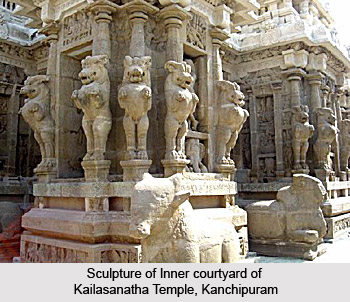 The sculpture of Kailasanatha Temple, also known as Kailash Temple, is one of the finest examples of Indian rock cut architecture of the Pallava era. It is located in Kanchipuram. This structure dates back to the 8th century. It is a fine example of `sandharaprasada` which means containing two walls providing an ambulatory. The temple has been sculpted in such a way that it is reminiscent of Mount Kailash. Hence it has been named `Kailasanatha.` It is situated in the
 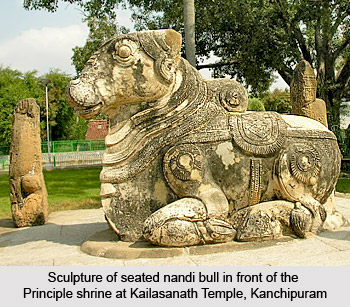 The courtyard of temple has not been left empty. There are two structures in the courtyard. In front of the principle shrine a seated image of Nandi bull has been sculpted. This shrine has been further decorated with intricate and detailed carvings. While taking a look at the base of the temple structure it would appear as if elephants are holding the structure in its place. Inside the temple the pillars have been decorated widely with lions and at times with elephants, nagas and bhulas.
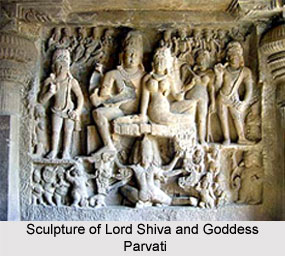 Ellora Kailasanathar temple is covered fully with exquisite sculptures. This temple is the world`s largest monolithic structure. The great block of residual rock was carved into the three- storeyed vimana, the main mandapa, two giant dhwajasthambas and four sub- shrines.