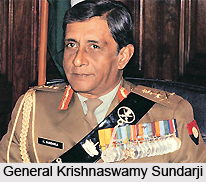
 General Krishnaswamy Sundarji was born on 28th April 1930 at Chengelpet in Tamil Nadu. He belonged to Hindu upper caste family(Tamil Bramhan).His family was not orthodox. He received his education from the Madras Christian College. He was very brilliant student .His teachers wanted him to be a doctor but his aim was to be an army man.So he joined the the Defence Services Staff College (DSSC) at Wellington.After passing graduation from there General Krishnaswamy Sundarji moved to US studied at the Command and General Staff College at Fort Leavenworth. Then he came back to India and got admitted to National Defence College in New Delhi.
General Krishnaswamy Sundarji also did his M.A in International studies from Allahabad University and M.Sc in Defence Studies from Madras University.
In 1946 General Krishnaswamy Sundarji was commissioned into the Mahar Regiment.At that he worked in the most difficult terrain in South asia.One is North-West Frontier Province and another is Jammu and Kashmir.During the war against Pakistan he bravely fought in the Kargil sector.
As part of UN mission General Krishnaswamy Sundarji was sent to Congo in 1963 as a chief staff of Katanga command.For his exceptional command he was mentioned in dispatches of the British Government.During the war against Pakistan in 1965 General Krishnaswamy Sundarji was recalled to India and commanded the Infantry battalion.He served as a Brigadier General Staff of corps in the Rangpur sector of Bangladesh, during the war against Pakistan in 1971. General Krishnaswamy Sundarji promoted to the rank of Major General in 1974.In this time he was selected for the technologically oriented special team of Indian Army. General Krishnaswamy Sundarji supported the nuclear policy of India as a senior officer of Indian Army and as a member of the core team created nuclear policy discussion. In 1984 he led the Operation Bluestar to drove the Khalistani seperatists out the Golden Temple,Amritsar . General Krishnaswamy Sundarji later told - "We went inside with humility in our hearts and prayers on our lips" According to his wife, after this incident Sundarji emerged a changed man.
In 1986 General Krishnaswamy Sundarji assumed the charge of the Chief of Army Staff of India. As the chief of the army he planned the operations at Sumdorong Chu in 1986 to evict the Chinese army from Sumdorong Chu. General Krishnaswamy Sundarji used mordern technology and equipments to combat with Chinese force.But at last India faced humiliating defeat in 1962. He was also associated with Operation Brasstacks in 1986.Under his tenure India sent troops to Srilanka to disarm the LTTE militants.But Indian faced difficulties to fight against LTTE as they had no experiences in jungle warfare.Later this Indian Peace Keeping Force was withdrawn.
General Krishnaswamy Sundarji was a good thinker.He always tried to bring modernization in the Indian Army.While he was the commandant of combat college at Mhow, he advocated for speed, decisive action, technology and his abiding love - armour through writing. General Krishnaswamy Sundarji wrote the book "Blind men of Hindoostan" in order to throw light on the nuclear policy of India. He also penned autobiography titled `Of Some Consequence: A Soldier Remembers`, which was partially completed . General Krishnaswamy Sundarji breathe his last on February 8, 1999 at the age of 69.