 Botanical name: Hyssopus officinalis Linn
Family name: Labiatae
Indian names are as follows:
Hindi:Zufah-yabis
Urdu:Zufah.
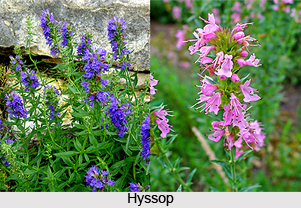
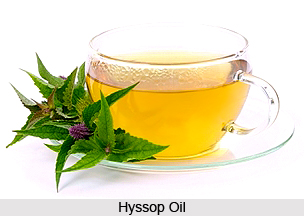
Hyssop is an aromatic, perennial shrub 30 to 60 cm high, found in the Himalayas from Kashmir to Kumaun at altitudes of 2435 to 3335 meters. It is native of Southern Europe and temperate zones of Asia. Branches are erect or diffuse; leaves sessile, linear-oblong or lanceolate, obtuse, entire; flowers bluish purple, in auxiliary tufts arranged unilaterally on terminal branches; nut lets dark brown, narrow, trigonous, smooth. Leaves and flower tops constitute the condiment or spice.
The herb contains volatile oil, fat, sugar, Choline, tannins, carotene (108.1 mg/100 g.) and xanthophylls (355.6 mg/100 g.). The tops contain ursolic acid (0.49 %). A glucoside diosmin, which on hydrolysis yields rhamnose, glucose and the aglucone diosmetin (4`-methyl luteolin), has also been isolated. Hyssop is stated to yield a grayish green dye. The fresh herb contains iodine in a concentration of 14 mcg/kg.
A volatile oil is obtained by the steam distillation of the aerial parts of the plant. The yield of oil is 0.15 to 0.30 % from fresh and 0.3 to 0.8 % from dried materials; the maximum yield is obtained from plants harvested just after the blossoms open. The oil obtained from all over ground parts of the plant is of uniform quality. Hyssop oil is colorless or greenish yellow with an agreeable aromatic, somewhat camphoraceous odor, warm and slightly bitter taste.
The leaves and flowering tops of hyssop have an agreeable aromatic odor, warm and pungent and bitter taste. They are employed as flavoring for salads and soups, and also in the preparation of liquor and perfume. Occasionally, the green tops are used as potherb.
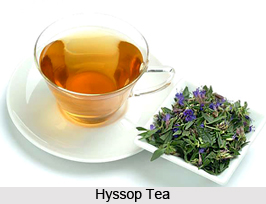 Hyssop is considered stimulant, carminative and pectoral. They are used in colds, coughs, consumption and lung complaints. An infusion or tea prepared from the plant is said to be effective in nervous disorders, toothache and in pulmonary, digestive, uterine and urinary troubles. Leaves are stimulating, stomachic, carminative, useful in hysteria and colic. The leaf juice is employed for the expulsion of round worms. The crushed herb is applied as a resolvent and vulnerary. Infusion of the plant is reported to be useful in asthma and coughs. Steeped in hot water, it is used for fomentation of wounds, sprains and strains, muscular rheumatism and for clearing discoloration of skin due to blows.
Hyssop oil is used as a flavoring agent in bitters and tonics, especially in French liquors. It is also used to some extent in perfumes with a spicy odor. In small dose the oil promotes expectoration in bronchial catarrh and asthma. It produces mild clonic convulsions when injected intravenously.
Hyssop Tea
Recipe
Take 1 dessert spoon dried herb in 1/4 litre boiling water. Leave for 10 minutes. Drink 2-3 cups a day. You can add sugar or honey to taste. Take this hyssop tea as soon as the symptoms develop for colds and flu. Use also for indigestion and a `nervous` stomach. Add with equal parts of White Horehound and Coltsfoot for coughs and bronchitis. Take in equal parts with Boneset, Elder Flower and Peppermint for the common cold. Take neat for pleurisy.
For black eyes soak a compress in hyssop water, it`s cheaper than steak! It can also be used to calm insect stings.
Hyssop Essential Oil
Hyssop essential oil is used to relieve tension and stress. As with all essential oils add a few drops of the essential oil to a carrier oil. Massage this oil into the aching area. It is also used for viral infections, hay fever, eczema and circulatory problems.
Massage hyssop oil into the soles of the feet, or into the aching area when suffering from gallstones.
Add a few drops of hyssop oil to a cold compress to clear bruises. It has been used for treating people who have undergone face lifts!
Massage 10 drops of hyssop essential oil, mixed with 20ml almond, or sunflower oil, on the chest for bronchitis and colds. You can add a thyme or eucalyptus.
 You can add 5-10 drops of essential oil to your bath when you feel nervously exhausted or are just `down in the dumps`.
Note: Do not use this oil if you are suffering from epilepsy.
Hyssop Benefits
Hyssop is used for disorders of the cardiovascular system. As it is both stimulating and sedative, it can regulate blood pressure whether high or low. Infusion of the hyssop leaves are also used to improve digestion, suppress coughs and relieve intestinal congestion.
Hyssop is available from health food stores and herbalists.
Precautions: Do not use for periods longer than a few weeks. Usage should also be avoided during pregnancy.