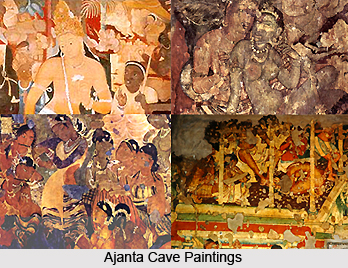
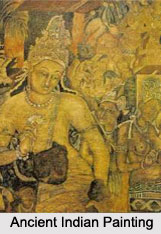
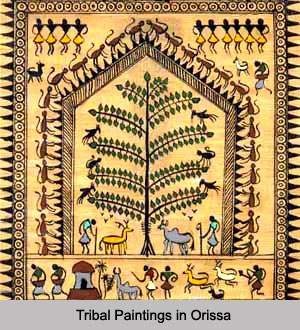
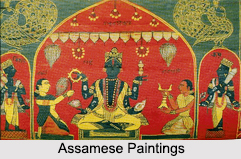
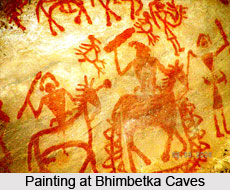
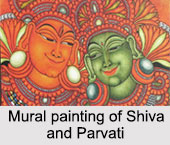
 Indian Mural Paintings are paintings made on walls of caves and palaces. The earliest evidence of murals is the beautiful frescoes painted on the caves of Ajanta and Ellora, also on the Bagh caves and Sittanvasal. In the old scripts and literature, there were many evidences of mural paintings.
According to Vinaya Pitaka, the noted courtesan of Vaishali, Amrapali employed painters to paint the kings, traders and merchants of that time on the walls of her palace. There are also numerous references in prehistoric texts to `Chitragaras` or galleries maintained by the kings and rulers.
History of Indian Mural Paintings
The history of Indian murals begins in earliest and early medieval times, from 2nd century BC to 8th - 10th century AD. There are more than 20 locations in India containing murals from this period that mostly includes natural caves and rock-cut chambers. The earliest surviving mural paintings in the Indian subcontinent are those of Ajanta. The paintings of Ajanta were made in two phases and the oldest dated to around the 2nd century B.C. The wonderful final phase was around the 5th century A.D., under the patronage of the Vakatakas.
Features of Indian Mural Paintings
The Mural Paintings are comparatively different from all other forms of illustrative art. The two major characteristics which make them significant are their organic relation to architecture and broad public importance. The Indian murals are rich in expressive practicality.
The utilization of colour, design, and thematic treatment in mural paintings has the capability to bring about an extreme change in the sensation of spatial proportions of the building. Mural Paintings are the only form of artwork which is truly three-dimensional, since it modifies and shares a given space.
The colour materials on the mural paintings in ancient India were derived from the natural materials like terracotta, chalk, red ochre and yellow ochre mixed with animal fat. The subjects included the figures of human beings and animals, hunting, family scenes, court life, deities and stories from Budhhist `Jataka`. The ancient painters did the murals with expert hands and observant eyes. This is evident from the cave paintings of Ajanta, which were made during second century BC and continued till the 5th-6th century AD by the decorative motifs, crowded compositions, figure types and details of costumes. The other significant mural paintings of this period are found at Bagh in Madhya Pradesh, caves of Badami in Karnataka, Sittannavasal in Tamil Nadu and the Kailashanatha temple in Ellora, Maharashtra of 8th century AD and known for their linear styles.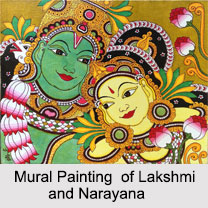
Mud plaster had been applied in two coats - the first was rough in order to fill in the pores of the rocks and then a final coat of lime plaster is applied over it. The Mural painting took place in stages. The line is drawn in red ochre the colours are applied & the contours are renewed in brown, deep red or black. The pigments that were required for the paints were from local volcanic rocks with the exception of lamp black. Animal glue and vegetable gums were also used. The facial expressions were highlighted by patches of light colours. In order to create illusion of depth various methods were used.
Different types of Indian Mural Paintings
Following are the different Indian mural paintings:
•Tempera Painting: Tempera painting is done by preparation of pigment into a water-miscible medium. These paintings are aimed at bringing desired consistency in the artwork while inculcating architectural fundamentals.
•Oil Painting: Oil Painting is a standard of painting in oil colours which grips suspension of pigments into drying oils. This technique offers an exceptional mixture of tones or colour which provides it a differentiated exclusivity among other fluid painting mediums.
•Fresco Painting: Fresco Painting is an ancient practice that engrosses painting of water-based pigments on recently applied plaster, usually on wall façade. The colours to be used in paintings are prepared by grinding dry-powder pigments in pure water.
•Encaustic Painting: Encaustic painting practice involves combination of pigments with hot, liquid wax, which are applied regularly over the painting plane. It is followed by pressing of a heating part over them until the individual brush marks vanishes to make up a thin & even layer.
Popular Indian Mural Paintings
In Arunachal Pradesh and Tripura sublime mural works have been found. Ladakh is known for its wall paintings in Alchi and Hemis monasteries, made on 11th-12th century and the Spiti Valley in Himachal Pradesh is known for its Buddhist paintings in the gomphas of Tabo Monastery.
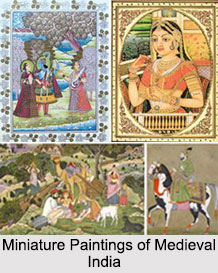
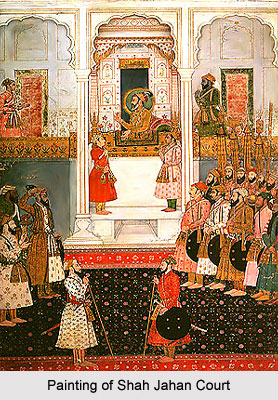
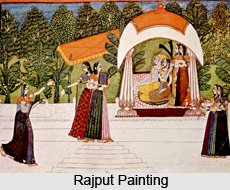
North India has a rich heritage of mural paintings even before the Mughal period. The murals at the Vishnu Temple located at Madanpur in Lalitpur district of Uttar Pradesh of 12th century AD reveals the skilful hands of the painters. Though the Mughal era is known mostly for the miniatures, the enthralling murals embellished on the walls of forts and palaces of Akbar and Jahangir quietly speaks of the influence of Persian styles. The Mughal painting traditions influenced the Rajput painting. The wall paintings in Deeg, Bundi, Jaipur, Ajmer, Jodhpur and other places in Rajasthan are quite convincing.
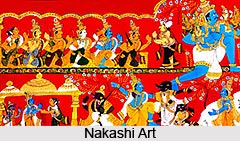
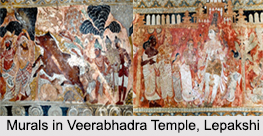
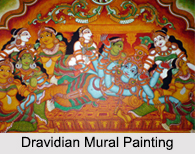
South India also got rich tradition of mural paintings. In the reign of Cholas, Vijayanagaras and Nayakas, this art reached the climax. The Deccan art of Bijapur, Hyderabad, and Golconda schools were influenced by the Mughal traditions and later by European idiom. Maratha murals are also shaped under the Mogul traditions and employed oil as medium. The mural art of Kerala vividly depicted on the walls of temples and monuments show traces of European affinity.