Emblem of India - Informative & researched article on Emblem of India
  Indianetzone: Largest Free Encyclopedia of India with thousand of articles Indian Administration


in  
Art & Culture | Entertainment | Health | Reference | Sports | Society | Travel
Forum  | Free E-magazine
Indian Administration : Constitution of India l Government of India l State Governments in India l Indian Judiciary l Indian Economy l Constitutional Bodies in India l Indian Civil Awards l Local Self Governments l Indian Political Parties l Foreign Relation of India l Indian Government Departments l National Symbols of India l Indian Media l Indian Armed Forces l Council of Ministers of India l Indian Coins l Indian Political Culture l History of Indian Administrative System l District Administration in India l Regional Administration in India l Distribution of Power between Centre and States
Home > Reference > Indian Administration > Constitution of India > Emblem of India
Emblem of India
The Emblem of India symbolizes power, courage and confidence and was adapted by the Indian Government on 26th Jan,1950.

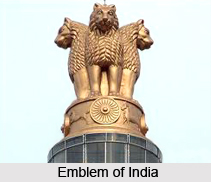
Emblem of IndiaThe Emblem of India has been taken from the Sarnath Lion Capital of Ashoka. The Indian Government adapted it on 26th January 1950; the day India became a republic. In the National Emblem, only three lions are visible, the fourth lion is hidden from the view. The lions are placed on the abacus.

The abacus is encircled with smaller animals has a bull on the west, a galloping horse on the south, an elephant on the east and a lion on the north, which are separated by overriding wheels over a bell shaped lotus. At the centre of the abacus, there is a chakra (wheel), which is the symbol of Dharma (Eternal wheel of law). The words Satyameva Jayate (truth alone triumphs) have been inscribed in Devanagari script below the abacus, which has been taken from the Mundaka Upanishad.

The National Emblem of India is the official seal of the President, and the Central and the State Governments. The emblem is the epitome of India`s sovereign nationhood and appears on all Indian currencies. It is used for official purposes and is among the most respected symbols of India. It symbolizes power, courage and confidence.

(Last Updated on : 12/01/2009)
  More Articles in Constitution of India
 
Constituent Assembly of India Indian Parliament Emblem of India
Architect of India`s Constitution Indian Citizenship Election Commission of India
Article 370 Preamble of Indian Constitution Fundamental Rights
Fundamental Duties Directive Principles of State Policy Amendment of Indian Constitution
Salient Features of Indian Constitution Making of Indian Constitution  
Recently Updated Articles in Indian Administration
  • Mathrubhumi
    Mathrubhumi, a Malayalam newspaper founded by K. P. Kesava Menon, played crucial roles in the social reformation movements like Vaikom Satyagraha and Guruvayur Satyagraha.
  •  
  • Fundamental Duties
    Fundamental Duties were added in the Constitution of India by the 42nd Amendment Act and are identified as the moral obligations of the civilians
  •  
     
  • Constitution of India
    Constitution of India presents the ultimate law for the country. It includes the political principles, procedures, powers, and duties of government institutions, directive principles and the duties of populace.
  •  
  • History of Indian Army
    History of Indian Army dates back to ancient India. From the ancient era to the modern age Indian army has evolved through the ages, with the bravery of Indians.
  •  
  • Bharat Ratna
    Bharat Ratna is the highest civilian award of the Republic India. This award is given for the highest degree of service to the nation. The award was established by the India`s first President Rajendra Prasad.
  •  
    E-mail this Article | Post a Comment
    RSS Feeds
    Forum
    Forum on Indian Administration

    Free E-magazine
    Subscribe to Free
    E-Magazine on Indian Crafts
     
     
    Emblem of India - Informative & researched article on Emblem of India
    Sitemap
    Contact Us   |   RSS Feeds
    Copyright © 2008 Jupiter Infomedia Pvt. Ltd. All rights reserved including the right to reproduce the contents in whole or in part in any form or medium without the express written permission of Jupiter Infomedia Pvt. Ltd.