Clothing styles were affected due to the climatic changes as well as the availability of raw materials in the region. With the evolution of various weaving techniques different types of clothing gained ground. The hotter regions had mostly the prevalence of unstitched garments whereas at some places we do see stitched or core garments. Vegetable bark, animal skins and subsequently felted fibers and woven yarns were used. Fabric was a precious commodity and from very early on, decorative elements were incorporated into the fabric during the weaving process. Starting from the earliest times, The Indus Valley Civilisation gives us the evidence of earliest textile production in India. The tradition of these people centered around the fertility cults , worshipping the deity of procreation , infusing creative power in them. And this eventually affected the clothing style and its various developments. From the middle of the second millennium BC, Indo - European or Aryan tribes migrated into North Western India in a series of waves, resulting in a fusion of cultures. This is the very juncture when new dynasties were formed resulting in the flourishing of clothing style of which the `Uttariya` forms a major part.
The post-Vedic texts gives us a somewhat clear views about the techniques of clothing and its development though there is no visual evidence of the Vedic times. By the end of the Vedic period, with the establishment of the Maurya empire there was also a boom in the trade and commerce of the country. A lot about the clothing of this period is learnt by the sculpture and other forms of art prevalent in this period. Dominated by the representations of nature and fertility, the yaksha is shown wearing an antariya, with a kayabandhan and an uttariya, the heads are invariably turbaned. While the Satvahanas controlled some parts ofcentral and south India, the north was invaded by various tribes. Like the Kushans , descendants of the Yue-chi tribe of North - Western China, had established a kingdom which extended as far as Sanchi in the South and Varanasi in the East. The consolidation and control of trade routes between India, Central Asia, China and the West brought prosperity to the Kushan empire and resulted in a thriving textile trade. The uttariya, antariya and kayabandhan feature alongside gowns, tunics, blouses with buttons, skirts and paijamas, quilted coats, Greek chitons, kaftans, and high boots. Kushan kings preferred the structured forms of their Scythian clothes to the looser Indian styles. They introduced a new structural dimension to the organic styles of Indian clothing.
Uttariya as the draping material is known since ages has been connected with the royal dressing as well as religious accessory in different ways. Before talking about the usages and other details it would be necessary to comment on the origin of uttariya in the Indian way of life. Lets begin from the ancient times of the Mauryan, Kushana, Sunga periods [321-72 BC]. Among the three unstitched garments from the vedic times - the antariya, kayabandh and uttariya , uttariya is the one which still at present times carry huge significance in our Indian tradition. Uttariya was of usually fine cotton, very rarely silk, which was utilized as a long scarf to drape the top half of the body. The gupta dynasty, established after many years of Buddhist dominance brought a resurgence in Hindu culture as well as religion. The queens of this dynasty mostly dressed in antariya and uttariya sometimes tunics as well.
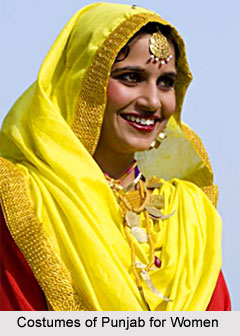
 The uttariya was worn in several ways to suit the comforts of the wearer: very elegantly by those at court, who drape it on both shoulders or one shoulder, or diagonally across the chest and casually knotted at the waist, or it could even be worn loosely across the back and supported by the elbows or wrist, and in many other ways according to the whims of the weather. But for the labourer and the craftsman, it was more a practical garment to be tied around the head as protection from sun, or tightly around the waist leaving the hands free for work, or again as a towel to mop the face when sweating. Its uses were endless for the poor sections of the society and for them it would be made of coarse cotton. The uttariyas of upper class women were of fine material with elaborate borders and often draped around the head as head covering. There were numerous ways by which it could be worn, simply it could be left to hang at the back or else secured to the head with a hairband. There was also another usage of an uttariya in the religious rites of the Hindu tradition. In olden times was worn, as the word would indicate, on the occasion of performance of sacrifice by a yajamana. It was a kind of uttariya worn over the left shoulder and under the right arm. Here uttariya actually means an upper garment worn at the time of religious ceremonies covering the upper body.
This was a very brief history of the uttariya in our Indian tradition but then its utility does not end with the ancient times when it occupied eminent position in the attires of royal households as well as the commoners. Even now at present uttariya has gained grounds as an important symbol for honour. In numerous occasions an uttariya is offered to personalities conferring honour on them by various authorities. This is also a part of clothing used in many Indian dance forms. Seems that it has embraced centuries of Indian tradition and culture and is still continuing to remain as the cynosure in various traditional ceremonies and art forms. With changes in time there has been numerous developments in weaving techniques and often this has served to be a boon for many fashion designers at present who can present Indian tradition to the masses outside India who are eager to know about this great cultural heritage. Clothing has now gone places by mingling with different cultures India and abroad and may be we have lost the predominance of uttariya as an important part of draping but then the essence of it still remains and hopefully the younger generations would not let it perish with the waves of change that has taken ovr since centuries.
No doubts the uttariya has triumphed the recklessness of time and continues to uphold the tradition and values of the Indian culture to its ultimate heights. Hence in this new progressive era too we see how an uttariya is still a part of our modern lifestyle and how we have still harked back to our ancient past even in this age when most of the tradition and values are somewhat fading.
Uttariya
The uttariya was worn in several ways to suit the comforts of the wearer.