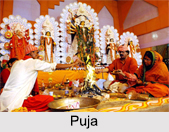
 Puja is referred to ceremonial worship of God and Goddesses in Hinduism. It may range from brief daily rites in the home to an elaborate temple ritual. Puja includes many ceremonial practices from the simplest daily offerings of flowers, fruits, leaves, rice and sweetmeats to the sacrifice of goats in temples for the worship of Kali, Durga and other female deities. Pujas can be classified into three categories; great, intermediate and small.
Steps in Performing a Puja
Any puja is conducted in the following manner:
•First comes the "Avahana" where the deity to be worshipped is invoked and a seat is offered called "Asana".
•Next, the deity is welcomed where the devotees honour the deity and anoint or smear with sandalwood paste or vermillion called "Swagata".
•"Padya" is the next step where the feet of the deity are washed with water.
•"Arghya", the next ritual is the offering of water to the God and the water is mixed with sandalwood paste, vermilion and rice.
•"Snanajala" is the next step of offering water to the deity.
•"Abharanasya" is the stage where clothes, jewels and ornaments are offered.
•The last and the final stage where the deity is given a farewell "Visarjana".
•All pujas end with an Aarti.
 The distribution of "Prasada" to devotees and applying of "Tilak" is the most important part of any puja. Puja also involves japa or meditation. The most important aspect of puja is that a devotee should have a pure body and mind. The Puranas lay more stress on the quality of devotion and good behaviour than on rigid puja procedures.
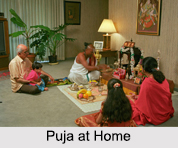
Puja at Home
Every Hindu home normally has a special room for puja, a sacred space set apart for honouring and worshipping the Gods. The pujas that take place everyday in a house are the foundation of all family actions and decisions.
Puja at Temple
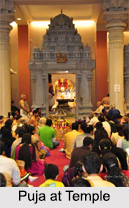 A Hindu temple is the earthly seat of the deity where it is believed that God wait for the devotees. Hence, temple structures are sacred places where God grants human offerings and where people can be with God. So the temples" atmosphere is always serene and tranquil. Many temples often resemble the structure of palaces, as God is often considered as King.
Puja in Religious Festivals
There are also puja performed in open air during religious festivals. The pujas that take the form of religious celebration are like Durga puja in Bengalis, Ganesha puja among Marathis, Shiva puja, Kali puja, Laxmi puja, Saraswati puja, Narayana puja, etc.
Puja is considered as a multi-sensory experience to the Hindu devotees. The worshipper offer the God with the lightened lamps, touches the ritual objects and the feet of the deity, hears the ringing of the bells and the holy chants being recited, smells the incense and taste the blessed food offered at the end of the ritual.
Puja
Puja is the Hindu act of worshipping a deity through prayers, songs and rituals.