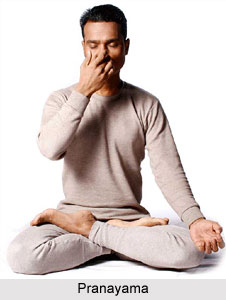
 Pranayama is the formal practice of controlling the breath, which is the source of Prana, or vital life force. It is a process by which the mind is controlled by voluntary regulation of the breathing. From yogic point of view it is a path that connects one`s physical existence and the spiritual consciousness. According to Patanjali, a slightest change brought in the normal speed of breathing is "Pranayama". Also systematically controlled and prolonged inhalations and exhalations constitute Pranayama. Obviously to do this a voluntary control is necessary. In normal breathing also, there is a pause between inhalation and exhalation that may be only for a few milliseconds. Therefore voluntary control brought on any one of the three, i.e., inhalation, exhalation, the pause, or on all three, will be called "Pranayama".
Etymology of Pranayama
The word Pranayama is formed by 2 words i.e., "Prana" and "Ayama". "Prana" means life force, which provides energy to different organs and also controls many vital life processes, like respiration and circulation of blood. "Ayama", on the other hand, signifies the voluntary effort to control and direct the Prana. 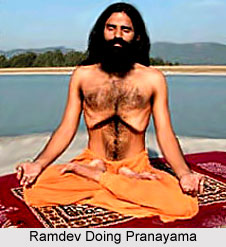 Breathing is one of the vital activities governed by Prana, considering that the mind could be controlled effectively with the voluntary regulation over breathing.
Types of Pranayama
Rishi Patanjali has explained 4 types of pranayama on the basis of a temporary suspension of breath. These types are:
1. Pause after or at the end of the prolonged (deergha) and very slow (manda) exhalation (prashwas).
2. Pause after or at the end of deep and prolonged inhalation (shwas).
3. Pause is brought any time one wants to bring for a considerable time. It may be somewhere in between the usual inhalation or exhalation. This is a prolongation of a break in the breathing (stambhavritti).
4. The practitioner experiences pause at any time without his voluntary efforts, after a long practice of above 3 types of pauses.
As per yogic literature, when breath is held after exhalation, it is known as "Bahya Kumbhaka"; when the breathing is stopped after inhalation, it is known as "Abhyantara Kumbhaka" while the fourth type of pause as mentioned above which comes automatically after a long practice of Pranayama, is known as "Keval Kumbhaka". Effect of each type of Pranayama is also different on the physical, mental and on the spiritual levels.