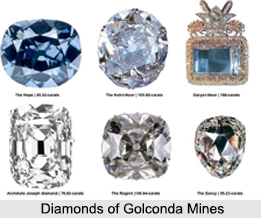
 From the dark waters of anonymity, most of the world`s ancient diamonds seem to have unexpectedly reappeared during the last century. Their pasts like their earlier owners, journeys and adventures are still mysteriously unknown; they either are so unformulated or go unregistered as to have no significance in their study. A few of these old gems have become so engrossed in myth over the years, and legend that categorization out actuality from castle in the sky would take many years for even the most meticulous researcher.
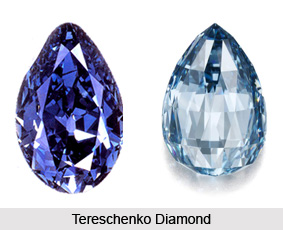
There is one such diamonds, whose story surfaces as late as the 20th century namely the Tereschenko. Whereas it is known that this pear-shaped conjure blue stone was unearthed in the Kollur alluvial deposits in Golconda. But it remains a mystery as how it made its journey to Russia.
The Tereschenko family, the sugar barons of Russia was the first recorded owners of the diamond. Mikhail Tereschenko, in 1915, asked the jeweler Jacques Cartier to set the stone as the centerpiece in a necklace made with an assortment of fancy-colored diamonds. Mikhail Tereschenko later became the minister of foreign affairs. As Cartier described their color like luscious, crystallized fruit, as "jonquil, lemon, aquamarine, sultana-green, gold button, grey, blue, crevet, lilac, rose, old port, madeira and topaz". The beautiful necklace was a masterpiece of shimmering colours, without hesitation. In all probability the Tereschenko was dislodged from the necklace in the year 1917, just before the Russian Revolution took place. The diamond smuggled out of Russia by its owners, and sold to a private buyer.
After spending nearly seven decades in reclusive splendor, the gem comes into public view only when Christie`s declared that they would be auctioning the fourth largest recorded fancy blue diamond in 1984. Christie`s chairman announced the start of the bidding at 3 million Swiss francs, on November 14, 1984 at 10 pm, in the middle of the animated buzz of buyers at Hotel Richmond. After forty seconds, the bidding reached 6.5 million, far beyond the price expected by even the most experienced auctioneers. The Tereschenko was finally pulled down to Robert Mouawad, who paid 10 million Swiss francs i.e. £3,180,000 for it. It was unquestionably a record price for a diamond ever.
Whatever its price today, a diamond is forever; The diamond represents the most compact and portable of investments at 142 carats to an ounce because a beautiful diamond weighing even half as much can easily get a hold of millions of dollars. It is comprehensible why no one is ever surprised by very expensive diamond prices. The exhilarating race to acquire them continues.