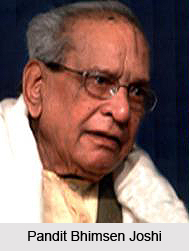
 Pandit Bhimsen Joshi was an Indian musician and vocalist in the Hindustani classical tradition. He is acknowledged as the leading light and descendant of the Kirana Gharana. Pandit Bhimsen Joshi is the renowned Khayal Singer of Hindustani classical music tradition. He is also celebrated for his popular renditions of Abhangs and Bhajans and other forms of devotional music. In the year 2008, Pandit Bhimsen Joshi was bestowed with India`s highest civilian honour, the Bharat Ratna.
Early Life of Pandit Bhimsen Joshi
Bhimsen Gururaj Joshi was born on 14th February 1922, in the town of Ron, in Gadag District of Karnataka. He was the eldest in a family of 16 siblings. Pandit Bhimsen Joshi was born to a conservative schoolmaster Gururaj who has written a slender book in Kannada, Naad-Putra, chronicling the life-story of his illustrious son. He would often be seen standing entranced outside a record shop on the main street of Gadag, listening to Fagwaa Brij Dekhan Ko, a Raag Basant composition rendered by Ustad Abdul Karim Khan.
At the age of 11years, Joshi left his home to learn singing through the master-disciple tradition or Guru-Shishya tradition. He spent three years in Gwalior, Lucknow and Rampur in North India trying to find a good teacher.
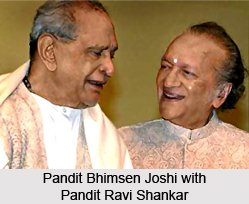 Ustad Hafiz Ali Khan, who was the most prized musician of the Scindias durbar of Gwalior, took Joshi under his wings and taught him the rudiments of Raag Maarwa and Raag Puriyaa. Joshi later, in 1936, trained under Sawai Gandharva, who was the main disciple of Abdul Karim Khan. Sawai Gandharva and his cousin Abdul Wahid Khan were the founders of the Kirana Gharana school of Hindustani music. Pandit Bhimsen Joshi was taught in the basics of Khayal-Gayaki. Rigorous Riyaaz or practice was followed by hours of household responsibilities, done dutifully as a mark of service to the hard-to-please guru. Between 1936 and 1940 Pandit Bhimsen Joshi stayed with Sawai Gandharva from where he started his rigorous training under him. Joshi perfected the patterns of Raag Multaani or Raag Todi.
Personal Life of Pandit Bhimsen Joshi
Pandit Bhimsen Joshi married to Vatsalabai, who was credited with having effectively intervened to wean her illustrious husband away from the alcohol. Bhimsen Joshi was also very passionate about cars, a football player and an enthusiast of yoga
Career of Pandit Bhimsen Joshi
In the year 1941 Bhimsen Joshi gave his first live performance at the age 19. The next year, in 1942, he released his debut album consisting of devotional songs in Kannada Language and Hindi Language through the record label of HMV. After he moved to Mumbai in 1943, he worked as a radio artist there.In the year 1946, he did a public concert in Pune to mark the Shashtyabdipoorti, the 60th birthday, of his guru Sawai Gandharva, which got him several accolades both from the audience and his guru. In the early 1970s, with Sant-Vaani, a four-hour concert of devotional music that blended Purandara Dasa with Kabir has been both a commercial success as well as an artistic accomplishment for him.
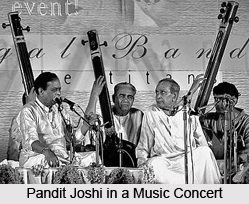 His training under Sawai Gandharva came to a sudden end because of some misunderstanding; Pandit Bhimsen Joshi went once again on a tour of north India. After leaving his guru he set out on his own with a strict regimen of up to 16 hours of daily Riyaaz. Joshi learnt to adapt to the changing times. In the modern era, he steadfastly adhered to the Khayal-Gayaki, even while striving to strike a balance between the common and the puritans. For over four decades Pandit Bhimsen Joshi has led the renaissance of Indian Classical Music with the passion and power of a one-man chorus. Pandit Bhimsen Joshi is most renowned for his famous ragas like Miyan Ki Todi, Shuddha Kalyan, Multani, Ramkali, Bhimpalasi, Darbaria and Puriya Dhanashri. Bhimsen`s devotional CDs Enna Paliso and Daaswani consisting Kannada Bhajans, Santawani and Marathi Abhangs, was also commercially successful.
Achievements of Pandit Bhimsen Joshi
Pandit Bhimsen Joshi has been honoured with the Padma Shri Award in 1972; the Sangeet Natak Akademi Award in 1976 and the Padma Bhushan in 1985. He earned the first platinum disc in the year 1986.
* 1972 - Padma Shree
* 1976 - Sangeet Natak Akademi Award
* 1985 - Padma Bhushan
* 1985 - National Film Award for Best Male Playback Singer
* 1986 - "First platinum disc"
* 1999 - Padma Vibhushan
* 2000 - "Aditya Vikram Birla Kalashikhar Puraskar"
* 2001 - "Nadoja Award" from Kannada University
* 2002 - Maharashtra Bhushan
* 2003 - "Swathi Sangeetha Puraskaram" by Government of Kerala
* 2005 - Karnataka Ratna
* 2008 - Bharat Ratna
* 2008 - "Swami Haridas Award"
* 2009 - "Lifetime achievement award" by Delhi government
* 2010 - "S V Narayanaswamy Rao National Award" by Rama Seva Mandali, Bangalore
Death of Pandit Bhimsen Joshi
On 31st December, 2010 Joshi was admitted to Sahyadri Super Speciality Hospital for the treatment of Gastrointestinal Bleeding and Bilateral Pneumonia. To ease breathing, he was put on ventilator support. But after he was taken off the ventilator, his condition worsened. Pandit Bhimsen Joshi died on January 24th 2011.
Pandit Bhimsen Joshi has added his own distinctive style, excelling in Gamakar, Meend and Tanakriya and adapting characteristics from other Gharanas to create a unique vocal idiom.
