Dvija - Informative & researched article on Dvija
 Indianetzone: Largest Free Encyclopedia of India with thousand of articlesIndian Religion


in  
 Art & Culture|Entertainment|Health|Reference|Sports|Society|Travel
Forum  | Free E-magazine  | RSS Feeds  
Indian Religion : Vastu Shastra |Indian Religions |Indian Myths |Indian Mythology |Gods of India |Goddesses Of India |Religious Thinkers of India |Types of Religion in India |History of Indian Religion |Indian Yogis |Ajivikas |Sacred Scriptures in Indian Religion |Tantrism |Shaivism |Indian Communities |Sacred Animals in India |Roman Impact on South Indian Art and Society |Bhattacharyas |Indian Classical Terms
Home > Society > Indian Religion > Types of Religion in India > Hinduism > Dvija
Dvija
Dvija is associated with the three upper castes and has nothing to do with physical rebirth or exiting the womb.

 Dvija is a Sanskrit word which means one who is twice born .It is associated with first three varnas in Hinduism. Brahmins, Kshatriyas and Vaishyas, although in many Shastras, Dvija usually refers to Brahmin only.

The "stages of life for a twice born man"is discussed in details in the Hindu Manusmriti.The concept says that a member of the Dwija are to undergo four periods of life :first as a student Brahmacharya; then, as a householder Grihastha; then, he shall live in retirement Vanaprastha; and finally, as an ascetic Sanyasi.

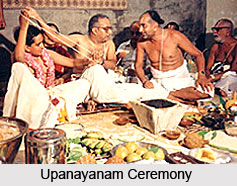
In the second stage of their life the boys belonging to these castes undergoes an initiation ceremony called upanayana, which allowed them to hear, study, and recite the Vedas, forbidden to sudras and women. Initiated members of the twice-born classes were distinguished by the sacred cord (yagyopavita, or, in Hindi, janeo), which they wore over Second Stage of Dvija - Upanayantheir left shoulder and under their right arm and never removed it in their lifetime. This thread ceremony also called Upanayanam is assumed to be the second birth of the boy, when he is initiated into the ultimate pursuit of life Brahmopadesam (Preaching/Advising in the matter of the nature of Brahman - the ultimate reality) A Dwija is governed by his Karma and his conduct has to be a cultured one. His life is governed by Dharma-Adharma (right and wrong), Karya-Akaryam (good and bad deeds) and Vidhi-Nisheda (Prescribed and Proscribed actions) as determined by Sastra Pramana. A Dwija does what he ought to do rather than what he wants to do. He does not avoid what he dislikes rather he avoids what ought to be avoided.

The Upanayanam ceremony gave a student a new status of dvija or twice born which comprised of pledging in front of sacred fire under the supervision of a priest .The symbol of Upanayanam was a sacred thread which has to be worn around the body by the boy. The sacred thread would bind him symbolically to the vow and remind him of the vow he had taken throughout his life. It would remind him of the vow to adhere to the qualities of hard work, humility, kindness, politeness and honesty.

Dvija or twice born status signified being born in spirit and undergoing a spiritual growth and mental transformations. It had nothing to do with being physically reborn or exiting the womb twice. Similarly, dvija was not related in anyway to the previous birth or reincarnation. Upanayanam acted as a preliminary exercise for a decent behaviour required for sruti learning.

However merely undergoing the Upanayanam (initiation) ceremony, acquiring the dvija (twice born) status or having (wearing) the yagyopavit (sacred thread) around one`s body was not enough to become a true Brahmin .The process to become a Brahmin lay in completing the necessary education.

(Last Updated on : 27/01/2009)
 
 
Aghora Vaishnavism Nath Siddhas
Sarvam Khalvidam Brahma Aham Brahmasmi Ayam Atma Brahma
Ekam Evadvitiyam Brahma Tat Tvam Asi Prajnaman Brahman
Brahma Satyam Jagan Mithya Mahavakyas Mahavidya Goddesses
Theory Of Creation Hindu Gods Hindu Goddesses
Shraadh Yajna Havan
Gotra Aarti Agnihotra
Devadasis Ishvara In Hinduism Devi
Grihya Sutras Dvija Hiranyagarbha
Brahman Cremation Puja
Janmotsava Shradh Anteshti Kriya
Homa Hindu Vrata Days of the Week
Ahalya Kachwaha Jyotirlinga
Brahmin Castes in India Panchangam Ashta Dikpalas
Astomi Brahmaloka Sannyasi
Samakara Hindu Sacred Places Origin of Hinduism
Hindu Religious Texts Hindu religious leaders Marudeva
Sarvesvara Lokas Papa
Maharudra Swahaakaar Yagna Conch Shell Punarjanam
Aghori Heaven Parting with money after sunset
Shraavana Sashtanga Kshama
Agrasya Sanskaras Libation
Kerari Kusha Maharajas
Chandrayana Bhagat Jiva
Devarshis Months of Hindu Calendar Varna System in Ancient India
Purohitas Hindu Rituals Pancharatra
Gorakhnathis Citta Ramanandi Sampraday
Omkara Cult of Draupadi in South India Development of Hinduism
Shaktism Places of Worship Mantra
Hindu Iconography Teachings of Hinduism Kalpa Sutras
Saura Goddess Tara in Hinduism Vaikhanasa
Matangi System Basvi System  
Recently Updated Articles in Indian Religion
Lord Subrahmanya
Lord Subrahmanya Swamy is considered to be the universal lord who blesses human beings and helps them get rid of their sins.
Gods of India
Gods of India form an inseparable part of the life of the people. Indian Gods are considered to be mysterious superhuman beings who are worshipped in this country in various forms.
Folk Gods of Kumaon
Folk gods of Kumaon have a rich history and they provide expression to the famous and popular ideas of the people.
Seven Sisters
Seven Sisters are the most famous among Dravidian deities in Southern India. The seven sisters also have a younger brother Potu Eazu.
Savitr
Savitr is a solar deity and off-spring of Vedic deity Aditi. Savitr has been mentioned in eleven hymns of Rig Veda.
E-mail this Article | Post a Comment
Forum
Forum on Indian Religion
Free E-magazine
Subscribe to Free E-Magazine on Society
 
 
Dvija - Informative & researched article on Dvija
Sitemap
Contact Us   |   RSS Feeds
Copyright © 2008 Jupiter Infomedia Ltd. All rights reserved including the right to reproduce the contents in whole or in part in any form or medium without the express written permission of
Jupiter Infomedia Ltd.