


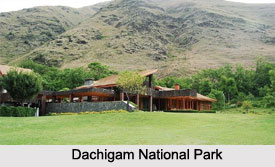
 Dachigam National Park is situated 22 km in the north-eastern part of Srinagar, the capital city of Jammu and Kashmir. Located among the Himalayan Mountains, the park is spread over 141 sq km. It is popular as the home of the rare and critically endangered ‘Hangul’ or ‘Kashmir Stag’. The park was the outcome of the then Jammu and Kashmir Maharaja’s efforts to create a game preserve and catchment area for Harwan reservoir. The reservoir supplied clean drinking water to the city of Srinagar. The park is situated at altitudes ranging from 5500 ft to 14,000 ft. Due to the variation in altitudes the park is demarcated into upper and lower regions. The park’s terrain ranges from gently sloping grasslands to cliffs and sharp rocky outcrops. Dachigam National Park is situated 22 km in the north-eastern part of Srinagar, the capital city of Jammu and Kashmir. Located among the Himalayan Mountains, the park is spread over 141 sq km. It is popular as the home of the rare and critically endangered ‘Hangul’ or ‘Kashmir Stag’. The park was the outcome of the then Jammu and Kashmir Maharaja’s efforts to create a game preserve and catchment area for Harwan reservoir. The reservoir supplied clean drinking water to the city of Srinagar. The park is situated at altitudes ranging from 5500 ft to 14,000 ft. Due to the variation in altitudes the park is demarcated into upper and lower regions. The park’s terrain ranges from gently sloping grasslands to cliffs and sharp rocky outcrops.
Foundation of Dachigam National Park The origin of Dachigam National Park has a past history. The name of the park literally stands for "Ten Villages" which might be in the memory of the 10 villages, which got dispersed due to the formation of the park. However it was initially created to ensure clean drinking water supply for the city of Srinagar. From the year 1910 onwards, it has been a protected area, primarily, under the attention and close observation of the Maharaja of Jammu and Kashmir valley. Under orders of the Maharaja, several species of trees, especially those preferred by wildlife were planted and efforts were made to increase the winter fodder available to wild animals. Later the government authority took charge of the entire park. After Jammu and Kashmir acceded to India, Dachigam was managed by the State Forest Department. Jammu and Kashmir government notified the area as a ‘Sanctuary’ in 1951 and as a ‘National Park’ in 1981. Flora and Fauna of Dachigam National Park Dachigam National Park is considered as the home to some of the unique Himalayan range of flora and fauna. More than 500 types of plants and herbs are being found here, with high medicinal values. Every one identifies the region due its wide varieties of wildlife animal species. Amongst them, the ‘Hangul’ or ‘Kashmir Stag’ is the significant. It is the rarest species of ‘Red Deer’ in the whole world. Numerous other species also reside in the park like the Snow Leopard, Hill Fox, Himalayan Black Bear, Brown Bear, Himalayan Tahr, Leopard, Yellow-Throated Marten, Leopard-Cat, Serow, Goral, Musk Deer, Himalayan Marmot, Wild Boar, Jackal, Common Langur etc. 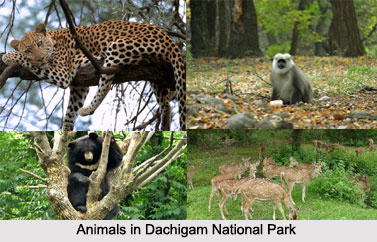 Over 150 species of birds are found here including Himalayan Monal, Koklass Pheasant, Lammergeier, Himalayan Griffon, Golden Eagle, Common Kestrel, Northern Goshawk, Tawny Owl, Kalij Pheasant, Yellow-billed Blue Magpie, Red-billed Chough, Yellow-billed Chough, Spotted Nutcracker, Ultramarine Flycatcher, Long-tailed Minivet, Wallcreeper, Himalayan Woodpecker, White-cheeked Nuthatch, Streaked Laughingthrush, Variegated Laughingthrush, Black-and-yellow Grosbeak etc. Over 150 species of birds are found here including Himalayan Monal, Koklass Pheasant, Lammergeier, Himalayan Griffon, Golden Eagle, Common Kestrel, Northern Goshawk, Tawny Owl, Kalij Pheasant, Yellow-billed Blue Magpie, Red-billed Chough, Yellow-billed Chough, Spotted Nutcracker, Ultramarine Flycatcher, Long-tailed Minivet, Wallcreeper, Himalayan Woodpecker, White-cheeked Nuthatch, Streaked Laughingthrush, Variegated Laughingthrush, Black-and-yellow Grosbeak etc.
Best Time to Visit Dachigam National Park The best times to explore these two areas are summer and winter respectively. Due to the upper region’s cold winter months, the best months for visiting here is between the months of May and August. For the lower region, the ideal time is between September and December and is also equally rewarding in the summer months. How to Reach Dachigam National Park The nearest town and airport is Srinagar is 22 km away. The nearest rail junction is Jammu at a distance of 200 km away from Dachigam National Park. A metalled road links Srinagar with Lower Dachigam. Upper Dachigam can be reached on foot. |
| |||



Dachigam National Park
| Dachigam National Park contains the last viable Hangul population in the world which is located in Srinagar. |
| ||||||||||||||||||||||||||||

