 Bhikku is the fourth philosophical tenet of Nistha or Faith. The Order of Lord Buddha asks everyone to become a Bhikku but to become a Bhikku is not an easy task. The Lord had laid down a code for the spiritual training of the Bhikkus. In order to be called a Bhikku one needs to follow the code sincerely. It has been said that a Bhikku should meditate and should be heedful. He should not allow his mind to find delight in sensual pleasures. The Bhikkus put on a yellow robe but the Lord has warned that a Bhikku who puts on a yellow robe without having cleansed himself from lust, impurities, sins, who is devoid of self-control and truth is not worthy of the yellow robe.
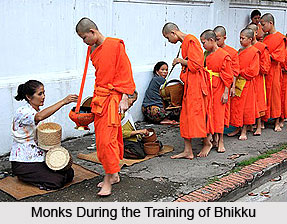
In fact Bhikkhu can be defined as one who renounces, the world and all its pleasures .He strives incessantly to improve himself, to maintain a noble behavior in any situation. The term Bhikku as per the literal translation stands for beggar and refers to the Buddhist monks who were required to beg their daily food. Bhikkhu`s were referred to the male Buddhist monks and the female Buddhist monks were called Bhikkhunis. The bhikkhu and the Bhikkhunis lived by the Vinaya`s framework of monastic discipline; the basic rules of which are called Patimokkha. They lead a simple and meditative life to attain Nirvana.
In Buddhism monkhood is part of the system of "vows of individual liberation." The vows of individual liberation are taken in four steps Monks and nuns take their vows for a lifetime, but they can `give them back` (up to three times in one life), a possibility which is actually used by many people. In this way, Buddhism keeps the vows "clean." It is possible to keep them or to leave this lifestyle, but it is considered extremely negative to break vows. There are still other methods of taking vows in Buddhism. Bodhisattva vows are to be taken by all followers of Mahayana Buddhism.
Dhammapada believes that as soon as one ponders over the origin and the destruction of the elements of the body, he experiences joy and bliss which belong to those who know the immortal or the Nirvana and hence starts the beginning of a wise Bhikku. A wise Bhikku is one who is able to execute control over their senses, contentment, restrain under the Precepts and associates with noble and zealous friends who have a pure livelihood. It has been advised by the Lord that an individual should lead a life of friendship, should be cordial, courteous and skilled in performing his duties. Only then he will be full of joy and will be able to end all his suffering.
According to the Lord one who controls his hand, his feet and his speech, who delights in meditation, who is composed and who is solitary and content can be called a Bhikku. It has been said that when a Bhikku dedicates his mind to the Teachings of Buddha he is able to illuminate the world. An ideal Bhikku should give up all attachments and enmity from his mind. Only when a Bhikku is without attachment and enmity he is able to attain Nirvana.
It has also been said in the Dhammapada that a Bhikku should keep himself away from ignorance and negligence. He should have a tranquil heart and experience a divine pleasure when he perceives the Dhamma or the Law clearly. In the Dhammapada it has been declared that a Bhikku should abide by the Dhamma or Law, should meditate in the Dhamma, should delight in the Dhamma, should remember the Dhamma, should follow the Dhamma and should never fall from the Dhamma.
Lord Buddha in this section has also warned the Bhikku of pitfalls. He had said that carelessly practiced ascetism leads one to hell. An ideal Bhikku should never perform any act carelessly, should not fail a vow and should not obey the code of chastity. If an individual practices all these it is certain to bring a catastrophe. On the other hand a Bhikku should perform all his actions vigorously.
Finally this section of Dhammapada concludes with the warning of the Lord. He had said that a Bhikku should be very careful with the yellow robe which is the distinctive garment worn by Buddhist priests. Unless the heart of the Bhikku is free from all impurities, lust and sin should never take up the yellow robe instead only such a Bhikku should accept the yellow robe who is grounded on virtues and vows and is possessed of self-control and truth.
Bhikku
Bhikku according to the Dhammapada is the one who has emancipated his soul from all cravings.