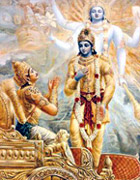
 Atman` is the highest self, it remains when everything that is not the self of a man is abolished. Inn English means "soul" or "Self". In Hindu Dharma, the word "Atman" has deeper connotations. It is the imperceptible, timeless, perpetual and essential self, residing within the mortal frame of every Jiva. Lord Krishna, the Divine Incarnation of Lord Vishnu had explained the perplexed Arjuna, the Fundamental Truth of Existence, in the Eternal Book of Life, Bhagavad Gita that the main essence is the Atman. The word `Atman` is derived from `an` which means `to breathe`, which is `the breath of life`. The meaning of the word changed with time and it covered life, soul, self or essential being of the individual. According to Sankara, `Atman` means `to derive`, `to eat` or `pervade all`. It is the principle of man`s life. `Atman` is the Sanskrit word for the soul of a man. Professor Radhakrishnan says in his exposition of the philosophy of the Upanishads, `Atman` is the `God`s dwelling place`.
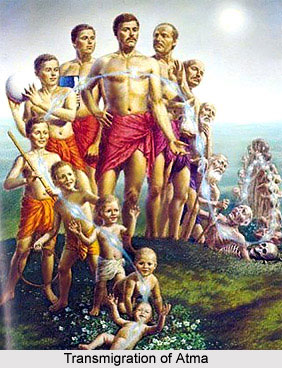
The general concept of Atman is that it is the indestructible and eternal soul. It is never born, never dead and after coming into existence never ceases to be. It is always, permanent and very ancient. At the time of death the soul does not die. It just leaves the body and enters into a new one. Adi Shankaracharya observes: "Like the waves in the ocean, the worlds arise, live and dissolve in the Supreme Self; the substance and cause of everything." Atman is that highest self. An individual hears, touches, sees, feels and thinks by the atman. The `Atman` continues despite the shutting off of consciousness, which is exalted above waking and sleeping. Atman inhabits in the unexplored, deepest recesses, of Jiva. "There the eyes cannot travel, nor speech nor mind. Nor do we know how to explain it. It is other than the known and beyond the unknown".
The `Atman` is not an object of any sort but is the eternal subject. We hear, touch, see, feel and think by the atman. The `Atman` continues despite the shutting off of consciousness, which is exalted above waking and sleeping. When a man withdraws from all outward things, by retreating into the ground of soul, in the remotest depth of the soul, we find the infinite. Atman is intrinsically connected to the Pure Consciousness of Brahman, the Cosmic Spirit. Hinduism asserts that Brahman is the Creative Aspect of God. Brahman is the Celestial Source of existence. It is the all-pervading, Divine Core, from which sprouts the inherent life force, driving every individual soul or Atman in Jiva.
Advaita philosophy of Hinduism sees no difference between the Brahman and Atman. Indeed, Mandukya Upanishad reinforces this idea. It is Brahman, which manifests itself as the Jiv atman within the tangible mould of the body, made of Prakriti, the "material-nature" of Ishvara. This ideology claiming every Atman, as Brahman, authenticates that all are its creations and manifestations. Atman is the Universal Soul, the Brahman. Therefore each creature bears as much importance as the other has. The core philosophy of the Upanishad has said that `Atman` is the `God`s dwelling place`. The real thing in every individual is the self or `Soul`. According to the Hindu religion, `Atman` means, the union of the collective human soul with God, which brings about a complete merge in the absolute totality of Brahman.
Advaita Vedanta traces Atman to be that pure, uncultivated, self-shinning consciousness, timeless, space less, and unthinkable. It is no congruent from Brahman under staying supporting an entity. Atman is pure, undifferentiated, self-shinning consciousness: It is a supreme power of awareness, transcendent to ordinary sense mental consciousness, aware only of the Oneness of being. In actuality, it is the strata of conscious wherein the partition of subject and object, which typify commonplace consciousness, are overcome. It is the transcendental conscious state. Atman is thus void of differentiation, but for Advaita it is not simply a void: it is the infinite richness of spiritual being.
On the other hand, the Dvaita Philosophy distinguishes Jiv atman from Brahman. Madhvacharya and his disciples were of the opinion, that every Jiv atman is dependent on the Independent Reality or Svatantra Tattva of the Supreme Brahman or Para Brahman, for its emergence as living forms. All Jivas are rooted in Brahman, but not the whole of Brahman. Atman is the path, which leads to Brahman. One can comprehend the immortal Atman only through Yoga or a mastery over the temporal characteristics of the Jiva or person. These are the body, the mind, the intellect and the senses. The material case of the body would have been rendered as inanimate, had the soul not invested it with life; whereas the command over the mind and the senses, invites a sublime knowledge of the Supreme Soul, the Ultimate Truth.
It is amazing enough, to discover, that the soul is not the actual rider. It is the power of intellect, which drives the chariot and holds the mind. However Buddhi is not the Lord of the chariot, but a devoted friend to Atman, who helps Atman in executing its functions. If the manas are allowed to obey the signals of the senses, without being filtered through the control-network of Buddhi or wisdom, the chariot containing the Atman, will never forge ahead in the right direction. In the darkness of ignorance, the Jiva thinks that the material body that he possesses is real and cannot sense the existence of the innermost Atman. The Katha Upanishad delineates the innate link between ego and Atman.
It is the Yogi, engaged in the great and illuminating activity of Yoga, who can subdue the hindering ego, and chastise it with the Ethereal Truth of Atman. Hinduism thus instils in its followers a basic sense of respect for all forms of life, by driving home the glorious relation of Atman to Brahman. As long as life will thrive on this earth, the elevated research on the superior subject of Atman, will appeal to mankind. Again according to the early prose Upanishads, `Atman` is the principle of the individual consciousness and Brahman the super personal ground of the cosmos.` Brahman, the first principle of the universe, is known through atman, the inner self of man. `Atman` never dies or takes birth. A person dies with his physical existence like the body perishes but the `Atman` exists all the time. "Nhanyate hanyamaney sharirey"-Atman is eternal, it hardly dies.
Atman
Atman or the Imperishable Soul within the "Jiva" or living being cast an eternal enigma in Hinduism.m.