


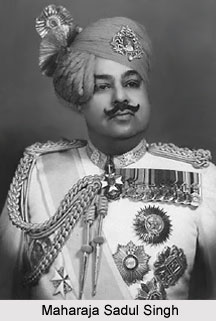
 Sadul Singh was the last ruling Maharaja of the princely state of Bikaner. He reigned over the state from 2nd February 1943 until the independence of India on 15th August 1947. He continued as the Head of the House of Bikaner until his death in the year 1950. Sir Sadul Singh was born on 7th September 1902 and was the eldest surviving son of Sir Ganga Singh. Before ascending to the throne, he served in several key positions for his father for a period of thirty years. Maharaja Sadul Singh of Bikaner had been a Page of Honour at the coronation of King George V and had also attended him at the durbar held in Delhi. He was attended the Paris Peace Conference in the year 1919 and was also present at the meeting of the League of Nations in 1924. Sadul Singh was the last ruling Maharaja of the princely state of Bikaner. He reigned over the state from 2nd February 1943 until the independence of India on 15th August 1947. He continued as the Head of the House of Bikaner until his death in the year 1950. Sir Sadul Singh was born on 7th September 1902 and was the eldest surviving son of Sir Ganga Singh. Before ascending to the throne, he served in several key positions for his father for a period of thirty years. Maharaja Sadul Singh of Bikaner had been a Page of Honour at the coronation of King George V and had also attended him at the durbar held in Delhi. He was attended the Paris Peace Conference in the year 1919 and was also present at the meeting of the League of Nations in 1924.
Later, Singh was appointed as the Chief Minister of the princely state of Bikaner and served the position from 1920 to 1925. He also took part in World War II in the Middle East, Persia and Burma. As the time of British dominion in India came to an end, Sir Sadul Singh acceded to the Dominion of India on 7th August 1947; and was among the earliest Indian princes to do so. Maharaja Sadul Singh merged and included the state of Bikaner into the United State of Greater Rajasthan on 30th March 1949. Sadul Singh died on 25th September 1950 in London, at the age of forty eight. He was succeeded by Maharaja Dr. Karni Singh, who was his eldest son. Titles of Sadul Singh Maharaja Sadul Singh of Bikaner acquired many titles and names during his rule. These are mentioned below- * Yuvaraja Sri Sadul Singh Bahadur (1902- 1918) * Lieutenant Yuvaraja Sri Sadul Singh Bahadur (1918- 1921) * Captain Yuvaraja Sri Sadul Singh Bahadur (1921- 1922) * Captain Yuvaraja Sri Sadul Singh Bahadur, CVO (1922- 1943) * Lieutenant-Colonel His Highness Sri Raj Rajeshwar Maharajadhiraj Narendra Maharaja Shiromani Sadul Singh Bahadur, Maharaja of Bikaner, CVO (1943- 1945) * Major-General His Highness Sri Raj Rajeshwar Maharajadhiraj Narendra Maharaja Shiromani Sadul Singh Bahadur, Maharaja of Bikaner, CVO (1945- 1946) * Lieutenant-General His Highness Sri Sir Raj Rajeshwar Maharajadhiraj Narendra Maharaja Shiromani Sadul Singh Bahadur, Maharaja of Bikaner, GCIE, CVO (1946- 1947) * Lieutenant-General His Highness Sri Sir Raj Rajeshwar Maharajadhiraj Narendra Maharaja Shiromani Sadul Singh Bahadur, Maharaja of Bikaner, GCSI, GCIE, CVO (1947- 1950) Honours of Sadul Singh Sadul Singh was honoured numerous times for his various progressive efforts and contributions. These are as follows- * Delhi Durbar Medal (1911) * Prince of Wales Visit Medal (1922) * Commander of the Royal Victorian Order- CVO (1922) * King George V Silver Jubilee Medal (1935) * King George VI Coronation Medal (1937) * Ganga Singh Golden Jubilee Medal (1937) * Bikaner Badge of Honour, 1st Class (1937) * Bikaner Accession Medal (1943) * 1939- 1945 Star (1945) * Burma Star (1945) * British War Medal (1945) * India Service Medal (1945) * Knight of the Order of St John- KStJ (1945) * Knight Grand Commander of the Order of the Indian Empire- GCIE (1946) * Indian Independence Medal (1947) * Knight Grand Commander of the Order of the Star of India- GCSI (1948) |
| |||



Home > Reference > History of India > Modern History of India > British Empire in India > Princely States of India > Indian Princes during British Rule > Sadul Singh
Sadul Singh
| Sadul Singh was the last reigning Maharaja of the princely state of Bikaner. Earlier, Singh was appointed as the Chief Minister of Bikaner. |
| ||||||||||||||||||||||||||||

