


 Music and instruments used in Yakshagana helps to enhance the art in a major way. This is a theatre form where music and dance forms an integral part. Dance, the race-mode of the people of Karnataka is an inevitable aspect of Yakshagana, and is the most effective medium for rousing the sentiment of Raudra and Adbhuta. Music and instruments used in Yakshagana helps to enhance the art in a major way. This is a theatre form where music and dance forms an integral part. Dance, the race-mode of the people of Karnataka is an inevitable aspect of Yakshagana, and is the most effective medium for rousing the sentiment of Raudra and Adbhuta.
History of Yakshagana Yakshagana in its present appearance is believed to have been powerfully influenced by the Vaishnava Bhakti society. Yakshagana was first introduced in Udupi by Madhvacharya's follower Narahari Tirtha. Narahari Tirtha was the minister in the Kalinga Kingdom. He also was the initiator of Kuchipudi. The first written data regarding Yakshagana is found on writing at the Lakshminarayana Temple in Kurugodu, Somasamudra, Bellary District. Yakshagana was an established performance art form by the time of the noted Yakshagana poet, Parthi Subba. The Yakshagana form of today is the result of a slow development, drawing its elements from ritual theatre, temple arts, secular arts (such as Bahurupi), royal courts of the past, and the artists' imaginations-all interwoven over a period of numerous hundred years. 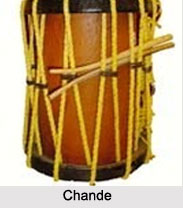 In the 19th century, Yakshagana began to move away from the severe conventional forms. Yakshagana defies simple arrangement into categories such as folk, classical or rural. It can be included in each or all of these, depending upon the rules used for sorting. It is more varied and dynamic than most dance forms. Yakshagana can, though, be classified as one of many traditional dance forms. In the 19th century, Yakshagana began to move away from the severe conventional forms. Yakshagana defies simple arrangement into categories such as folk, classical or rural. It can be included in each or all of these, depending upon the rules used for sorting. It is more varied and dynamic than most dance forms. Yakshagana can, though, be classified as one of many traditional dance forms.
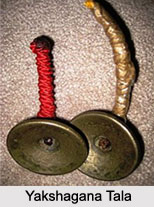
Music and Instrument used in Yakshagana Yakshagana lays particular emphasis on its percussion instruments like Maddale, Mridanga and Chande. Mridanga accompanies the Bhagavata in all his singing while Maddale and Chande are usually employed only in dramatic moments of tension. Chande, the most vital instrument of Yakshagana is a high-pitched drum, beaten with two thin sticks. Chande is the mainstay of Yakshagana in developing the sentiments of Roudra and Adbhuta. The rise and fall in the tempo of Chande, accompanied by Tala and Chakratala (bigger pair of cymbals) brings about the rise and fall in the emotional intensity of the performer and the battle becomes tense and thrilling. It is true that the cymbal is replaced by the gong and Pungi by the harmonium but there is no near about instrument to replace Chande. Chande remains the life sound of Yakshagana. The beat instruments in Yakshagana are the chande, maddale and a Yakshagana tala (bell). Taala: Yakshagana bells or cymbals are a pair off finger bells made of a particular alloy. They are made to fit the tone of the bhagawatha's voice. Singers carry more than one set, as finger bells are accessible in diverse keys, thus enabling them to sing in diverse pitches. They assist, produce and guide the background music in Yakshagana. Maddale: The maddale is a percussion instrument and beside with the chande, it is the prime rhythmic addition in the Yakshagana ensemble. |
| |||



Home > Art & Culture > Indian Dances > Folk Dances of Indian States > Folk Dances of Karnataka > Yakshagana Dance > Music and Instrument used in Yakshagana
Music and Instrument used in Yakshagana
| Music and instruments used in Yakshagana plays an important role in this form of folk theatre. |
| ||||||||||||||||||||||||||||

