


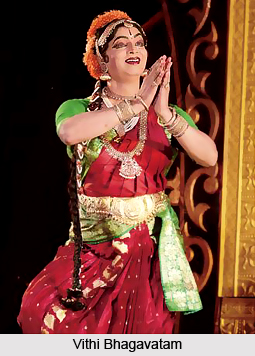
 Vithi Bhagavatam is a conventional dance drama, and it is believed that Siddhendra Yogi banned the women from participating and it became an exclusive prerogative of the male dancers. Talented male dancers with histrionic skills impersonated female roles even surpassing the female artists and have won legendary fame. However, there are some exceptions to this very culture. Vithi Bhagavatam is a conventional dance drama, and it is believed that Siddhendra Yogi banned the women from participating and it became an exclusive prerogative of the male dancers. Talented male dancers with histrionic skills impersonated female roles even surpassing the female artists and have won legendary fame. However, there are some exceptions to this very culture.
Evolution of Vithi Bhagavatam Towards the end of 19th century AD, a few art educated pundits in dance drama and Natya Shastra, migrated from Kuchipudi, crossed Godavari and settled down at Pithapuram, Amalapuram and Mandapeta. Some went to Chintalandi, Eluru or Chattapparu. The surnames of these pundits were changed later and known as Bharatamvaru. Most of them imparted training to female dancers and produced their versions of Kuchipudi dance drama repertoire. So a derivate solo dance performance came into being known as Vithi Bhagavatam. The girl artists generally from the families of courtesan, expert in sadir nautch, solo dance forms, were trained by Bharatamvaru in their repertoire. By mixing these two forms, Vithi Bhagavatam evolved. Independent of Kuchipudi dancer and their groups, the female dancer made Vithi Bhagavatam famous. Instead of separate solo pieces, Bharatamvarus instructed the Kalavantulu, courtesans, into a sustained Bhagavata folklore. Vithi Bhagavatam has two kalapams in its repertoire; i.e. Bhama Kalapam and Golla Kalapam. These special kalapams feature single female dancers. To put across the argument succinctly, sometimes a Brahmin joins in Golla Kalapam. He also provides the much needed commentary and humour, like vidushaka in Kudiyattam and acts as an interlocutor. Gola Kalapam in this very genre has many versions and more or less follows same arguments as seen in Kuchipudi dance drama version of Golla Kalapam. Performance of Vithi Bhagavatam Vithi Bhagavatam is actually performed in the open, at streets or in front of temple at night. The dancers appear from behind the curtain. The performance starts with Nandi, a conventional nata raga, and invocation in praise of Saraswati, Vinayaka and Nataraja are rendered. The verses are rendered in conventional ragas, gradually taking the shape of a song with laya. These are set in varying meters like Sisardham and Kandardham when they are split into song phrases with varying time units. The jatis are also orally recited to the accompaniment of mridanga. The dancers perform abhinaya along with dance or nritta to each of darus. It allows instant improvisation in abhinaya. The band of dancers performed Vithi Bhagavatam during temple festivals and also on marriage festivals as well. This particular dance form, over the years, has not received much support from the people and has been overshadowed by the success and appreciation of solo Kuchipudi Dance forms. |
| |||



Home > Art & Culture > Indian Dances > Classical Dances of India > Kuchipudi Dance > Vithi Bhagavatam
Vithi Bhagavatam
| Vithi Bhagavatam is a traditional dance form. Talented male dancers with histrionic skills impersonated female roles even surpassing the female artists and have won legendary fame. |
| ||||||||||||||||||||||||||||

