Madras School of Arts
|
Madras school of arts was set up in the year 1850 by the British Empire. It believes in creating new ideas.
|
|
|
 During the colonial rule in India, the British Empire found India was a bubbling house of talent in the field of art. The art in India were concentrated mainly into two schools of thoughts. One of course the Bengal school of artand the other was Madras School of art. British rulers discovered that Madras (now Chennai) had some of the furnished and talented intellectual minds in the world. As British have also set up massive settlement in and around the city of Chennai, so Georgetown was chosen to establish an institute that would cater to the artistic expectations of the royals in London. During the colonial rule in India, the British Empire found India was a bubbling house of talent in the field of art. The art in India were concentrated mainly into two schools of thoughts. One of course the Bengal school of artand the other was Madras School of art. British rulers discovered that Madras (now Chennai) had some of the furnished and talented intellectual minds in the world. As British have also set up massive settlement in and around the city of Chennai, so Georgetown was chosen to establish an institute that would cater to the artistic expectations of the royals in London.
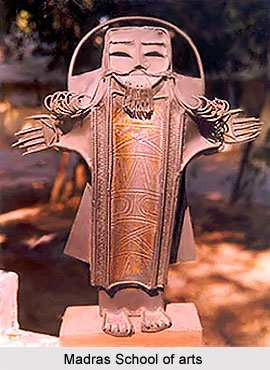
Madras school of arts, under British administration, was set up in year 1850, trained Indian artists and craftsmen to produce decorative arts both in European and Indian style to suit the growing artistic needs of the time. Madras school of arts also produced talented artists in the later period under the leadership of a well known painter and sculptor Dr. Devi Prasad Roy Choudhury who became the Principal of Madras school of Arts in 1927. Mr. K.C. S. Panicker succeeded as principal created the image of Christ in both oil and painted water colour while Mr. S. Dhanapal and Mr. P.V. Janakiram made bronze and metal sculptures depicting the image of Jesus in 1962 - 65. "Christ carrying the cross" was a popular composition done by S. Dhanapal in Bronze which was selected for a National Academy award in 1962.
The other sculpture named "Christ carrying the cross" is a group sculpture, in which Christ carrying the cross with his followers depicts and expresses grief and sorrow. In both these sculptures one can see the face and the figuration following Indian contemporary style of expression. The eyes and elongated face of Christ convey a deep sense pf compassion and tolerance which are the characteristic portrayal of Christ. 72-year-old artist Mr. S. Dhanapal expired March 2000 after leaving his other creative works in Madras.
This has, over the years, come to be known as the Madras School. Initially traditionally artists were employed to make exquisite varieties of furniture, metal work and curious and their work was sent to the royal palaces of the Queen.
Unlike the Bengal School where 'copying' is the norm of teaching, the Madras School actually flourishes on 'creating' new methods and styles, arguments and trends.
|
|
|
|





