


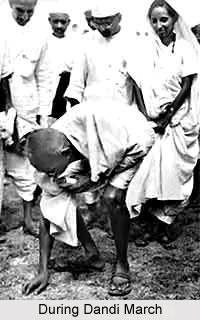
 Satyagraha which can be loosely translated as "insistence on truth"- Satya (truth); Agraha (insistence) "soul force" or "truth force" is a particular philosophy and practice within the broader overall category generally known as non-violent resistance or civil resistance. The very term "Satyagraha" was developed and coined by Mahatma Gandhi. He deployed Satyagraha in the Indian independence movement and also during his earlier struggles in South Africa. Satyagraha which can be loosely translated as "insistence on truth"- Satya (truth); Agraha (insistence) "soul force" or "truth force" is a particular philosophy and practice within the broader overall category generally known as non-violent resistance or civil resistance. The very term "Satyagraha" was developed and coined by Mahatma Gandhi. He deployed Satyagraha in the Indian independence movement and also during his earlier struggles in South Africa.
Satyagraha is basically non violent or civil confrontation. The term was conceived by Mahatma Gandhi. This was one of the major mediums used by him in order to attain freedom. Satyagraha became strength in practicing non vicious methods. Civil disobedience and non-cooperation are elements of Satyagraha. He had pictured Satyagraha as a method to be used in political struggle as well as a universal solution for harm. It was applicable to large-scale political struggle as well as for interpersonal conflicts. In order to teach Satyagraha he found the Sabarmati Ashram. Origin of Satyagraha 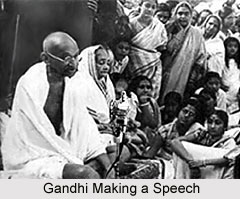 The very term Saytagraha was first originated in a competition in the news sheet of Indian Opinion in South Africa in 1906. It was also an adaptation by Mahatma Gandhi as one of the entries in that competition. "Satyagraha" is a Tatpuruaa compound of the Sanskrit language words Satya (meaning "truth") and Agraha ("insistence", or "holding firmly to"). For Mahatma Gandhi, Satyagraha went far beyond mere "passive resistance" and became strength in practising non-violent methods. The very term Saytagraha was first originated in a competition in the news sheet of Indian Opinion in South Africa in 1906. It was also an adaptation by Mahatma Gandhi as one of the entries in that competition. "Satyagraha" is a Tatpuruaa compound of the Sanskrit language words Satya (meaning "truth") and Agraha ("insistence", or "holding firmly to"). For Mahatma Gandhi, Satyagraha went far beyond mere "passive resistance" and became strength in practising non-violent methods.
Satyagraha Theory The following principles were asked to be followed by the Satyagrahis by him: * Non-violence or ahimsa * Truth * One should not steal * Celibacy * Physical labour * Appetite Control * One should not have any fear * Every religion should be respected equally. * Equal respect for all religions * boycotts should be used when required * Untouchability should not be practiced Seven rules were also listed by him that included: must have faith in God, belief in truth and non-violence, must lead a chaste life, must wear khadi, should not drink alcohol, should carry out rules of discipline and abide the jail rules till it hurts the self respect. A prisoner must obey the jail rules unless they are specially devised to hurt his self respect Principles of Satyagraha are as follow: * Refrain from anger * Tolerate the foe's anger * Stop reacting to punishment. However one should not surrender. * Willingly submit to exclusion of own property * Defending the property through non violent means if one is a trustee. * Abstain from cursing or swearing * Enemies should not be insulted * Do not insult the opponent * Opponent's flag should be neither insulted nor respected * The opponent should be defended if anyone attempts to insult him * The prison regulations need to be obeyed to. * No special treatment should be asked for as a prisoner * The instructions of the leaders of civil disobedience should be obeyed * One should not instigate communal fights The Salt Satyagraha drew the attention of the world. The Civil disobedience movement continued till early 1931 when he was finally released from prison. This led to the Gandhi Irwin pact. The first mass Satyagraha was the Non-cooperation movement from 1920-1922. After the opposition of the Congress members it was suspended. The Satyagraha at Bardoli in 1928 was successful. It paralysed the British government. |
| |||



Home > Reference > History of India > Modern History of India > Indian Freedom Struggle > Satyagraha - Mahatma Gandhi
Satyagraha - Mahatma Gandhi
| Satyagraha was a medium deployed by Mahatma Gandhi in the Indian independence movement. It means truth force. |
| ||||||||||||||||||||||||||||

