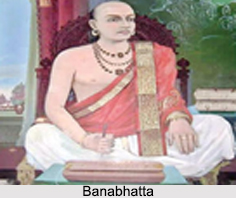
 Banabhatta was a 7th century Sanskrit prose writer and poet and was the Asthana Kavi in the court of King Harshavardhana. Harsha"s reign was from 606 to 647 CE in North India extending from Sthanvishvara, current day Thaneswar, to Kannauj. Banabhatta is considered to be one of the greatest ornaments in the literary circle of Harshavardhana.
Life of Banabhatta
Banabhatta has revealed a part of his life in his works. In the introductory verses to the Kadambari, he has given a detailed account of his family but in the first three verses of the Harshacharita, he has given an autobiographic account of his life. Banabhatta was born to Chitrabhanu and Rajadevi in the village of Pritikuta on the banks of the Hira?yavahu in a Bhojaka family of Vatsyayana gotra in the current district of Chhapra. He lost his mother at a young age and at the age of 14 years he lost his father. Banabhatta led a wandering life for a period but later came back to his native village.
Works of Banabhatta
The Harshacharita and Kadambari are the two celebrated prose works of Banabhatta. His biography of Harsha provides valuable information about the period, and glorifies the works and reforms of the king. The prose is written in the ornate kavya style, involving extremely lengthy constructions, elaborate descriptions, and poetic devices, the work has great vitality and a wealth of keenly observed detail. His second great work, the prose romance Kadambari, is named after the heroine of the novel. The book describes the affairs of two sets of lovers through a series of incarnations. Both works were left unfinished; the second was completed by the author"s son, Bhusanabhatta. Thus Kadambari is divided into two parts, Purvabhaga and Uttarbhaga, ascribed to the father and son respectively. Other than these, there are two other works by Banabhatta, they are Chhandakasthtaka and Parvatiparinaya.
This article is a stub. You can enrich by adding more information to it. Send your Write Up to content@indianetzone.com
