Treaty of Purandar - Informative & researched article on Treaty of Purandar
 Indianetzone: Largest Free Encyclopedia of India with thousand of articlesHistory of India


in  
 Art & Culture|Entertainment|Health|Reference|Sports|Society|Travel
Forum  | Free E-magazine  | RSS Feeds  
History of India : Sources of History of India |Ancient History of India |Medieval History of India |Modern History of India |Indian Historical Dynasties |Indian Battles |Sepoy Mutiny 1857 |Indian Rulers |History of India |Indian Freedom Struggle |Indian Governor- Generals |British Indian Acts |Post Independence India |Iron Age in India
Home > Reference > History of India > Medieval History of India > Maratha Empire > Shivaji > Shahaji > Treaty of Purandar
Treaty of Purandar
Treaty of Purandar was signed on June 11, 1665. The treaty was signed between the Rajput ruler Jai Singh I and Maratha Chhatrapati Shivaji Maharaj.

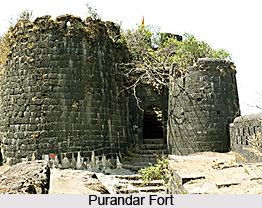
 Purandar fortShivaji was compelled to sign the Treaty of Purandar after Jai Singh beleaguered the Purandar fort. When Shivaji realised that war with the Mughal Empire would cause damage to the empire he chose to sign a treaty instead of leaving his men under the Mughal supervision.

The main conditions of Treaty are:
* Shivaji had twelve forts under him, along with an area worth income of 1 lakh huns.
* Shivaji had to help the Mughals whenever and wherever required.
* Shivaji`s son Sambhaji was given the responsibility of commanding 5,000-strong force under the Mughals.
* If Shivaji wanted the Konkan area under Vijapur`s control, he would have to pay 40 lakh huns to the Mughals.
* He had to give up his forts to the Mughals at Purandar, Rudramal, Kondhana, Khandagla, Lohagad, Isagad, Tung, Tikona, Rohida, Nardurga, Mahuli, Bhandardurga, Palaskhol, Rupgad, Bakhtgad, Morabkhan, Manikgad, Saroopgad, Sakargad, Marakgad, Ankola, Songad, and Maangad.

Shivaji also agreed to visit Agra in order to meet Aurangzeb for further political talks.

This article is a stub. You can enrich by adding more information to it. Send your Write Up to content@indianetzone.com.

(Last Updated on : 08/04/2011)
Recently Updated Articles in History of India
Trade Union Movement in India
Trade Union Movement in India emerged due to the state intervention for the need of improved working conditions of the working classes.
Post Independence India
Post independent India was a dichotomous amalgamation of both dark and bright sides, striving towards best.
Sultan Shahjahan Begum
Sultan Shahjahan Begum was the ruler of the princely state of Bhopal. She ruled for two terms, from 1844 to 1860 and again from 1868 to 1901.
Abu al-Hasan
Mughal Emperor Jahangir took the initiative to train Abu al-Hasan in his enormous studios and workshops.
Origin of Bahmani Dynasty
Origin of Bahmani Dynasty deals with the emergence of Bahmanid Empire or Bahmani Kingdom in the region of Karnataka in the medieval era.
E-mail this Article | Post a Comment
Forum
Forum on History of India
Free E-magazine
Subscribe to Free E-Magazine on Reference
 
 
Treaty of Purandar - Informative & researched article on Treaty of Purandar
Sitemap
Contact Us   |   RSS Feeds
Copyright © 2008 Jupiter Infomedia Ltd. All rights reserved including the right to reproduce the contents in whole or in part in any form or medium without the express written permission of
Jupiter Infomedia Ltd.