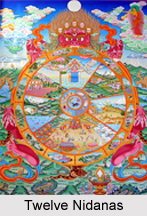
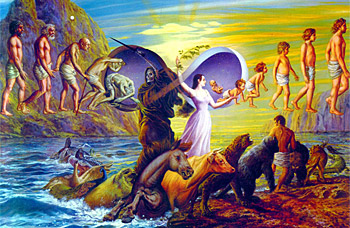
 The theory of transmigration of souls emphasizes the continuity of the soul. Worldly existence is a stage of transition from past existence towards future lives. Life is a continuous process. Birth and death are simply landmarks. When a birth or death takes place there is merely a shift in the man`s position. The soul discards damaged physical bodies and assumes new forms. This belief is the base of Hindu social and metaphysical thought.
This theory has had an important effect which is the belief in the immortality of the soul. The soul is the Jiva or Atma and is considered to be a part of God. The soul is immortal and eternal. Jiva is the instrument for animation and devoid of it. Death does not affect the jiva. It is believed that each individual soul has to go through a large number of worldly incarnations. According to the Indian Puranas, it is rare for a jiva to be born into a human body. Reincarnation occurs when the soul, comes back to life in a new body after the death of a body.
Transmigration of souls is called metempsychosis is based on the theory that a soul may pass out of one body and reside in another. This theory is most spoken of in Hinduism and was developed in the Upanishads. Souls are regarded as a release of the divine spirit.
The theory of transmigration of souls has been closely interwoven with the concept of Karma. This cycle of karma and transmigration of souls may extend through innumerable lives. The ultimate goal is the re absorption of the soul into the ocean of divinity. Transmigration of soul occurs when it reaches the perfect state of the almighty. The soul goes through several lives for attaining perfection.
This article is a stub. You can enrich by adding more information to it. Send your Write Up to content@indianetzone.com