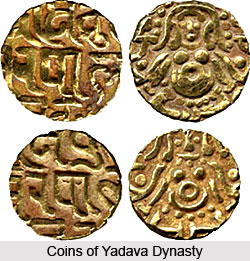
 Coins of Yadava Dynasty are attributed to the king Kumara Pala. The Yadava line of Rajputs was a minor house whose capital was Bayana, southwest of Delhi. The coins were meticulously manufactured to the same rigid weight standard. The obverse Lakshmi design of plate coins has a five-beaded necklace and a mouth or chin shaped like a long crescent with points upward. Coins had a diameter of around 18 to 19 mm. They have also gone through some evolution of style, with fine and crude portrayals of Lakshmi. There is also a possibility that the coins had differences in terms of features. It is also possible, judged on fabric alone, that some of the coins are earlier types and some later types with contemporary designs. The length of reign of the Yadava Kumara Pala had been longer than the apparent four years.
Further, there was a Lakshmi-type gold coin of Muhammad bin Sam, which bears features common to the Kumara Pala coins. The full weight-unit coins of this flan size are unknown elsewhere in the Rajput Lakshmi gold coinages and the Lakshmi portrayal on Kumara coin is quite unlike that of other Rajput coins. So the Kumara Pala coins must come from a mint that was seized by Muhammad bin Sam. The gold coins were issued at Bayana. This is confirmed by the coin`s gold content. According to some scholars, the coins of Yadava Dynasty include two-third gold and were bimetallic in composition. The coins had specific gravity ranging from 16.25 to 15.00. Coins were greatly alloyed with silver. Using the proper gold or silver alloy, the Kumara coin had a relative gold composition ranging from 77.2 per cent to 65.1 per cent.
Thus, there is fair certainty that the Lakshmi-type gold coin of about four g weight standard was issued and circulated late in the twelfth century in the region of Delhi. This was the third Lakshmi gold coin of the era which might be called a `migrant coin`, for it has also been recovered in hoards in Kabul and Paktiya regions of Afghanistan. The other two `migrant coins`, those of Gangeya Deva and Govinda Chandra, are found together in hoards in the extreme northwest of the subcontinent with the Kumara Pala coins, in circumstances not necessarily due to trade.