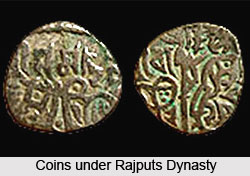
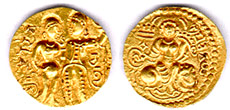
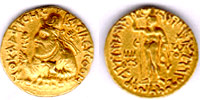
Coins of Kanauj mostly included gold coins. Mostly Gangeya Deva base gold coins were in circulation in this province. These could have been issued as late as AD 1070. Moreover, Lakshmi-type base gold coins were in the reign of Govinda Chandra, AD 1114 - 1154, which could have been issued as early as AD 1104. The coin resembles very strongly the silver issues of Gangeya Deva. The coins were unique in character. Like for instance, in the coins the tika or brow mark, eyes and nose of Lakshmi form a cluster or cross of dots, and the reverse legend is executed with very squarish letters and a number of extraneous dots in the field.
Specific gravities of four of Govinda Chandra`s coins range from 13.68 to 10.50. There was an additional miscalculation as has been stated by scholars that they were mainly alloyed with silver. Other historians state that the coins of Kanauj were tri-metallic in composition mainly including gold, silver and copper much like the coins of Chandella Dynasty. They specified that gold composition was around 36.9 per cent; silver, 32.4 per cent; copper, 30.6 per cent and almost all in even proportions. It accounts for the base appearance of the Govinda coins. Further, this composition is therefore most likely the average for the coinage series of Kanauj.
Eventually, there was a decline in the real value of the coin of Kanauj under Rajputs. Govinda Chandra reigned until 1154, but certain evidences prove that the coin type in his name was struck by his Gahadavala successors at Varanasi until the conquest by Muhammad bin Sam in AD 1194. According to historical analysis, Govinda Chandra`s gold coins were issued for ninety years, sufficient time for a slow debasement. Still, a devaluation of 63 per cent in gold content was a considerable drop. The Govinda Chandra type was as numerous as the Gangeya Deva type of the same denomination, from the previous century. The coins were current throughout the Gahadavala dominions, and beyond. Some of the coins have been unearthed at Delhi (in Govinda Chandra`s time ruled by the Tomaras) and some at Taxila (ruled by the Yaminids); but neither kingdom seems to have been the final terminus of the gold money migration. Rather they were places of passage, and the gold coinage of the Gahadavala Rajput kingdom eventually found its way into Afghanistan.