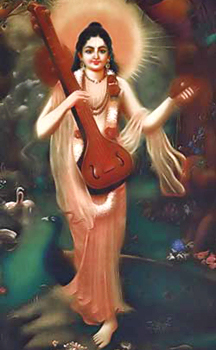
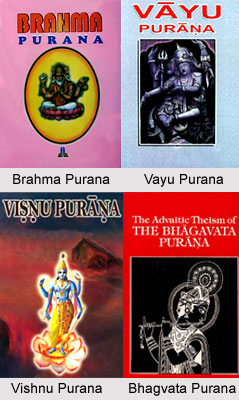
 Narada Purana primarily is a discourse between Narada Muni and Sanat Kumar. The adhyayas in Narada Purana contain various tales that had been narrated by the sage.
The Narada Purana is divided into two parts, comprising respectively 125 and 82 chapters or adhyayas. This Hindu text deals with the places of pilgrimage. The Narada Purana begins with the words "First one should pray to Nara and Narayan the best of humans. One should also pray to Saraswati, the Goddess of Learning, and then only start reading the sacred texts known as Jaya."
As far as the compilation of the book is concerned, it is often said that all the adhyayas do not belong to the same period. The period of chapters 42-62 of this Purana, which form the second pada of the first part of the Narada Purana, appears to be different. Chapters 42-45, dealing with the philosophical matters, are mostly indebted to the Mahabharata. These adhyayas probably date between 4th century B.C. to 4th century A.D. On the other hand Chapters 50-57 of the second padas which deal with the six Vedangas, belong to a different period. Chapter 50 on education deals with the rules of pronunciation of Vedic and Classical Sanskrit and also with the art of music and other cognate sciences. This chapter may be dated between the 7th and the 8th century A.D. Hence it is evident that the chapters have been incorporated within text at different points of time.
The Part I of Narada Purana deals with a number of tales involving the Indian sages. One such story is about Shounak and many other astutes who meditated in the forest called Naimisharanya. Some performed sacrifices, others meditated on the true nature of Vishnu, and few others made offerings to Vishnu. The sages were trying to attain the four goals of Dharma (righteousness), artha (that which gives meaning to life). Kama (that which is desired) and Moksha (liberation). Shounaka suggested them to hear the recitals from Suta the disciple of Ved Vyas. He would be able to deliver the wisdom of Indian Puranas.
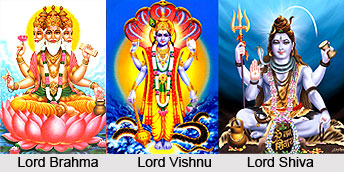
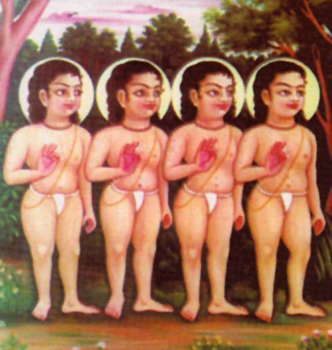 Lord Brahma had four sons, i.e. Sanaka, Sanatkumara and Sanatana, and Sanadana. Before starting to attend the assembly of Brahma at Mt. Mahameru, desire to have a bath in the tributary of holy Ganges called Sita. At that time, sage Narada reaches there and takes bath along with them. Then Narada requests them to narrate the greatness of Lord Vishnu and enlighten them regarding the three chief duties, knowledge and penance, the honouring of guests. Afterwards, Narada prayed to Vishnu by reciting the Paurusastava.
There was a sage named Mrikandu. He prayed for many years in Shalagrama. He regarded all other living beings as no different from his own self. Lord Indra and the other gods got scared at Mrikandu`s tapasya. They themselves went and began to pray to Vishnu on the shores of the great ocean. Vishnu was moved by their prayers and appeared before them. He also paid a visit to Mrikandu who was delighted in seeing Vishnu. He wanted no benefits. Vishnu blessed him and departed.
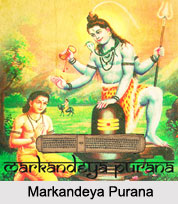
This is followed by the story of Markandeya who was the son of Mrikandu. Markandeya became well versed in all the sacred texts. He had also prayed to Lord Vishnu who granted him the boon to compile a Purana. This was called Markandeya Purana. Vishnu grants him a benefit so that Markandeya becomes immortal; he even survives the end of cosmic cycle.
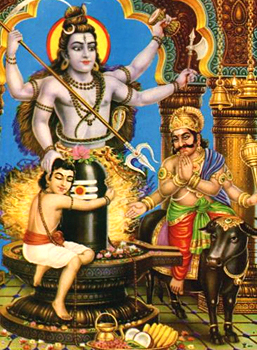 There are adhyayas or chapters explaining the description of moral and religious duties, various types of hells and sufferings undergone there. Duties of a man in his respective stages of life are illustrated.
There are dialogues on cosmogony between Bhrigu and Bharadvaja. A chapter on four classes (varna) which are Brahmanas, Kshatriyas, Vaishyas and Shudras. Here the primary duties and responsibilities of the four categories are given. Thereafter, there is a description of the greatness of the Narada Purana.
In Narada Purana, Part II sage Vashishta elucidates the greatness of Ekadasi vrata to king Mandhata. Similar rites are recommended on devdasi tithi. A vrata which can be observed by all called pornamasi vrata has also been detailed upon. The prayers that needed to be chanted during this time have also been elaborated on. Several enumerations of numerous holy places and sacred sites on the banks of the Gariga, in Gaya, that describes their holiness and location in the course of instructions given by sage Vasu to Mohini.
A chapter states that, as instructed by sage Vasu, Mohini goes on visiting and paying homage to the holy places, offering pinda to her departed husband Rukmangada and worshipping deities like Visvanatha, Purusottama and others. At last, Mohini reaches the river Kalindi. There she goes into the waters and disappears. Then she occupies the last part of the Dasamal tithis.
At the end, it is said that the Nnrada Purnna was recited first by Harhsasvarupi Bhagavan (Lord Visnu) to sages Sanaka and then it was narrated by them to saga Narada, and afterwards by Narada to Vyasa.
The Narada Purana is one of the greatest among the Indian Puranas. A man or a woman, without any distinction of caste or creed, is eligible to recite this Purana and to attain the final salvation. The Narada Purana has a hasty end. In the other Puranas, the sages generally thank Suta for his pains. There are no such couplets in this Purana. The beauty of the Purana is instinctively descriptive.