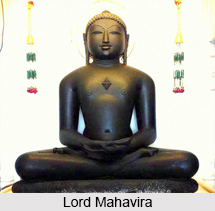
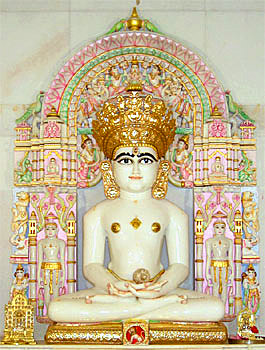
 Jainism is one amongst world`s oldest religionsestablished in the 6th century by Vardhamana who was called Mahavira. Stories relating to the history of Jainism have appeared to us in a manner, which is quite indistinguishable from miraculous tales. People are still much unaware of the early history of Jainism. The Jains, as the followers are known as, follow the teachings of the Tirthankaras, out of whom; Mahavir Jain brought together different preexisting beliefs and philosophies of the religion. He did this in a systematic way, but he cannot be called the founder of the religion. Mahavir`s original name was Vardhamana, and he was born in 599 B.C.
Mahavira was born in a wealthy family but then went through meditation and fasting and all sorts of hardships to get his physical state accustomed to a much coarser way of life. He continued with the religious tradition of Parsva who might be termed as the 23rd Tirthankara of Jainism. Teachings of Jainism revolves around a comprehensive knowledge about the whole nature, universe as a whole, which is termed as Keval Jnana. Right faith, right knowledge, right conduct forms the basic teachings in Jainism that`s why they are called the `three jewels` or ratnatraya of Jainism. Jains strongly beileve in Ahimsa meaning non-violence.
Mahavir`s teachings:
Vital aspects of the teachings of Jainism are based on few thoughts, which can help in having a better peaceful life. Mahavira stressed on the thoughts like having right faith, proper conduct, and knowledge is very important. These actually shape an individual`s life. Belief is very personal, until it makes sense it can be considered useful, it cannot be taught or phrased. Similarly, all the living organisms including humans, animals and the plant kingdom have a pure spirit or soul (jiva,which is a Jain word), which is free in its own regard and has complete knowledge. This pure spirit is engulfed with gross things like Karma, which actually obliterates our knowledge limiting our freedom and finally tying us up with one another. Karma in Jainism has a different meaning. It is not the mysterious force controlling the fate of living beings, deed or work but it simply refers to the composites of a very fine matter that is unperceivable to the senses. A soul undergoes great transformation with its interaction with this matter. Mahavir believed in Karma and teaches to free us from the miseries of Karma and gain Moksha or Nirvana. Mahavira had no faith on God but believed in the existence of a power in all the souls, which is omnipotent.
Five principals that Mahavira propagated are:
1. Ahimsa - not to injure any living beings.
2. Satya - to speak truth
3. Asteya - not to steal
4. Tyag - not to own property
5. Brahmacharia - to lead a virtuous life
Jainism has also advised ways to attain Moksha. In this context the nine Tattvas deserve a mention. These nine principles are entwined with the theory of Karma, they are "jiva, ajiva, punya, paap, asrava, bandha, samvara, nirjara and Moksha".
Impact of Jainism:
Teachings of Jainism has an extensive effect on the Indian population in terms of religion, culture, language, cuisine and so on. Jainism has a global impact too, and today we find large population of the Jain community in United States, United Kingdomn, Canada, and East Africa. Jainism today has a very modern outlook; it fits to the modern world aptly. Mahavira propounded a casteless, class less society with no high and low, gender distinctions. His teachings have helped in producing a better surrounding to live in. Jainism teaches us to be truthful and honest, helps in creating a society bereft of theft, lies and general insecurity. Jainism believes in existence of spirit among every living matter hence it encouraged vegetarianism and abandonment of animal sacrifice. It is important from the most humane grounds and has brought a change in the society. On the grounds of peace and non-violence Jainism has immense contributions.
Teachings of Jainism stress on the ideas of equality, non-violence, spiritual liberation and self-control. What Mahavira has taught ages back still has its significance in modern day life. Jains are an important religious community and Jainism preaches on different principles of virtue enriching the population.