


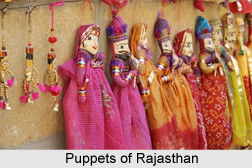
 India is the abode of puppet theatre from the inception, especially in the 5th Century BC. Puppetry or the puppet theatre is one of the ancient forms of entertainment in India. Although primarily it is used as a form of entertainment; yet its importance in conveying significant meaning cannot be denied. For centuries, Indian puppet theatre in one form or the other flourished in India, particularly in the villages. India is the abode of puppet theatre from the inception, especially in the 5th Century BC. Puppetry or the puppet theatre is one of the ancient forms of entertainment in India. Although primarily it is used as a form of entertainment; yet its importance in conveying significant meaning cannot be denied. For centuries, Indian puppet theatre in one form or the other flourished in India, particularly in the villages.
Since ages, it has been an important part of folk culture depicting the folk traditions of India. From the ancient days, Indian puppet theatre therefore developed not only as an art form but also as an effort of conveying a lot whilst uttering actually nothing. India, which has a rich history of her creativity, has slowly become a name in the rich timeline of Indian natya with the emergence of this Indian puppetry as a typical visual art form. In Indian puppet theatre the puppets or the dolls comes alive, simulating life and reality whilst giving meaning to the creator's ideology. History of Indian Puppet Theatre History of Indian puppet theatre is long, enlaced with a rich past. The origin of puppetry somewhat dates back to the long gone era of the 5th Century BC. The chic dash was then missing; even the modish approach was not there; yet Indian puppetry as an enduring form of entertainment stood apart as an intense form of theatre since the historic days of ancient times. 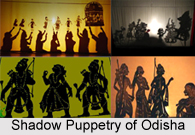 While some says Indian Puppet Theatre did originate in medieval India, other says that it was there throughout, typically as an art form even at the time of the Indus Valley civilization. Not only as an art form Indian puppet theatre at that epoch was an effort of illustrating the histories of great prince, princes, and mythological heroes and even unveiled the legendary incidents and also portrayed those eposes and stories from the epics. Puppetry was then chiefly a media for entertainment; an effort to teach the mass and guide the then society amidst its creativity and in the midst of its story telling aspects. It was during this time, in Indian puppetry two distinct forms were evolved; while one form was then chiefly evolved as the religious portrayal, the other form mainly made satire and farce as the central theme. It is with the colossal development of the religious puppetry, shadow puppetry evolved as a medium in epitomizing the stories of Ramayana and Mahabharata. It was much later; in the history of Indian puppet theatre, satire and farcical comedies became quite an important part in articulating the socio political set up of India. While some says Indian Puppet Theatre did originate in medieval India, other says that it was there throughout, typically as an art form even at the time of the Indus Valley civilization. Not only as an art form Indian puppet theatre at that epoch was an effort of illustrating the histories of great prince, princes, and mythological heroes and even unveiled the legendary incidents and also portrayed those eposes and stories from the epics. Puppetry was then chiefly a media for entertainment; an effort to teach the mass and guide the then society amidst its creativity and in the midst of its story telling aspects. It was during this time, in Indian puppetry two distinct forms were evolved; while one form was then chiefly evolved as the religious portrayal, the other form mainly made satire and farce as the central theme. It is with the colossal development of the religious puppetry, shadow puppetry evolved as a medium in epitomizing the stories of Ramayana and Mahabharata. It was much later; in the history of Indian puppet theatre, satire and farcical comedies became quite an important part in articulating the socio political set up of India.
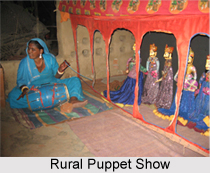 Indian Puppet Theatre as an Artistic Visual Art Indian Puppet Theatre as an Artistic Visual Art
Indian puppet theatre as an artistic visual art is still vibrantly alive in a variety of style. The major types of puppetry that are practiced in different Indian states are: rod, string, shadow and glove puppetry. The puppetry is very popular in the states like Odisha, Rajasthan, Kerala, Andhra Pradesh and Karnataka. Sometimes the puppets are made with leather and the movements controlled by stick and often they are made with wood or cloth where the movements are duly controlled by strings. The string puppetry is prevalent in Karnataka and Rajasthan. Correct string movement is very important to make the puppetry a thriving entertainment. The string attached to the puppet's head goes over the operator's hands and fingers which again are linked back to the puppet. The operator controls the movement of each hand of the puppet by separate strings. In Indian puppet theatre, the puppets which are used are generally small in dimension. The large head accompanied with prominent eyes offers a magical charm to the puppets whilst sketching their personality. 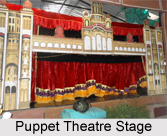 Colours of Puppets in Indian Puppet Theatre Colours of Puppets in Indian Puppet Theatre
The colour of the puppets also determines the portrayal of character in Indian puppetry. To depict a royal character mainly a light coloured puppet with impressive moustaches is used whereas a gawk eyed and dark coloured puppet usually paints a negative character. The female figures hold their skirts or Sarees in their hands while dancing; thus showcase a vibrant show. The male puppets are shown as the ones who excel in fighting; they dash against each other strike, chase, wrestle and even fall dead whist offering life to the entire puppet show. Themes in Indian Puppet Theatre The themes in Indian puppet theatre presented in an Indian puppet theatre are usually based on the two epics Ramayana and the Mahabharata. Often sagas from the age old Indian fables and folklores and even stories from Indian historical events also contour the theme for the puppetry. In the rural areas generally a puppeteer family manages the whole show. 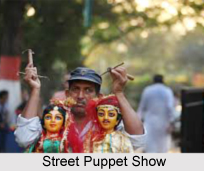 The controlling of the strings are carried over by the male members of the troupe; while the music, singing, dialogue and narrations are provided by the female members of the family. Mridangam and cymbals are generally played by the youngsters. This further offers a remarkable diction to the overall presentation. The controlling of the strings are carried over by the male members of the troupe; while the music, singing, dialogue and narrations are provided by the female members of the family. Mridangam and cymbals are generally played by the youngsters. This further offers a remarkable diction to the overall presentation.
Indian Puppet Theatre and Contemporary Age Indian puppet theatre has also progressed and the contemporary puppet theatre in India stands as a true progression from its elemental form. Contemporary puppet theatre in India does have its own idiom- "the puppeteer designs the figure and idea much in the same way like an artist or a poet". The satire, farce, fantasy, reality and dreams all support in contouring the storyline of a contemporary puppet theatre which remains as a vibrant art form echoing the rich past of Indian puppetry in an eloquent way. |
| |||



Home > Movies & Entertainment > Indian Drama & Theatre > Forms of Indian theatre > Indian Puppet Theatre
Indian Puppet Theatre
| Indian puppet theatre since time immemorial developed a typical theatrical art form in conveying the significant meanings of the Indian urban and rural life and cultural backdrop. |
| ||||||||||||||||||||||||||||

