 Indian paramilitary forces are agencies that provide support to other Indian law enforcement agencies and the Indian Army. Apart from Indian soldiers, the security and integrity of India, especially border security and internal matters are dealt by Indian paramilitary forces. They are security forces falling under the Ministry of Home Affairs or the Ministry of Defence. They are integrated with Indian Armed Forces, acting as Armed Forces Auxiliaries. There are many paramilitary forces in India, with an extensive variety of roles. The diverse forces follow the role of Gendarmerie and carry out Counter-Insurgency or Anti-Terrorist Missions. Indian Paramilitary Forces are regarded as the world`s largest and most powerful forces. Some of the Indian paramilitary forces are discussed below.
Assam Rifles
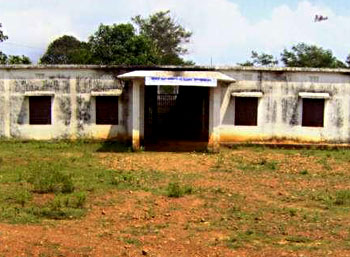
Assam Rifles evolved from a paramilitary police force called Cachar Levy in 1835. The unit acquired its present name, Assam Rifles in 1917. During the World War II, Assam Rifles managed the influx of refugees, who were coming from Burma, in order to flee the Japanese advance in 1942. Between the end of the World War II and Indian Independence, Assam Rifles constituted 5 battalions, that were one part of the Civil Police, under the Assam Inspector General of Police. After Independence, the Indian Government assigned Assam Rifles its own Director General. In October 1962, Assam Rifles were the frontline troops in the beginning of the Chinese-Indian War. Assam Rifles maintained its peacekeeping roles in northern India in the face of tribal unrest and insurgency. 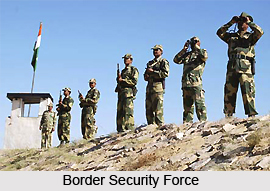 Assam Rifles helps in basic education, assists in rebuilding and agricultural activities and maintains communications in remote areas.
Rashtriya Rifles
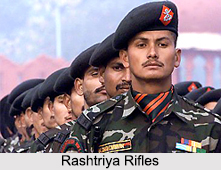
Rashtriya Rifles (RR) is a Counter-Insurgency Force in India. In 1990, General B C Joshi raised the unit specially to fight insurgency in Kashmir and also to work hand-in-hand with the local security forces in the area. Its major role is to allow the Indian Army to carry out the primary task of defending the borders and the state territories, unhindered by action from Pakistani-backed terrorists and guerrillas. Rashtriya Rifles is presently deployed in Jammu and Kashmir.
Defence Security Corps
Defence Security Corps (DSC), earlier known as Defence Department Constabulary Centre was established on 25th of April, 1947 at Mathura, Uttar Pradesh. This unit generally offers protective services to the Defence Ministry sites and looks after the security of various Defence Installations.
Border Security Force
 Border Security Force (BSF) was established on 1st of December, 1965. It is responsible for guarding India`s land borders during peacetime and preventing trans-border crimes. It is a central paramilitary force, operating under the Ministry of Home Affairs.
Central Industrial Security Force
Central Industrial Security Force (CISF) was established on 15th of June, 1983. It is headquartered at New Delhi and works directly under the Union Ministry of Home Affairs. This unit functions to provide security to installations, industrial units and government infrastructure projects all over India. The unit also provides consultancy services to private industries and organizations, within the Government of India.
Central Reserve Police Force
Central Reserve Police Force (CRPF) came into existence as the Crown Representative`s Police on 27th of July, 1939. After Indian Independence, this force acquired its present name based on the enactment of the CRPF Act on 28th of December, 1949. Its primary role is to assist the state/ union territories in police operations, to maintain law and order and contain insurgency.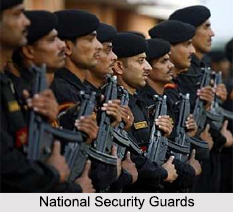
Rapid Action Force
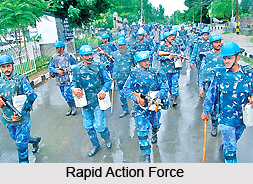
Rapid Action Force (RAF) was founded on 11th of December, 1991 and is headquartered at New Delhi. It works under the Ministry of Home Affairs. It is an Anti-Riot Police of the Indian Union. The members of this unit are provided non-lethal weapons in order to disperse the crowd, with minimum harm and losses. The officers of Rapid Action Force have provided services during communal violence and terrorist attacks.
Indo-Tibetan Border Police
Indo-Tibetan Border Police (ITBP) was established on 24th of October, 1962. It was conceived for the security of the Indian border along the Tibet Autonomous Region of China, which is spread across 2115 km.
Other Indian Paramilitary Forces
Other Indian Paramilitary Forces are National Security Guards, Railway Protection Force, Civil Defence, Indian Home Guard, Special Security Bureau, Special Protection Group, etc.