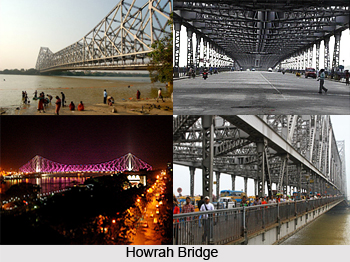
 Howrah Bridge is a pontoon bridge over the Hooghly River, connecting the twin cities, Kolkata and Howrah. It is one of the finest specimens of the Cantilever Era and is one of the best cantilever bridges in the world. It is a great contribution of the British engineers and the Indian heritage is enriched with this exquisite masterpiece of technology. Seeing the importance of Kolkata and Howrah in the economic sphere, a need arose to build a bridge connection, which resulted in the construction of the famous Floating Pontoon Bridge in 1874. It became the busiest bridge and the census of the daily traffic on the bridge, in May 1946, stated that the traffic comprised of 27,400 vehicles, 121,100 pedestrians and 2,997 cattle. Howrah Bridge was renamed as Rabindra Setu on 14th June 1965 in the honour of the first Nobel laureate of the country, Gurudev Rabindra Nath Tagore.
History of Howrah Bridge
Since the time of construction, Howrah Bridge went through a transformation. The Howrah Bridge Act was passed by the Legislative Department of the Government of Bengal, under the Bengal Act IX of 1871. Initially, the earlier avatar of modern Howrah Bridge was created by Sir Bradford Leslie, a famed professional engineer, in 1874. The bridge then was 62 ft wide 1528 ft long. But, gradually, the traffic on the bridge got exposed to various risks and the upcoming problems became quite evident. The Hooghly River has always been prone to tides and during high tides, bullock carts were unable to cross their way, resulting in traffic jams. Back then, the traffic was so high that, with time, the bridge started losing sufficient strength for heavy loads. Hence, all these reasons provoked the Government of Bengal in 1933 to replace the Floating Pontoon Bridge. Around 20th Century, the bridge started showing signs of menace, owing to the increased traffic load, and the Port Commissioner took charge for the renovation of the structure. Though, the outbreak of the First World War (1914 to 1919) postponed the construction of the new bridge, partial renovation was done in the years 1917 and 1927. Finally, the Floating Pontoon Bridge, which was originally commissioned for 25 years service, was decommissioned on February 1943. It was in service for a long span of 69 years and then the construction of the new bridge started in 1936, under the supervision of Howrah Bridge Commissioners, guided by the Commissioner of the Port of Calcutta. The construction was completed in the year 1942 and was exposed to public traffic in 1943.
Architecture of Howrah Bridge
Howrah Bridge is a living testament of technical brilliance. The new Howrah Bridge is technically a `cantilever truss` bridge, constructed exclusively by `riveting`, without nuts or bolts. The super structure is 280 ft high and extends 1500 ft between the main towers. Its Anchor arms and the Cantilever arms are 325 ft and 468 ft respectively. Beyond the towers, the bridge is supported by two piers; each nearly 90 meters above the road. The Bridge deck is suspended between the towers through panel points with 39 pairs of hangers in the lower chord of main trusses. The width of the Bridge deck is 71 ft and on either side of the bridge run 15 ft footways. The bridge was made by using more than 26,500 tons of a combination of high-tensile steel and mild steel. The final cost of the new Howrah Bridge amounted to Rs. 250 lakhs. Presently, the eight-lane bridge carries a regular stream of more than lakhs of vehicles and 2 million commuters every day.
Maintenance of Howrah Bridge
Kolkata Port Trust monitors the maintenance and repair of the Bridge along with the restoration of damaged components. Over the years, Howrah Bridge has been a faithful link between Kolkata and Howrah, bearing heavy traffic loads and surviving the havocs of time.
One can get a very good view of the bridge from the ferries that ply on the heart of the Ganges. At night it looks stunningly beautiful with the lights and in a majestic way it stands out as our contemporary which has passed over from the British rule. Howrah Bridge has been a kind of motivation for the film industry and time and again we have seen it being pasteurized on the screens. The bridge is not only well known for its brilliant technological mastery but also as a boon for the Indian traffic, which is hugely benefited by this. Kolkata is the storehouse of many such specimens of which Howrah Bridge stands as the epitome of developed technology way back in the British period.