 Dating back to the Vedic period, the history of Indian athletics was moulded into shape by the principles of the Atharva Veda. During the Vedic period, sports like chariot racing, equestrian, archery, military tactics, wrestling, weight lifting, swimming and hunting were in vogue. In due time, the nature and character of sports in India started to change leaving space for the up-gradation of sports and athletics in India.
Contemporary versions of track and field events began to be played regularly and in organized form in the early years of Indian independence. Till then, there were a number of phases in the history of Indian Athletics. At the initial period, games were played in grass and cinder tracks, until a gradual shift to synthetic tracks occurred. The later introduction of technology into athletics improved its status further as keeping the record of players` timing became much easier.
 Overview of History of Indian Athletics
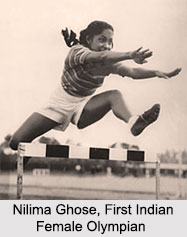
During the 20th century, when the country was still under the rule of the British Empire, India participated in the 1900 Summer Olympics and Norman Pritchard, an Anglo Indian won silver medals in the 200 meters hurdles. This was an awe inspiring moment and following this in the 1920 Antwerp Olympics, sprinter Purma Bannerjee, and distance runners Phadeppa Chaugule and Sadashir Datar were the first indigenous Indians to compete at the games. At the 1952 Helsinki Games, history was made when Nilima Ghose and Mary D`Souza Sequeira became India"s first female Olympians. Henceforth, the nation has continued to send athletes at the Olympics athletics competition every four years.
In the 1930s Far Eastern Championship Games, India took part in a regional level but failed to win any medals. The nation hosted the Western Asiatic Games and won all but three of the athletics events and in 1951, India also hosted the Asian Games. Here, India managed to finish second to Japan and won the men`s sprint double by Lavy Pinto and two silvers in women`s sprints by Roshan Mistry. And in the 1954 Asian Games, Mary D`Souza Sequeira gave India its first women athletics gold medal, taking the 4 X 100 metres relay title.
 The decade of 1940s and 1950s are most notable in the history of Indian athletics, as a number of athletics associations started their journey in India, during that period. In 1946, the Amateur Athletics Federation of India (AAFI) was established for the management of Indian athletics. It worked in collaboration with other athletics associations for improving the entire scenario of Indian athletics.
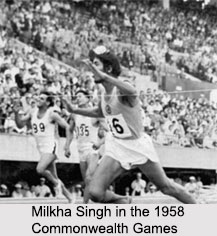
The history of Indian athletics is incomplete without mentioning "The Flying Sikh" or Milkha Singh, who at the 1958 Asian Games won the 200 m/ 400 m double. He even took on the 440 yards title at the British Empire and Commonwealth Games and became the first Indian winner at the competition.
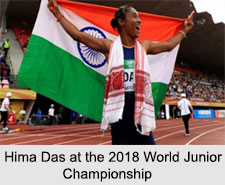
Over time and by the beginning of the 21st century, stark improvement was noticed in the standard of performance of sports in India. The country began to host major athletics events more frequently, like the 2004 Asian Cross Country Championships, 2003 Afro- Asian Games, 2004 IAAF World Half Marathon Championships, 2007 Military World Games, 2008 Commonwealth Youth Games and 2010 Commonwealth Games, all representing the first time that India had hosted those competitions. At the 2018 IAAF World U20 Championships, Hima Das became India`s first athlete to win a medal in a track event at an IAAF competition with her 400 metres gold medal.
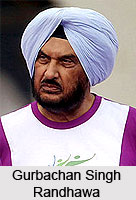
Some of the most successful athletes in the history of Indian athletics include Praveen Kumar, T. C Yohannan, Gurbachan Singh Randhawa, Neeraj Chopra and Sriram Singh, etc. Other than these, few of the notable contemporary female athletes include P T Usha, Swapna Singh, Jyotirmoyee Sikdar, Krishna Poonia, Saraswati Saha, Soma Biswas and Anju Bobby George, India"s only global athletics medallist.