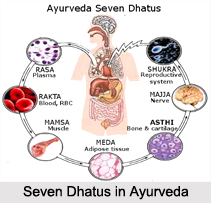
 Asthi constitutes the skeleton, is the hardest of all connective tissues. One unique feature of Ayurvedic physiology is that each human tissue is derived from the previous tissue in ascending order of complexity. So from rasa (life sap) the body builds up rakta (blood), from rakta it develops mansa (muscles), from mansa originates med (fat) and from this med is developed asthi (bones), which in turn generates majja.
Asthi, the shaper of the skeletal framework, is made up of bone cells and intercellular ground substance. The organic part, which constitutes 40 percent of this ground substance is composed of substances like `collagen fibres` and `the osteo-collagenous fibres`, and is bound by a material scientifically termed as mucopolysaccharide cementing material or ossein. The remaining 60 percent, which gets deposited as a dense substance, is inorganic and mainly constitutes calcium salt. The covering around bone is known as periosteum. Asthi consists of three types of bone cells---- osteoblast, osteocyte and osteoclast. These three are closely related with one another. Osteoblast is concerned with the formation of bone and is present in the growing surfaces where the bony matrix ( a solid substance between the cells that comprises bone and another connective tissue called cartilage) is deposited. This cell is shaped like a cuboid or pyramid and its nucleus is large and distinct. Since the cell helps in calcification, it has a rich concentration of the enzyme called alkaline phosphatase.
Osteocytes are those osteoblasts, which become trapped within their own secretory material. These cells are small and ovoid in shape. Osteoclast is a giant bone cell with about 20 nuclei. It is abundant in those areas where active deposition of asthi takes place. This cell is linked to the process of growth and remodelling of bone. So, its function is to dissolve or destroy bony tissue.
Development of asthi begins from the sixth week of the embryonic life and a good number of bones of the body continue to grow until a person reaches twenty-five years of age. There are 206 bones in the human body. The bones serve a variety of functions. It performs a mechanical function in forming the skeletal support and shape to the body, thus enabling movement and work. The vital organs and the deep blood vessels as well as the nerves are protected from injury.
Asthi serves as a great storehouse of minerals like phosphorus and calcium that are periodically supplied to the blood. Some toxic elements like lead; fluorine, arsenic and radium are removed from the main bloodstream and deposited in the bones, thus enabling detoxification of the body. The attachment of the bones to the muscles is the basis for locomotion in human beings. The cavities of long bones contain a substance called the bone marrow, whose main function is the production of blood cells and their release in circulation.
According to modern standards, asthi dhatu comprises of bone tissue, including cartilages. Its main function is to give support to the majja dhatu and provide support to mansa dhatu also. The disorders in this dhatu may lead to complications like extra bony growth, tooth problems, bone related problems, osteoporosis, formation of renal stones, gall bladder stones and problems related to the skeletal system.