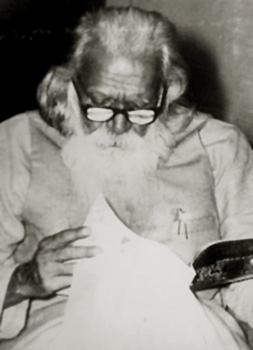
 Gandhian writers in Gujarati literature are the various writers who were closely associated with Mahatma Gandhi and gave vent to the newfound philosophy in literary expressions. Among the many writers who wrote during this time, one was Kaka Saheb Kalelkar (1885-1980), who entered the field of Gujarati literature with a tremendous flourish. His writings are significant because he wrote abundantly in Gujarati, although his language was Marathi, and also because his prose was well cultivated to convey the profoundest thought as well as to rise to poetic heights.
Kaka Saheb was a constant traveler, and he has encapsulated in his travelogues, such as Himalayano Pravas (1924) and Purva Africaman (1959), his experiences during his innumerable sojourns in India and abroad. These travelogues reveal his profound knowledge of history and culture and also provide the readers with vivid descriptions of the various places that he has traveled to. A sense of joy was Kaka Saheb`s second nature. Rakhadvano Anand (1953) is about the joy of wandering, and Smaranayatra (1934) contains delightful reminiscences of his childhood and adolescent days. Among the serious writings of Kaka Saheb are Jivan Sanskriti (1939), Jivanbharati, and Jivanvyavastha (1964). The Sahitya Akademi presented an award to Jivanvyavastha as an outstanding work of reflective writing (1964). Even when he wrote heavy prose to suit philosophical subjects, he kept his style free from any kind of heavy language. With him, Gujarati prose acquired greater maturity, revealing immense possibilities and inner strength of the language.
Mahadev Desai (1892-1942), Gandhiji`s private secretary for many years, was an outstanding writer, at ease with Gujarati, English, and Bengali language. He wrote biographies such as Vir Vallabhbhai (1928), Sant Francis (1934), and Be Khudsi Khidmatgar, about Khan Abdul Ghaffar Khan and his brother Khan Saheb. His most important work is Mahadevbhaini Diary, in 15 parts, a record of the contemporary events as well as his inner growth during his years with Gandhiji. Mahadevbhai`s translations of Sarat Chandra Chatterjee`s stories (1923) and the little novel Virajvahu (1924) from original Bengali and some of Rabindranath Tagore`s poems are excellent. He also translated Jawaharlal Nehru`s autobiography (1936). As a writer and translator, he is placed highly in Gujarati literature.
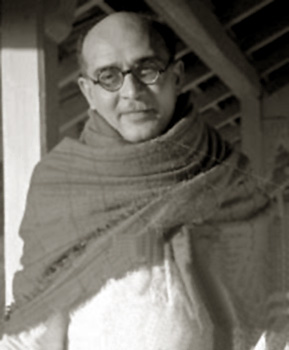 There are a number of other Gandhian writers, like Swami Anand Jugatram Dave and others, who have also contributed to Gujarati literature through their biographical and other serious writings. However, a tall figure among them is Indulal Yajnik (1892-1982), originally influenced by Mazzini and Garibaldi but subsequently drawn toward Gandhiji. He started the Young India and Navjivan weeklies (1915), which he handed over to Gandhiji (1917), and then started the monthly Yugadharma and edited the daily Hindustan. As a writer, he is known more for Gandhijina Sahavasman, in two parts, describing his experiences with Gandhiji. However, his most important work is his autobiography, Atmakatha, in five parts (1935-56), an extremely frank account of his life at various stages and a fine human document.
There were a number of other writers of the Gandhian era who further enriched the field of Gujarati literature with abundant output in different fields. Ramanayan Pathak (1887-1955), the founder-editor of the prestigious magazine Prarathan (1926), was one of them. Among Pathak`s critical works are Arvachin Kavya Sahityanan Vaheno (1935) and Sahityavimarsh (1939). His Brihat Pingal (1956) earned him the Sahitya Akademi Award. A thorough scholar of Indian prosody, Pathak considered criticism an act of social responsibility. Continuing the tradition of Anandashankar Dhruv, and others, he gave literary criticism during the Gandhian era a solid foundation. His works of poetry collected in Sheshnan Kavyo (1938) reflect his calm and generous bent of mind and sense of humor, combining compassion, seriousness, and playfulness, and display a mature diction and a radiant quality. Pathak`s short stories have a masterly touch and are emotionally linked with life. Swairavihar 1, 2 (1931, 1937) and Manovihar (1958) contain his serious essays. Though he was a product of the Gandhian era, Pathak did not mechanically recite Gandhian principles. The whole body of his writings demonstrates Pathak as an eminent literary figure.
After him came Vijayrai K. Vaidya (1897-1974), forcefully protesting the literary criticism during the Pandit Yug, which he felt was unsympathetic. He edited the quarterly Kaumudi (1924), which was later turned into a monthly (1930-37) and reemerged as Manasi, which continued breathing life into the contemporary literary scene and encouraging rebel writers until 1960. He advocated creative literary criticism in his critical works like Sahityadarshan (1935) and Sahityani Rooprekha. His other prose writings include satirical articles. In whatever literary capacity, Vijayrai is a name to be counted.
One of the greatest critics with a refined taste cultivated by the study of great literary works was Vishnuprasad Trivedi (1899-1991). His works, like Vivechana (1939), Parisheelan (1941), and Drumparna (1963), convey his mature aesthetic sense, catholicity of mind, and original thinking. Jhaverchand Meghani (1896-1947), a creative writer, was a rage in his lifetime. His poetry collections, such as Veninan Phool (1923) and Yugavandana (1935), reflect his vibrant, all-embracing personality. His short stories, following the model of Dhoomketu, are collected in Vilopan one Biji Vato (1944) and others. Among his original novels are Sorath Taran Vahetan Pani (1937) and Tulsikyano (1940). He also adapted Upton Sinclair`s novels Samuel the Speaker and Love`s Pilgrimage. Meghani`s Manasaina Dive (1946) is based on the experiences of the Gandhian worker Ravishankar Maharaj among the tribals. Saurashtrani Hasdhar, in five parts (1923-27), with its stories of valor, sacrifice, and love, Radhiyali Real, in four parts (1925-42), and Chundadi, in two parts (1928-29), compilations of Gujarati folksongs and marriage songs, respectively, are the fruit of Meghani`s lifetime devotion to Gujarati`s folk literature.
Thus the works of the Gandhian writers has gone a long way in enriching the field of Gujarati literature.
