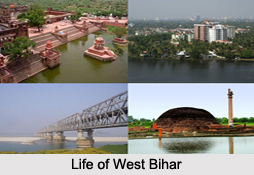
Introduction
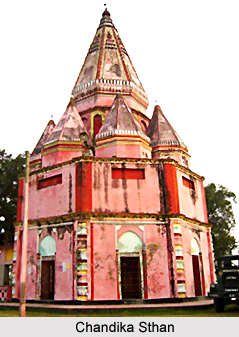 Saharsa District, which is a territory near Kosi River, is an administrative district of Bihar. It has its headquarters located at Saharsa Town. Total area occupied by Saharsa District is 1661.30 sq kms.
History of Saharsa District
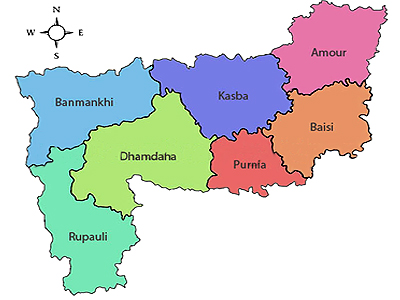
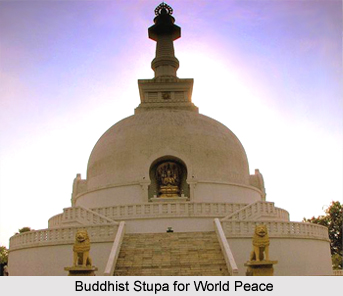 History of Saharsa District states that earlier this district was within Bhagalpur Division. Kosi Division was formed on 2nd of October, 1972 consisting of Saharsa, Purnia and Katihar District with its head quarters at Saharsa. Similarly, a new Civil Sub-Division Birpur was created on 1st December 1972 consisting of 24 development blocks namely Raghopur, Chhatapur, Basantpur and Nirmali, which were previously under Supaul sub-division of this district. Two new districts Madhepura district and Supaul district have been formed from Saharsa District on 30th April, 1981. Saharsa District now consists of 2 sub-divisions, namely Saharsa Sadar and Simri Bakhtiarpur. The district consists of 10 development blocks and anchals each.
Saharsa District was created on 1st of April, 1954. Formerly it had no independent status and parts of Saharsa were included in the old districts of Munger district and Bhagalpur district. The district has been largely influenced by its geography. Some important historical objects or landmarks have been preserved in a few places and it is on the basis of these that some kind of a connected account of the early history of Saharsa District can be constructed.
According to the ancient history of Saharsa District, Vaishali was the strongest republic in northern portion of Bihar and beyond that; there is the famous territory of Anguttarap. There was a small Janpad, named Anga, in Anguttarap and it included a portion of the district of Shaharsa. Various sites of the district now completely eroded and destroyed mainly Biratpur, Budhiagarhi, Budhnaghat, Buddhadi, Pitahahi and Mathai are associated with Buddhism.
Both Anga and North Bihar (including Saharsa) continued to be independent till the early part of the sixth century BC. For some time Magadha remained an integral part of Anga. Soon the prosperity of Anga declined. Magadh Empire was growing rapidly and the Nandas and Mauryas brought the whole of Bihar under the sway of Magadhan rule.
Under the Gupta Empire (from 320 AD), entire North Bihar was consolidated as a province with its capital at Vaishali. Therefore, the forward province came to be known as Bhukti and the district came to be known as Vishaya. In North Bihar, there were two Bhuktis, namely Tirabhukti (practically the whole of North Bihar) and Pundravardhanbhukti (included a portion of Saharsa, Purnia and a portion of North Bengal).
After the decline of the Gupta Empire the political gap came to be utilized by all contemporary chiefs. Taking advantage of the situation the Varman Dynasty of Assam (Assam) extended their authority up to this region. The rule of Purnavarman over North Bihar included the present district of Saharsa. Rise of Harshavardhana in 7th century AD was an event of great importance. He brought under his sway the whole of Northern India. The Pala Dynasty of Bihar and Bengal (8th century) AD gave a stable administration to the district. As, the Kalchuris pressed South Bihar, the Palas apparently shifted to North Bihar and Saharsa have been their headquarters during the time of Vigraphapala-III. Quite a few villages in Saharsa District are associated with the names of Pala rulers and it was through this district that the Palas could establish contact with Nepal.
Further, history of Saharsa District also states that the establishment of the Karnata in Mithila dynasty and the Sena dynastiy in Bengal followed the decline of the Pala authority in Bihar and Bengal. Both the Kanrnatas and Senas claimed authority over portion of Saharsa and often entered into armed conflict. After the fall of Oinwaras, there was virtual chaos. The Gandhaviya Rajputs are said to have acquired power and ruled during this period of confusion.
In 1764, Saharsa passed with the rest of Bengal under the Control of British East India Company. The district played a prominent role in the subsequent events which continued till the country`s independence.
Demography of Saharsa District
According to the Census in 2011, Saharsa District had population of 1,897,102 of which male and female were 995,502 and 901,600 respectively. The population of Saharsa District population constituted 1.83 percent of total population of Bihar. The average literacy rate of Saharsa in 2011 was 54.57 percent compared to 39.08 percent of 2001. If things are looked out at gender wise, male and female literacy were 65.22 and 42.73 respectively. The total literates in Saharsa District were 829,206 of which male and female were 521,560 and 307,646 respectively.
Tourism in Saharsa District
 Tourism in Saharsa District includes exploring places of religious, historical and archaeological importance. Tourism in Saharsa District offers visits to several temples. The tourist attractions of this district attract people from all parts of the country. Thus, tourism in Saharsa District means an enriching and memorable experience for the visitors.
Some of the popular places of interest of Saharsa District are mentioned below -
Tara Sthan at Mahishi: It is situated at a distance of about 16 kilometres west of Saharsa in village Mahishi where an ancient temple of Bhagwati Tara is built. The idol of Bhagwati Tara is said to be very old and draws devotees from everywhere.
Chandika Sthan at Biratpur: Biratpur village under Sonebarsa block of Saharsa District is famous for an ancient temple of goddess Chandi. This village is also associated with Mahabharata. During exile, the Pandavas had lived here for 12 years. Tantric scholars and devotees attach much significance to this Chandi Devi Temple, which is said to form an equilateral triangle with Katyayani temple near Dhamhara ghat and Tara temple at Mahishi. During Navratri people from distant places visit the village to offer prayers at this temple.
Mandan Bharti Asthan: The place is situated in Mahishi Block of the district. It is said that a religious discourse (Shastrarth) was held between Shankaracharya and a local scholar Mandan Mishra. Bharti, wife of Mandan Mishra, who was also a great scholar, was named as Judge for the discourse. It is also said that Shankaracharya, after his initial victory over Mandan Mishra was challenged by Bharati, was outwitted by her and he accepted defeat.
Sun Temple at Kandaha: Like Deb (in Aurangabad District), the Sun Temple at Kandaha village is an important religious and historical place which has been duly recognized by the Archaeological Survey of India. The idol of sun god riding seven-horsed chariot, has been carved on a single granite slab. At the door of the sanctum sanctorum, there are inscriptions that confirm that this sun temple was built during the period of King Narsimha Deo of Karnata dynasty who ruled over Mithila.
Laxminath Gosaisthal, Bangoan: The huge banyan tree under which the remains of Laxminath Gosaiji (famous saint and poet) have been preserved is the centre of great reverence for the people of the district.
Nauhatta: It is an old village, considered important since the time of Mughals and is presently the headquarters of the block of the same name. The village has a `Shiva temple` about 80 feet in height. Raja Srinand Singh of Srinagar Estate reconstructed the temple, which was damaged in the earthquake of 1934.
Udahi: The village is situated in Kahra block. It contains an ancient image of Goddess Durga discovered during excavation. Devotees throng here from everywhere. A fair is held on the day of Mahaashtami Puja every year.
 Karu Khirhari temple: Situated on the bank of Kosi River, a temple of Saint Karu Khirhari is said to have attained divinity by virtue of his Shiva-Bhakti. People from all occupations come to offer milk to Karu Baba. This temple near Mahpura village is situated 2 kms away from Mahishi block office. It is situated in the riverside of the eastern Kosi Embankment. Recently the state government has announced to develop Karu Khirhari temple as a major tourist spot.
Matsyagandha Mandir: The barren water logged area in Saharsa town has been developed as a beautiful place commonly known as Matsyagandha Mandir.
These are some of the main attractions of Saharsa District and all of them are worth visiting.