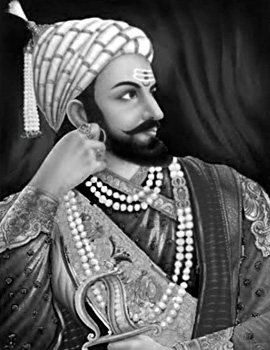
 Military administration of Shivaji was a very efficient one. Cavalry and infantry constituted the primary parts of the army of Shivaji. The strength of his army at the time of his death was forty five thousand paga and sixty thousand silahdar cavalry, and one lakh infantry. The War-elephants numbered only three hundred. He possessed small artillery as well. The paga cavalrymen were provided horses by the state while the silahdars purchased their arm and horses themselves. The paga cavalry was well organised.
The infantry was also divided. The foot soldiers were called the path. There was a nayak over every nine paiks, one havaldar over every ten nayaks, over every two or three havaldar a jumladar, over ten jumladars one hazari and over every sever hazaris one seven-hazari. There was no Jive-hazari in the infantry. Above all was the sar-i-naubat of the infantry. Shivaji also kept Muslim soldiers in his army. The army of Shivaji was well-disciplined. Every care was taken in the recruitment, training and equipment of the army. Shivaji looked after the recruitment of the soldiers personally. The soldiers and officers of the army were mostly paid in cash. The foot-soldiers and their junior officers were paid rupees three to rupees nine a month while the soldiers and the junior officers of the cavalry were paid rupees six to rupees seventy per month. Shivaji paid the salary of his officers and soldiers on a fixed day. The army was kept under strict discipline by Shivaji.
The army remained in the cantonment only during four months of rainy season. During the remaining eight months, it went out either to conquer fresh territory or to collect supplies from the enemy-land. Every article of every soldier was accounted before he left cantonment and when he returned to it, so that no soldier could hide his booty. Shivaji formed elaborate rules and regulations to maintain discipline in the army and all of them were rigorously enforced. Therefore, he succeeded in organising a well-disciplined, strong and highly mobile army during his own life-time.
The forts and their security occupied an important place in the army organisation of Shivaji. Shivaji had nearly two hundred and fifty forts which were important for him both for purposes of defence and offence. Therefore, he took all necessary measures for the security of his forts. There were three important officers, viz., a havaldar, a sabnis and a sar-i-naubat in every fort. All the three were jointly responsible for the safety of their fort. The sar-i-naubat and the havaldar were Marathas while the sabnis was a Brahmana by caste. There was mother officer called kharkhana-navis who was responsible for the maintenance of all sorts of supplies in the fort. He also kept the account of every income and expenditure incurred in the fort. The havaldar had the duty to look after the working of his subordinates, the right to dismiss them, to receive and dispatch letters, to close the gates of the fort in the evening, to open the gates in the morning and to check the measures taken for the security of the fort.
Shivaji maintained a navy as well. Once he conquered the Konkan coast, it became necessary for him to safeguard his coastal territory from the invasion of the Sidis of Janjira. Shivaji had four hundred ships of different kinds in his navy. The navy was divided into two parts and each part was commanded by daria nayak and mai nayak respectively. The navy of Shivaji fought against the Dutch, the Portuguese and the English at several occasions.
Thus, Shivaji was successful in maintaining an efficient military administration during his reign.