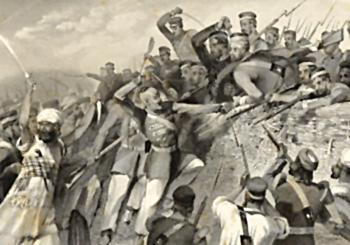
 Many causes were responsible for the failure of the revolt of 1857. In the first place the revolt was localised. There were many parts of India which were not affected by the revolt at all. Particularly the territory south of the Narmada River remained undisturbed. Sindh was quiet. Rajputana was loyal. It is contended that if the Revolt would not have been localised and would have spread to every nook and corner of the country then the fate of the Revolt would had been different.
The rebels failed on account of the lack of leadership among them. It is true that the Rani of Jhansi was a capable woman but she was neither the head of all the forces nor an experienced general. General Bakht Khan was a brilliant man but he was not in charge of the whole show. The rebels worked without any common plan. They were short of modern weapons and other materials of war. The fought with ancient weapons such as pikes, swords, arrows etc. They were brave and selfless, but they were ill disciplined. Sometimes they behaved more like riotous mob than a disciplined army. There was no centralised leadership. There was no co-ordination among them in various parts of the country. The rebels were joined together by a common feeling of hatred against foreigners and when British power was overthrown from any area, they did not know what sort of power to create in its place. They were often suspicious and jealous of one another and often got involved in suicidal quarrels. It has been said that the selfishness of the leaders sapped the strength of the revolt and prevented its consolidation. The peasantry having destroyed the revenue records and account books of the money lenders became passive and did not know what to do next. The British succeeded in crushing the leaders of the revolt one by one.
The rebels had no forward looking programme to be implemented after the capture of power. The absence of a modern and progressive programme enabled the reactionary princes and Zamindars to seize the levers of power of the movement. These people had already been defeated by the British and they had nothing new in them which could help them to succeed against the British.
The money lenders were the targets of the attacks by villagers. They were naturally hostile to the revolt. The merchants gradually became unfriendly towards the rebels who were imposed to impose heavy taxes on them in order to finance the war or to seize their stocks of foodstuffs to feed the armies. The merchants often concealed their wealth and goods and refused to give free supply to the rebels. The Zamindars of Bengal remained loyal to the British. The hostility of Bihar peasants towards the Zamindars frightened the Zamindars of Bengal. The big merchants of Bombay, Calcutta and Madras supported the British because the main profits came from foreign trade and economic connection with the British merchants.
The educated Indians did not support the revolt. They stood for ending the backwardness of their country and they believed that the British Government in India was destroying the feudal forces in the country and was bringing in a new era of progress in the country. Their view was that the rebels stood for the old order along with its superstitions.
The personal character of the Bengal troops was also responsible for the failure of the Revolt. They were arrogant and were hated in every part of India to which they were sent. At many places the rebels were crushed by the people themselves.
The year 1857 was favourable to the British in many ways. The Crimean War was over in 1856. The Chinese War was just over. The British armies were free to throw in their weight against the rebels. Russia was defeated in the Crimean War and there was no danger from those quarters. Internationally, the Indian rebels were isolated.
As the British had control over the sea, they were in a position to pour into India both men and materials with practically no difficulty. A large number of troops were sent to India t once. The Indians fighting with primitive weapons were no match for the British with the Enfield rifles.
The only hope of success for the rebels was to have quick victories. Time factor was against them. It could be taken for granted that the British would be able to get reinforcements from outside and when that happened, the revolt collapsed.
The rebels appealed to all other sections of society but no appeal was made to the peasants. While all other classes were promised a better deal, the peasants were ignored all together. The inability of the rebel leaders to rally the peasants to their side doomed their cause. The revolt got its strength from the princes, noble-men and other feudal interests and those forces were incapable of overthrowing the British Government in India.
Finally it can be said that the Sepoy Mutiny of 1857 failed because it was not inspired by any positive creative ideas. It did not entertain either the vision of a high social order or of a higher political system. It was a transient intoxication and not a permanent transformation of the will of the people. Moreover intellectually they were no match for their enemy whose military technique was based on science. Even in strategy and techniques the British forces were far superior to the Indian ones.