
 Licchavi, also spelled Lichchhavi are people of northern India. They settled in the 6th-5th Century BC on the north bank of the Ganga River in what is now Bihar state; their capital city was at Vaishali. The Licchavis were renowned for their republican government, which had a general assembly of the heads of the leading Kshatriya-caste families. They were, for a time, of considerable importance and rivalled the rising power of Magadha, forming a confederacy with other tribal groups.
Licchavi Tribe
LicchaviTribes were a famous tribe of eastern India. They were present in the Indian land from the times of Lord Buddha as well as Mahavira.
Introduction
Licchavi, also spelled Lichchhavi are people of northern India. They settled in the 6th-5th Century BC on the north bank of the Ganga River in what is now Bihar state; their capital city was at Vaishali. The Licchavis were renowned for their republican government, which had a general assembly of the heads of the leading Kshatriya-caste families. They were, for a time, of considerable importance and rivalled the rising power of Magadha, forming a confederacy with other tribal groups.Origin of Licchavi Tribe
It has been recorded in the history that the Licchavis were present in India from the times of Lord Buddha and Lord Mahavira preached. The Licchavis were also associated with the Sakya Tribes. Rather, it can be said that the Licchavis and the Sakyas were branches of the same origin.
Society of Licchavi Tribe
According to the society of the Licchavis are concerned it can be said that they lived in great amity and concord, and this unity coupled with their martial instincts and the efficiency of their martial institutions made them great and powerful amongst the nations of North-Eastern India. The sympathy of the Licchavi for one another was exemplary. If one Licchavi fell ill, the other Licchavis came to see him. The whole clan would join in any auspicious ceremony performed in the house of one of their number; if any foreigner of rank and power paid a visit to the Licchavi capital, they would all go out in a body to receive him and do him honour.
The young Licchavis were handsome in appearance and fond of brilliant colours in their dress and equipages. They Licchavis suited the colour of their clothes and ornaments to the tint of their complexions. The Licchavis were divided into separate sects distinguished by the colour worn by each. There was a profusion of gold and jewels in everything in their equipage carriages drawn by horses, gold-bedecked elephants, palanquins of gold set with all kinds of precious stones.
It is evident from the historical records that the Licchavis were prosperous but they were not at all indolent in nature. Rather they were hardy and active, ardent and strenuous in their military training. They were fond of manly pastimes such as elephant training and hunting. It was a custom that the Licchavi youths went to distant countries for their education.
As far as art and architecture is concerned it can be said that it flourished to a large extent in the city of Vaishali which was a splendid place of the Licchavis. The magnificent palaces of the Licchavis are a testimony to the fact that architecture had reached a pinnacle during the times of the Licchavis. They were equally enthusiastic in the building of temples, shrines, and monasteries for the Bhikkhus; and the Bhikkhus themselves superintended the construction of these buildings for the Order. The Licchavis of Vaishali built many chaityas or shrines inside and outside their great city.
Regarding the marriage customs of the Licchavis it has been said that there were rules restricting the marriage of all girls born in Vaishali to that city alone. The people of Vaisali had made a law that a daughter born in the first district could marry only in the first district, not in the second or third; one born in the middle district could marry only in the first and second; but that one born in the last district could marry in any of the three; moreover, no marriage was to be contracted outside Vaishali. The Licchavis appear to have had a high idea of female chastity; violation of chastity was a serious offence amongst them.
The Licchavis observed various festivals, of which the Sabbaratticaro was the most important. At this festival, songs were sung, and drums and other musical instruments were used. When a festival took place at Vaishali, all the people used to enjoy it, and there were dancing, singing and recitations.
The young Licchavis were handsome in appearance and fond of brilliant colours in their dress and equipages. They Licchavis suited the colour of their clothes and ornaments to the tint of their complexions. The Licchavis were divided into separate sects distinguished by the colour worn by each. There was a profusion of gold and jewels in everything in their equipage carriages drawn by horses, gold-bedecked elephants, palanquins of gold set with all kinds of precious stones.
It is evident from the historical records that the Licchavis were prosperous but they were not at all indolent in nature. Rather they were hardy and active, ardent and strenuous in their military training. They were fond of manly pastimes such as elephant training and hunting. It was a custom that the Licchavi youths went to distant countries for their education.
As far as art and architecture is concerned it can be said that it flourished to a large extent in the city of Vaishali which was a splendid place of the Licchavis. The magnificent palaces of the Licchavis are a testimony to the fact that architecture had reached a pinnacle during the times of the Licchavis. They were equally enthusiastic in the building of temples, shrines, and monasteries for the Bhikkhus; and the Bhikkhus themselves superintended the construction of these buildings for the Order. The Licchavis of Vaishali built many chaityas or shrines inside and outside their great city.
Regarding the marriage customs of the Licchavis it has been said that there were rules restricting the marriage of all girls born in Vaishali to that city alone. The people of Vaisali had made a law that a daughter born in the first district could marry only in the first district, not in the second or third; one born in the middle district could marry only in the first and second; but that one born in the last district could marry in any of the three; moreover, no marriage was to be contracted outside Vaishali. The Licchavis appear to have had a high idea of female chastity; violation of chastity was a serious offence amongst them.
The Licchavis observed various festivals, of which the Sabbaratticaro was the most important. At this festival, songs were sung, and drums and other musical instruments were used. When a festival took place at Vaishali, all the people used to enjoy it, and there were dancing, singing and recitations.
Religion of Licchavi Tribe
 Licchavis had a strong religious bent of mind in spite of the fact that they were vigorous, martial and highly prosperous. The main religions of the Licchavi tribes were Jainism and Buddhism. The Licchavi tribes appear to have been imbued with a strong religious spirit. The Licchavis appear to have had numerous shrines in their town as well as in the country. Even after Jainism and Buddhism had obtained a strong hold on the Licchavis of Vaishali, the great body of the people of the Vajji country as well as of the capital remained staunch followers of their ancient faith, the principal feature of which was Chaitya worship, although they had due respect for the Jaina or Buddhist sages who wandered over their country preaching the message delivered by their respective teachers.
Licchavis observed their old religious rites for a long time because initially Buddhism at the early stage was a form of faith for ascetics only, not a religious creed for all people. The Buddhists at this period formed only one of the numerous ascetic sects of Northern India; thus there was nothing unusual in the fact that many of the Licchavis who were householders and had not accepted the life of Bhikkhus. About the worship of the Licchavis it can be said that that the religious beliefs of the Licchavis were not much different from other parts of northern India. Some of the well known Chaityas of the Licchavis were Capala, Saptamraka, Bahuputra, Gautama, Kapinahya and a lot more.
Historical records say that Lord Buddha had said that as long as the Licchavis honour and esteem and revere and respect and support the Vajjian shrines in town or country they shall never decline from their position but rather they would always prosper. Lord Buddha had exercised a remarkable influence even over the fiercest of the Licchavis. Many times Lord Buddha had paid his visit to Vaishali in order to help them out from many other problems. Even many of the Licchavi women were converted to Buddhism some of the Licchavi women who had been converted to Buddhism were Siha, Jenti, Vasetthi, and Ambapali.
Some of the Buddhist books refer to the fact that many of the Vedic deities like Indra and Prajapati or Lord Brahma were worshipped by the Licchavis in the pre-Buddhist period. On the other hand Kautilya`s Arthasashtra has stated that the Licchavis used to worship many other deities besides the several Vedic deities.
Administralicchavi_tribetion of Licchavi Tribe
 As far as the administration of the Licchavis is concerned it can be said that the Licchavis formed a republic in the sense that there was no hereditary monarch, the power of the State being vested in the assembly of citizens. It does not appear to have been a completely democratic republic, but an oligarchy, citizenship being confined to members of the confederate clans. The Licchavis formed what was called a samgha or gana, that is, an organised corporation.
It has been mentioned in the Arthasashtra of Kautaliya that among the Licchavis each citizen had the right to call himself a raja, `king`, i.e. a dignitary who did not owe allegiance or pay revenue to any one else. Each citizen not merely looked upon himself as a raja, but considered that his title should be recognised not only by his fellow clansmen but also by the other people of India. Kautilya observes that all these samghas by virtue of their being united in such corporations were unconquerable by others. He had further observed that for a king, a corporation was the best and most helpful of all allies, because of the power derived from their union which made them invincible.
The public hall where the Licchavis used to hold their meetings was called the Santhagara, and there they discussed both religion and politics. It has also been said that in those public halls the Licchavis also discussed the teachings of Lord Buddha. As in the Buddhist congregation, so among the Licchavis, the elders of the clans were highly respected, as we see from the Mahaparinibadna Suttanta.
The disputes among the Licchavis were settled by the votes of the majority and this voting was by ballot; voting tickets were served out to the voters, and an officer of approved honesty and impartiality was elected to collect these tickets or voting papers. The appointment of this officer was also made by the whole assembly. There was also a provision for taking the votes of absent members. From all these it is evident that the political organisation among the Licchavis was very strong.
History states that an Uparaja or Viceroy, a Senapati or general, and a treasurer formed the private staff of every Licchavi Raja. Each Raja had personal property of his own which was managed by him with the help of these three officers. There were officers who recorded the decisions of the Council.
The Atthakatha has given an account of the judicial procedure among the Licchavis. When a person who had committed an offence appeared before the Vajjian rajas, they surrendered him to the Viniccaya-Mahamattas, i.e. officers whose business it was to make enquiries and examine the accused with a view to ascertaining whether he was innocent or guilty. If they found the man innocent, they released him; but if they considered him guilty, they made him over to the Vohdrikas, i.e. persons learned in law and custom. These could discharge him if they found him innocent; if they held him guilty, they transferred him to certain officers called Suttadhdras, that is, officials who kept up the sutra (sutta) or thread of law and custom. They in their turn made further investigation, and if satisfied that the accused was innocent, they discharged him. If, however, they considered him guilty, he was made over to the Atthakulaka which was evidently a judicial institution composed of judges representing the eight kulas or tribes of the confederacy.
The Atthakulaka if satisfied of the guilt of the accused, made him over to the Senapati or commander of the array, who delivered him over to the Uparaja or sub-king, and the latter in his turn handed him over to the Raja. The Raja released the accused if he was innocent; if he was found guilty, the Raja referred to the Pavenipotthaka, that is, the pustaka or book recording the law and precedents, and prescribing the punishment for each particular offence. The Raja having measured the culprit`s offence by means of that standard, used to inflict a proper sentence to him.
Recently updated articles in Tribes of India
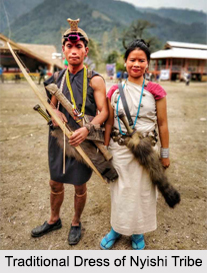
Traditional Dress of Nyishi Tribe
Traditional Dress of Nyishi Tribe is worn during festivals and social gathering. Men wear a cane helmet surmounted with the beak of the great Indian H...
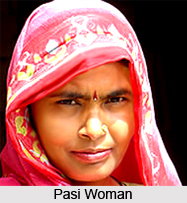
Pasi Community
Pasi is an aboriginal race of India and are mainly distributed over the northern region of the country. The traditional occupation of Pasi is the extr...

Bhojas
Bhojas have been described as a very important tribe in the Aitareya Brahmana. Historical records have said that the Bhojas were settled towards the s...
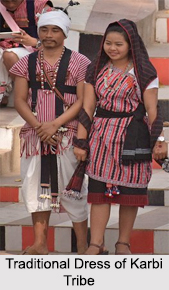
Traditional Dress of Karbi Tribe
Traditional Dress of Karbi Tribe can be easily recognized by the artistic designs inherited from their forefathers. Karbis have their own traditional...
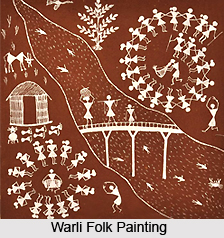
Indian Folk and Tribal Arts
Indian folk and tribal art are the exclusive handiwork of the section of people who belong to different social groups and it is richly enriched with a...
Related articles in Tribes of India

Sentinelese Tribe
Sentinelese tribal community is one of the most isolated and secluded tribes that are found in the whole world.
Bhil Tribe
The people of the Bhil tribe are the most widely distributed tribal groups in India.
Jaintia Tribe
Jaintia Tribes are located in the Jaintia Hills of Meghalaya. They are also called the Pnars. They are famous for weaving of carpet, making of musical...
Garo Tribes
Garo Tribes are one of the matrilineal tribes of North-East India who reside in the Garo hills of Meghalaya. Historically, the tribe originated in Tib...
Garasia Tribe
The Garasia tribal community holds a significant position within Indian culture, renowned for their distinctive way of life and rich cultural heritage...