


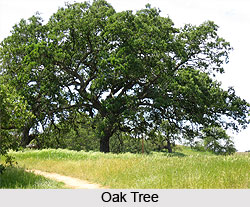
 Oak belongs to the genus "Quercus" family which comprises over 600 different species of trees. Most species of oak trees are deciduous with only couple of evergreen forms. Oak trees generally occur in the temperate areas of the Himalaya and strangely enough none are found in the Nilgiris. The main use of the timber is as fuel and the leaves are a good fodder and hence they are ruthlessly lopped for this purpose. An indirect value of oaks is the protection which they give to the more important coniferous trees, during the youth of the latter. Oak belongs to the genus "Quercus" family which comprises over 600 different species of trees. Most species of oak trees are deciduous with only couple of evergreen forms. Oak trees generally occur in the temperate areas of the Himalaya and strangely enough none are found in the Nilgiris. The main use of the timber is as fuel and the leaves are a good fodder and hence they are ruthlessly lopped for this purpose. An indirect value of oaks is the protection which they give to the more important coniferous trees, during the youth of the latter.
Oak trees are prone to fungal diseases that may induce rotting of the inner part of the plant. Besides fungi, insects often attack oaks and induce removal of the leaves. 78 species of oaks are listed as endangered because of the habitat destruction, over exploitation, diseases and introduction of invasive species. Many plants commonly called "Oak" are not Quercus species e.g., African Oak, Australian Oak, Bull Oak, Jerusalem Oak, Poison Oak, River Oak, She Oak, Silky Oak, Tanbark Oak, Tasmanian Oak and Tulip Oak. Characteristic Features of Oak Trees Oaks have spirally arranged leaves, with lobate margins in many species; some have serrated leaves or entire leaves with smooth margins. Many deciduous species are marcescent, not dropping dead leaves until spring. In spring, a single oak tree produces both male flowers and small female flowers. The fruit is a nut called an acorn, borne in a cup-like structure known as a cupule; each acorn contains one seed and takes 6-18 months to mature, depending on species. The live oaks are distinguished for being evergreen, but are not actually a distinct group and instead are dispersed across the genus. Different Species of Oak Trees About 32 species are found in the subcontinent including Burma. The more important of these are the Ban Oak, Buk Oak and Moru Oak. 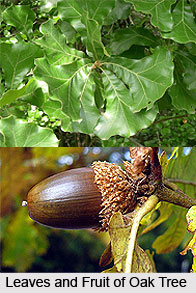
Uses of Oak Tree In hill stations of India, besides fuel wood and timber, the local people use oak wood for making agricultural implements. The leaves are used as fodder during lean period and bedding for livestock. Oak bark is also rich in tannin, and is used by tanners for tanning leather. Toxicity in Oak Tree The leaves and acorns of the oak tree are poisonous to cattle, horses, sheep and goats in large amounts due to the toxin tannic acid, and cause kidney damage and gastroenteritis. Symptoms of poisoning include loss of appetite, depression, constipation, diarrhoea, blood in urine and colic. Biodiversity and ecology Many species of oak trees are under threat of extinction in the wild, largely due to land use changes, livestock grazing and unsustainable harvesting. There is a continuing threat to these forests from exploitation for timber, fuel wood and charcoal. In the Himalayan region of India, oak forests are being invaded by pine forests due to the increase in temperature. |
| |||



Oak Tree
| Oak trees are large tree which is found in plenty in the Himalayan regions. The primary use of its timber is as fuel and the leaves of this tree is the best fodder. |
| ||||||||||||||||||||||||||||

