


 Impact of Portuguese Rule in Kerala introduced a more scientific method of agriculture. They also established the trade links between Kerala and the western world. When one considers the record of the Portuguese in Kerala, it is quite easy to focus on its more dramatically unpleasant aspects while forgetting the better side, and the changes, some of them undoubtedly good, which were brought to Kerala. Perhaps the best thing of all for the Portuguese is that, however bigoted they may have been in religion, they do not believe in the prejudices of race. Wherever they went, colour bars were abolished. Portuguese officials and soldiers were encouraged to marry Keralan women, and Malayalis, if they became Christians, had equal rights as whites in the municipality which was set up in Fort Cochin. Converts were also provided high civil and military posts, and some were even ennobled. It could be said that Francis Xavier, with his mass conversions among the fishermen of Travancore, struck the first blow in the long battle to stop the evils of untouchability. Impact of Portuguese Rule in Kerala introduced a more scientific method of agriculture. They also established the trade links between Kerala and the western world. When one considers the record of the Portuguese in Kerala, it is quite easy to focus on its more dramatically unpleasant aspects while forgetting the better side, and the changes, some of them undoubtedly good, which were brought to Kerala. Perhaps the best thing of all for the Portuguese is that, however bigoted they may have been in religion, they do not believe in the prejudices of race. Wherever they went, colour bars were abolished. Portuguese officials and soldiers were encouraged to marry Keralan women, and Malayalis, if they became Christians, had equal rights as whites in the municipality which was set up in Fort Cochin. Converts were also provided high civil and military posts, and some were even ennobled. It could be said that Francis Xavier, with his mass conversions among the fishermen of Travancore, struck the first blow in the long battle to stop the evils of untouchability.
Economically, with their greedy demand for pepper and other spices, the Portuguese accelerated the tendency for agriculture to focus on cash crops for export at the expense of food crops, and it went to such an extent that as early as the 16th century rice was already being imported since local production was insufficient. In the year 1557, when the Portuguese blocked the rice ships coming down the coast from Mangalore, Calicut was jeopardized with famine. Rice shortage in Kerala, which gained immense publicity in recent years, is thus a condition which is prevalent ever since the Portuguese altered the economic balance of agriculture in Kerala. 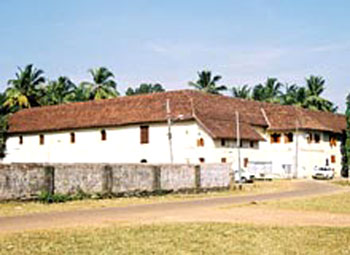 The Portuguese in Kerala encouraged a much more systematic and scientific way of farming cash crops than the Malayalis had hitherto practiced, and thus they changed the very appearance of the Keralan countryside. Before they arrived, coconut was cultivated mainly for local use. It was the Portuguese who, having discovered the use of coconut fibers in making sturdy coir ropes started encouraging its commercial cultivation and thus made coir and copra articles of world trade. They even brought in from Africa a new strain of coconut which produced better and bigger fruit than the trees the Ezhavas had brought on their wanderings so long ago.
Today it is these Portuguese coconuts, (ship-borne coconuts, as they are called in Malayalam language) which are planted for mile after mile along the Kerala coast and which, more than any other element, form the peculiar beauty of the landscape. They are not the only familiar plants in Kerala which came with the Portuguese, who introduced both the pineapple and the papaya, which are now cultivated in every Malayali compound, and also the cashew-nut which is now a major export crop; the Malayalis still call it the Frankish Mango (Parangi Mavu). Impact of Portuguese Rule on Kerala Architecture 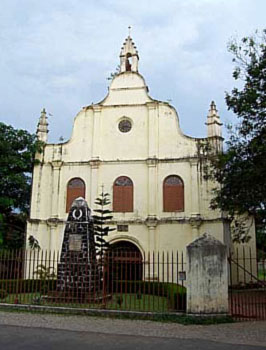 In town planning and architecture, in education and, more negatively, in warfare, the Portuguese also helped to change the nature of the life of Kerala. To this day Fort Cochin, which they, in the first place, planned and built, the nearest thing to a European town in Kerala, with its dense population, its compactness, its streets of shops and houses laid out in regular patterns and its huge masonry warehouses and public buildings. Yet Cochin, as it exists now, is only a ghost of Portuguese Cochin, with its colleges, palaces and churches. The Dutch pulled down a number of these buildings, but one Dutchman, Captain Nieuhoff, the famous voyager, remembered them with regret.
There is one church which remains at Fort Cochin as a monument to the Portuguese is that of St. Francis, constructed originally as the Church of St. Anthony in the year 1516, and used successively as a government church by the Anglican English and the Calvinist Dutch. There are still, however, some Portuguese churches with splendid whitewashed baroque facades which have lasted in villages along the backwaters and on the seashore, and near Cranganore stands the last living example of another type of Portuguese architecture, square, the grim, utilitarian block of the deserted fort of Pallipuram, so massive that the centuries have worn away at it to little effect. The domestic architecture of the Portuguese even had its influence on the tastes of the native princes. Before the arrival of Vasco da Gama, the palaces were wooden buildings; often very small, where the kings used to stay for short periods, travelling from one to the other like the earlier emperors of Japan. In the year 1555, however, the Portuguese at Mattancherri constructed as a gift to the Raja of Cochin a large stone palace having thick walls and a profoundly tiled roof, which still survives under the misleading name of the Dutch Palace and which possesses one of the finest groups of traditional Indian mural paintings in the state of Kerala. The Dutch Palace set a fashion for mansions made of masonry, and at the time of the Portuguese period many such buildings were apparently constructed for the use of the Nayar nobles in trading towns like Quilon, Cochin and Kolikod (Calicut). The Portuguese colleges established by the Jesuits at Vaippicotta and Cochin and the Franciscans at Cranganore were religious in intent, founded in order to increase Roman Catholic influence among the Syrian Christians, but they accomplished another purpose by teaching Portuguese and Latin to many hundreds of young Malayalis, and in this way they contributed to the beginning of the great educational movement which was later to make the state the most literate regions in India. Apart from the local Christians, a majority of the Hindu chiefly families were influenced by this early Western education. In fact, till the formation of British supremacy in Kerala, Portuguese continued to be the diplomatic language of the rulers of the state. For instance, all the letters addressed by the Zamorin to the English factor, for over half a century after the departure of the Portuguese from Kerala, were written in the language of Camoens. Certainly, as compared to the changes which British domination brought in the ways of life of every section of the community, the impression of the Portuguese occupation was slight. But in another sense they were accountable for all that came afterwards from the Western world, since it was the trade they instituted that linked the fate of Kerala with the life of Europe for almost three centuries after they had gone. In fact, except politically the link has not been broken yet and Kerala is still more dependent than other states of India on its foreign trade and hence on the vicissitudes of world markets. |
| |||



Impact of Portuguese Rule in Kerala
| Impact of Portuguese rule in Kerala contributed to the advancement of educational system in the state along with advanced mode of agriculture and foreign trade. |
| ||||||||||||||||||||||||||||

