


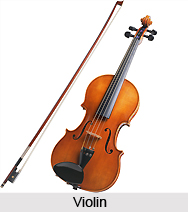
 Violin is one of the most outstanding examples of cultural inert-mingling and absorption in music. Violin in Indian Classical Music was first adopted for string accompaniment in South India at the end of the eighteenth century. The violin filled the need for an accompanying instrument, besides the Sarangi, that could duplicate, by bowing, the long breath of vocal style. Violin is one of the most outstanding examples of cultural inert-mingling and absorption in music. Violin in Indian Classical Music was first adopted for string accompaniment in South India at the end of the eighteenth century. The violin filled the need for an accompanying instrument, besides the Sarangi, that could duplicate, by bowing, the long breath of vocal style.
History of Violin in India Bowed instruments have been present in India for over ten centuries, and there are sculptures showing remarkable similarity to the violin in the Mallikarjuna temple (Vijayawada, tenth century) and the Nataraja temple (Chidambaram, twelfth century). The modern violin as we know it today was undoubtedly brought by the Western colonizers-the Portuguese, the French and the British, particularly the last. The rich sound qualities and the great versatility of the violin have made its adaptation to Indian music easy and beneficial. It found its way into Indian music when a Tanjore court minister, Varahappaiar, who was also an accomplished musician, visited the British Governor's compound in Chennai on business. There he saw, tried, and carried back to Tanjore a violin (and also a piano) presented to him by the governor. The first South Indian musician to adapt the violin to Carnatic music was Balaswami Dikshitar (1786-1858). Believing that the instrument could be made suitable for his own musical tradition, Balaswami retuned it from G D A E to Sa Pa Sa Pa and began to experiment. He concertized successfully for the rest of his life on the violin, as well as on other instruments. Another artist who is dubbed as a pioneer in the introduction of the violin to Indian music is Vadivelu (1810-1845). He was the youngest of four brothers who achieved such musical fame that they were known as the Tanjore Quartet. Structure of Violin The instrument consists of a body, sound box, to which is attached the fingerboard by means of a neck. The body is made of the curved upper plank (the belly) which has two F-shaped holes and the lower plank (the back). The two are connected by thin plates of wood called the ribs. At the playing end, the fingerboard ends in a head which consists of the peg box and the scroll. There are four pegs corresponding to four strings. At the end of the belly the strings are fixed to the tailpiece, where small screws, one for each string are fitted for delicate tuning. The bridge standing on the belly is thin and curved at the top to facilitate bowing of the strings. The strings are usually of steel or gut; sometimes thin gut covered with fine silver coil is used. The tuning is as Ma, Sa, Pa, Ra, or Sa, Pa, Sa, Pa. Inside the body, under the bridge, a small vertical piece of wood, the sound post, is placed, the purpose of which is to conduct sound from the belly to the back. The bow is thin and long. The stick is much longer and is almost straight and horse hair is fixed permanently to the distal end. At the holding end they are attached to a movable piece which can be shifted forward or backward by means of a screw inside the bow. This gives the proper tension to the hairs of the bow. Playing of Violin The Carnatic musicians sit cross-legged to play the violin, holding the instrument vertically, and balancing it between the chest and the right foot. The left hand is free to move up and down the fingerboard. This position and the fingering technique in Carnatic violin playing reduce the volume of the sound. Customarily, the violin is pitched an octave higher than the voice of the singer it is accompanying. The violin has become a prominent instrument in Carnatic Music. In Hindustani music, however, it is even more recent, perhaps five decades old. Although the violin is played as a solo instrument by a few Carnatic musicians, its primary role in the South is to participate in vocal performances. |
| |||



Home > Movies & Entertainment > Indian Music > Indian Musical Instruments > String Instruments > Violin
Violin
| Violin is a string instrument which, though an import from the west, is extensively used in Indian Music. It is most prominently used for Carnatic music performances. |
| ||||||||||||||||||||||||||||

