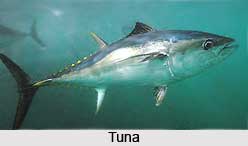
 Tuna or Tunny belong to the family Scombridae. These are very widely distributed important fishes in the tropical and temperate regions of all the oceans of the world. Having a fusiform robust stature, they are powerful swimmers; every part of their body is streamlined: a bullet-shaped head, close-set jaws, the dorsal, pectoral and pelvic fins fitting into grooves and depressions to minimize resistance to water. Another unique feature of tunas is that their body temperature is higher than the surrounding water. Most of them are bright steel-blue on the back, becoming lighter silvery towards the belly. Some have stripes while some species have long spots on the sides. Similarly some species have long pectoral fins and some have short ones. Their migrations have been a matter of curiosity and speculation since ancient times but it has now been established that these rovers of the oceans migrate for breeding and feeding during certain seasons.
Several species of Tuna visit the western coast of India during the month of September to the month of March when the smaller fishes such as sardines and mackerel also arrive in this area. Large species such as the Ocenic Skipjack, Ketsunus pelamis and Yellow-fin Tuna, Thunnus albacore macropterus grow to about a metre (weighing twenty five kilograms) and two metres (fifty kilograms) respectively and are available near the offshore islands of Lakshadweep. Smaller forms such as Frigate Mackerel (Auxix sp.), Bonito (Sarda orientalis), Little Tunny (Euthynus affinis) and the Northern Blue Fin (Kishinoella or Thunnus tonggol) approach coastal waters in search of live food. They disappear from the coastal waters at the end of the usual season. About twenty five thousand tonnes is annually landed in Indian ports, about a fifth of the entire Indian Ocean production. Tuna, when canned, is very popular in Europe and USA, where it is considered as the chicken of the sea.
This article is a stub. You can enrich by adding more information to it. Send your Write Up to content@indianetzone.com