Pomfret
|
Pomfret is among the most sought after edible fishes in the markets of India due to their flavour.
|
|
|
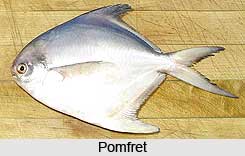 Pomfrets (Stromatidae) are the most popular edible fish in India and fetch the highest price in Mumbai markets, their popularity stemming from the clean white appearance of the body, firmness of flesh and flavour. Three species, Silver pomfret (Pampus argenteus), Grey pomfret (Pampus sinensis) and Parastromateus niger, the Black pomfret, are commonly met with on the east and west coasts of India. The black pomfret has been placed into a separate family but it continues to be associated with the category of pomfrets in common parlance. Pomfrets (Stromatidae) are the most popular edible fish in India and fetch the highest price in Mumbai markets, their popularity stemming from the clean white appearance of the body, firmness of flesh and flavour. Three species, Silver pomfret (Pampus argenteus), Grey pomfret (Pampus sinensis) and Parastromateus niger, the Black pomfret, are commonly met with on the east and west coasts of India. The black pomfret has been placed into a separate family but it continues to be associated with the category of pomfrets in common parlance.
Silver pomfret, the commonest of the three, is somewhat rhomboid in shape, has a blunt nose, a single long dorsal fin and a caudal fin with long lobes, the lower caudal lobes being much extended and pointed. The lobes shorten as age progresses. Adults are silvery white with small silvery scales, but when about five to eight centimetres they are black, and lightly striped when smaller. Though the average large size of Silver pomfret is about one kilogram and thirty centimetres long; the largest reach a length of forty centimetres and weigh two kilograms. Being an offshore species, they normally prefer twenty to forty fathom depth and remain in the middle column of water but nearer the bottom. Their first spawning period is calculated to be July and August, with a second in November and December, but where they spawn and their early life history are not known so far. Similarly, though they are known to take small pelagic protocordates like Salpa and Doliolum, more detailed study of their food has been rendered difficult because of a thick-walled stomach in which the food items are crushed to minute unidentifiable pieces.
The Grey pomfret is broader, heavier and larger than the silver pomfret and has shorter caudal lobes. It is greyish, as the name suggests. It is more common in the Gulf of Kutch than southwards and is much more in demand in the market. The Black pomfret is more elongated than the silver one and larger in size, the largest weighing five kilograms and being sixty centimetres long. Its colour is actually dark grey. Its tail region (caudal peduncle) is slender, hard and covered with thickened scales (scutes).
|
|
|
|





