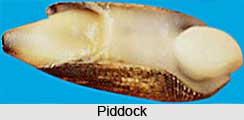
 Piddocks are boring bivalves. They are widely distributed in all warm waters. They are called stone-borers but in fact they do not bore hard stones but only chalk peat and hardened mud and clay deposits found along the extreme low-tide mark. Their foot and shell are admirably suited to dig holes in which they live. The edges of their mantles are largely closed and their siphons, which are long and united, can communicate with the water outside the hole. The foot is strong, stout, truncate and disc-shaped. The shell long, broad and round anteriorly and gradually tapering posteriorly. The umbo, which is near the anterior end, is strengthened by one or two accessory calcareous plates. Although brittle, the shell is hard and its exterior carries stiff radial ribs traversed by concentric striae resulting in a hard prickly surface. The valves are are white in colour and gape at both ends.
For boring holes in soft rocks the action of the foot is supported by the file-like surface of the shell and its strong and sharp accessory plates. The Piddock rasps the rock by adopting a rocking and twisting movement which grinds the toothed ends of the shell into the rock surface. The burrows of Piddocks are about thirty centimetres deep while the animals themselves are less than fifteen centimetres. They remain within the hole, extending their bifid siphon just a little beyond the mouth of the burrow.
Pholas orientalis and Pholas bakeri (called Angel Wing) are the common Indian large-sized Piddocks. The former is more common along the eastern and southern shores and the latter along the west coast. Pholas is known for its luminescence, or light-giving capacity. The whole respiratory siphon glows brightly, particularly, during summer nights.
There is a smaller Piddock resembling a small Pholas called martesia. This mollusc, while very young, gets attached to some floating timber. There it makes a hole just as a Pholas bores mud or peat by rocking or twisting its shell into the wood. It remains inside the hole with its siphons opening outside communicating with water. Remaining in the timber, it is carried over the surface of the ocean by the waves and feeds on tiny floating organisms.
There is an entirely different kind of wood-boring bivalve, more dangerous than Martesia, called Teredo, also known as the Ship-worm. It has a greatly reduced shell at its anterior end. It enters wood as a larva. It remains and grows, digging a circular burrow with the sharp edge of its shell. An adult Ship-worm has no resemblance to a bivalve at all, not even to a mollusc. It has a long, worm-like body, at one end of which are two small valves and at the other end the two siphons united. The animal bores using the shell end of the body. The valves of the shell are capable of being rocked on two points on either inner surface. The rocking movement grinds the wood and makes a narrow hole. The wood ground and converted into sawdust through this operation is not thrown out, but it is not known whether ship-worms feed upon the wood they excavate or not.
The damage the animal does to the pilings and ships is very great. Before the days of steel, ships had their hulls sheathed with copper to keep out Teredo. Chemicals deter them but control is still a major problem. Cement concrete pilings have been substituted for wood at many landing stages.